

Where the fire finishes what the flood started

Share

Byron Bay studio Kitsune Moon turns storm-damaged and salvaged timber into furniture that keeps its scars visible.
A slab found rotting in a shed, fungus already threading through its grain, is not the kind of material most furniture makers would choose to begin with, yet it is exactly the sort of starting point that defines the practice of Kitsune Moon Studio. Founded by Jason Moon and based in Byron Bay, the studio works almost exclusively with timber that has already failed in some way, whether through flood, fire risk, structural obsolescence or simple decay, and treats that failure as the design brief rather than a defect to be corrected. “I love the irregularity: the damaged, the twisted, the cupped, the knotted and cracked,” Moon says. “It reminds me of us. I’ve never met a perfect person; we’re all flawed, and the beauty is in the shapes those cracks and twists become, the knockdowns we take and get back up from.”
The material sources read like a regional disaster register as much as a materials list. Oregon shipped from Canada in the late 1800s and early 1900s, framed into coastal buildings of that era, comes out more than a century later still carrying the with which split it arrived. Waterlogged gum pulled from the Lismore floods of 2017 opens along its own grain as it dries, restless and unpredictable. Camphor laurel, a declared weed across northern New South Wales and routinely cut down and forgotten, becomes a structural centrepiece rather than offcut. Blackbutt already stacked for burning goes into the fire anyway, on Moon’s terms rather than a council’s.
Damage left legible
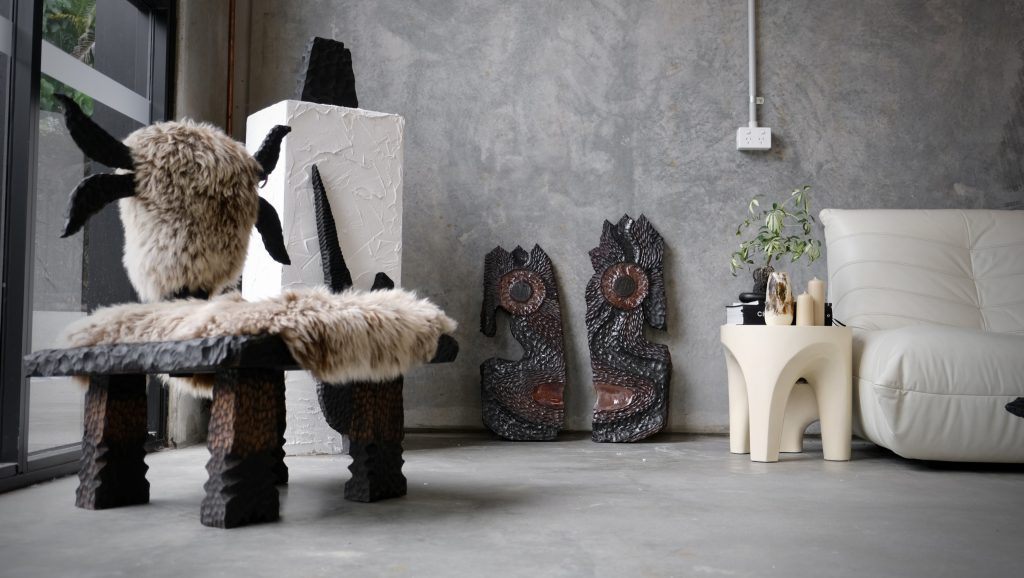
None of this damage is repaired or disguised across the collection, and that restraint is arguably the studio’s clearest design position. Pieces are pinned, laced, stitched and left open rather than filled or squared away, using brass, copper, leather and timber as visible mending rather than concealment. The Cute Ugly chair, a flooded gum seat the back of which split as it dried, has that split laced shut with leather stitching left proud of the surface rather than sunk flush. Kogeta Portal, three reclaimed blackbutt boards salvaged from a burn pile, hangs as three separate panels rather than one joined piece, the gap between them doing as much work as the timber itself.
Whether a piece begins with the timber or with an idea depends entirely on the project, and Moon treats both starting points as equally valid. “Sometimes the timber dictates the design; other times the design arrives in a burst of inspiration, usually late at night or in the middle of something completely unrelated, and the timber becomes the vehicle for it,” he says. Some pieces, he adds, sit in the studio for years before he works out what they are going to be.
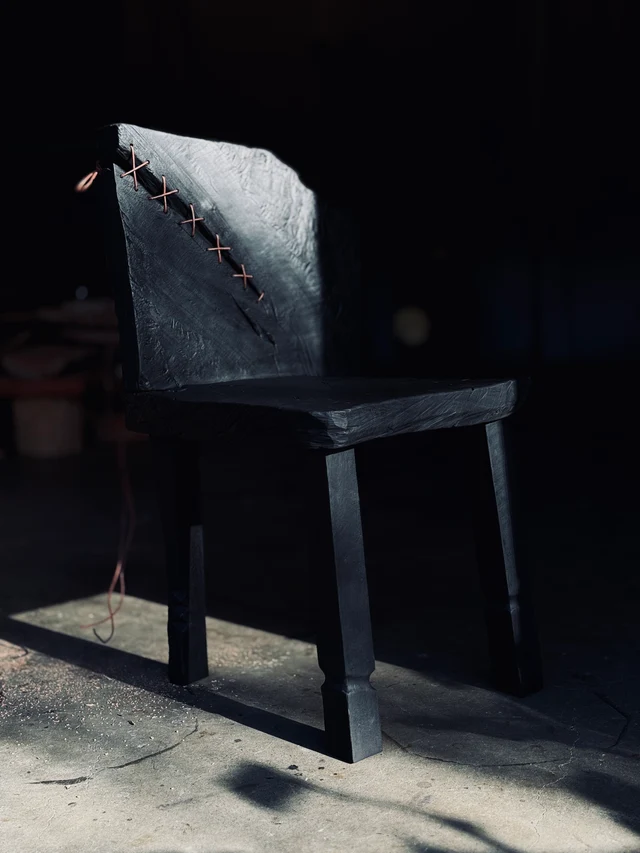
Shou sugi ban, the traditional Japanese technique of charring timber for preservation, runs through nearly every piece, but the emphasis here sits less on protection and more on finish. Most works carry no stain and no pigment, so the black surface is simply what the fire left behind rather than an applied colour. Where colour does appear, as in the raw red pigment worked into the Orangēji Ceremonial table, it stands out precisely because it is the exception rather than the rule.
Scale and secrecy in equal measure
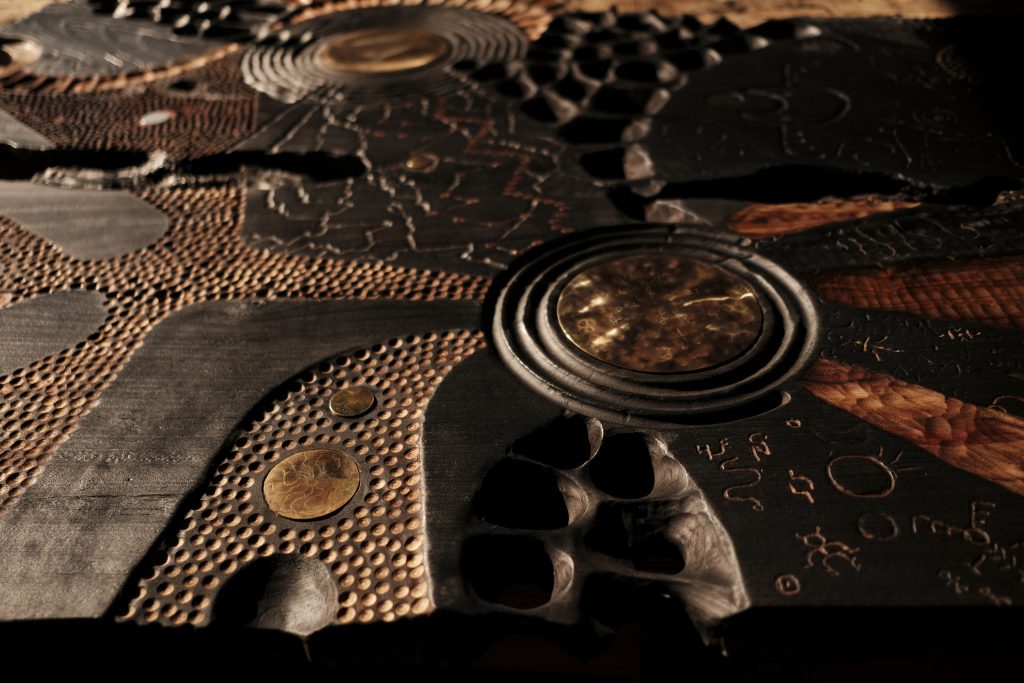
OKAR, the collection’s centrepiece, took two and a half years to complete and carries carved glyphs, drilled copper fields and hammered brass discs across a camphor laurel panel more than 1.7 metres tall. Every mark on the surface belongs to a written mythology called Itsuwa, delivered as a physical, hand-bound book to whoever acquires the work rather than published or reproduced. Moon sees the decision as a deliberate counterweight to how openly everything else gets shared. “I love the mystery of things, the little secrets that no one gets to know. I love old ruins and temples and the mysteries they hold,” he says. “OKAR and Itsuwa are a representation of that. Only the initiated get to know the mystery; everyone else gets to speculate.” OKAR was on show at NOWE Studio in Bangalow during July 2026 and returns to Byron Bay at the end of September.
For a commission, Moon works from a brief that sets the size, the function and the feeling a client wants in a room, though he stops short of promising how any given piece of damaged timber will actually resolve. “That negotiation is where the actual work happens,” he says, and it only becomes clear once he is standing in front of the material with tools in hand. Recent commissions for Studio Haus Co include Temple Farm House and the Temple Hangars in Nashua (about 20 minutes inland from Byron Baby), alongside a placement he is not yet able to name.
The recognition has followed the work rather than led it: The Yak won Best Art Piece at Byron Bay Art Fair in 2024, and the Cymatic Ceremonial table earned a commendation in Australian Wood Review‘s Maker of the Year awards the same year. For architects and designers specifying collectible pieces, the appeal lies less in matching a material palette and more in introducing an object the history of which, and a good deal of its meaning, was never meant to be fully explained.
Lead image: Cymatic Ceremonial table, reclaimed white coastal Mahogany – timber that has already lived a full life – pulled from wherever old wood goes and given a second one.
All images: Supplied
You Might also Like


Related Stories

© Niche Media 2026