

Establishing a sense of place: Build-to-rent comes alive through narrative intent
Establishing a sense of place: Build-to-rent comes alive through narrative intent

Share
What does it mean to have a sense of place? Where does it come from? Is it innate and immutable – the result of a perfect collision between environmental, constructed and human elements? Or can it be generated from ‘nothing’, shaped deliberately and consciously?
On a recent visit to Melbourne property development group Salta’s first Build-to-Rent (BTR) offering, Fitzroy & Co by Est, Australian Design Review (ADR) discovered that the answers to these questions are as multidimensional as the site-specific artworks throughout the building and as complex as the individuals and families who call Fitzroy & Co home.

In recent years, placemaking – which in simple terms is ‘the process of creating quality places that people want to live, work, play and learn in’ – has become a buzzword in the architecture and design sphere. However, the theory and practice of placemaking was born in the 1960s – a period of rapid cultural and social change and tension, fundamentally not too dissimilar from the complicated milieu we find ourselves in today.
Viewed through the lens of history’s repeating patterns and our universally human desire to find points of connection and belonging amid the chaos, it comes as no surprise that placemaking – and everything it encompasses – is once again front of mind.
Placemaking history lessons
As a distinct field of enquiry and design practice, placemaking emerged from the seminal work of Canadian-American writer, journalist and theorist Jane Jacobs, The Death and Life of Great American Cities (1961), along with American urbanist, sociologist, organisational analyst and journalist William H Whyte’s The Organization Man (1956).

Up until that point, urban planning and design were concerned with providing amenity, facilitating productivity and little else. What Jacobs and Whyte laid bare was the extent to which this placeless, soulless approach had negatively impacted society.
Through their insights, a fundamental shift to both the theoretical and practical approach to urban design, architecture, interior design and government policy took place, paving the way for the participatory and intentional processes that we now take for granted.
Bringing people together through art and development
You might be wondering what placemaking theories from the 1960s have to do with a privately owned build-to-rent apartment building in the heart of Melbourne’s vibrant inner north.

On the immediate, street-level surface, the answer is nothing whatsoever – until you realise that the boldly graphic monochromatic mural, Convergence, by mixed-cultural First Nations artist Lisa Waup, which has become a sentinel-like landmark on the Fitzroy North skyline, was commissioned for Fitzroy and Co, becoming the anchor for the public art and curatorial strategy.
It’s certainly not uncommon for commercial property owners and developers to commission a mural to adorn the exterior of a building. If nothing else, doing so gives personality to what might otherwise be a dull concrete wall. Waup’s work, however, goes beyond adornment.

Using art to confer meaning and create a tangible, shared anchor that creates community has been practised for tens of thousands of years. What are cave paintings if not an acknowledgement of the innate human drive to leave a mark and share stories with others?
Recognising this, as well as the contemporary notion that when art and design are brought together consciously, they become powerful tools to communicate universally across cultural and social divides, Salta engaged art consultant Sarah Weston to develop the public art and curatorial policy in the early stages of the project. As Salta development and project lead for Fitzroy and Co, Megan McCormick notes, “The curatorial strategy Weston developed is a vital ingredient in the success of Fitzroy & Co.”
A curated approach to place
For Weston, engaging with the history of a site is always where she starts. “We begin always by looking at the direct, specific histories that make up the fabric of any site,” Weston says. “Here, there is a rich First Nations history – the Merri Creek is just over the road – and there are also layers of Victorian history – Fitzroy used to be full of textile mills and brick works. It’s such fertile ground in so many ways.”
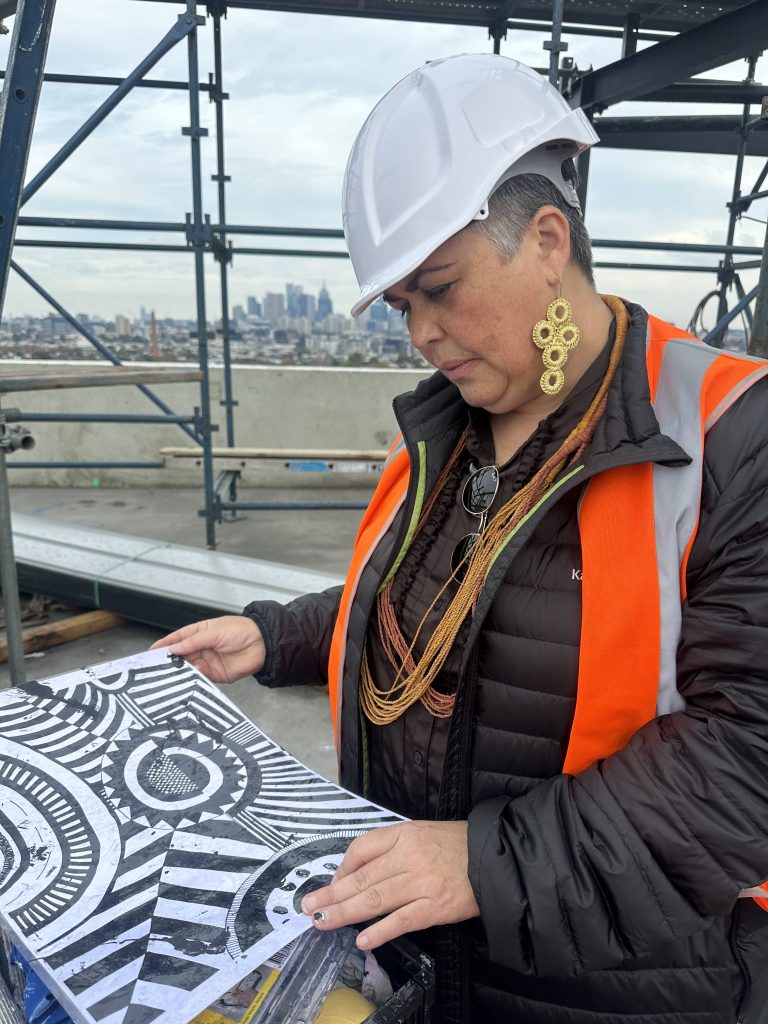
The work that Waup created gives direct expression to placemaking fundamentals. Weston reached out to Waup at the start of the project, seeking her participation and giving her the opportunity to respond directly to the site.
Over many walks along Merri Creek – a significant waterway that directly connected Waup to Country – and through lengthy conversations about the project’s community intent, the bold graphic mural that adorns the exterior of the building came to life. “For Lisa, the circle motifs in her work speak to ideas of community and people coming together,” Weston says. “The pathways and lines within the work reflect pathways of connection and coming together.”

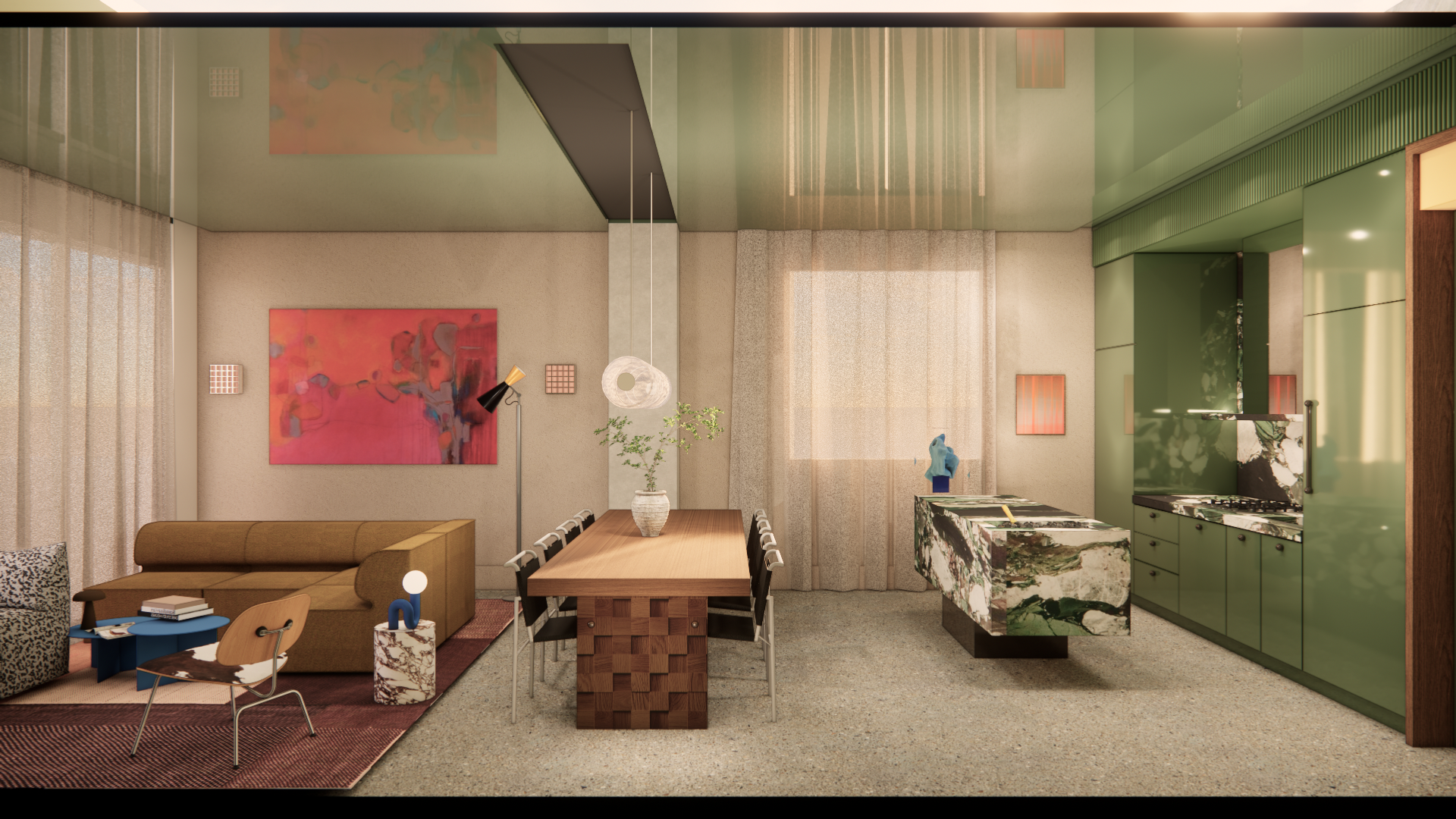
From the moment you walk through the unassuming automatic door entrance, this sense of connection to a very specific, very unique place is palpable. There is no denying that you’re anywhere but the inner north of Melbourne. Every detail, from the materials and colour palette to the vintage furniture and, of course, the art collection, has been considered through the lens of people and place.
“We always start with the history of the area. From there, we consider the intention of building as a whole, then each of the spaces independently,” Weston says. “What is the feeling of a particular space? What is the intention behind that space? This leads to thinking about the artists who are working within the space and the stories that they want to tell about this place through their work.”

Telling the stories of history and creating new ones for the future
Storytelling is a thread that underpins almost every creative act, from architecture to interior design or fine art. In the most successful projects, the narrative is evident without being overt, expressed through nuanced layers and the relationships between them.
At Fitzroy & Co, the story of place comes to life in multiple ways. The most noticeable layer is Weston’s art curation, which intentionally brings together Melbourne artists and makers at different stages of their careers, working with various materials to develop an art collection that reflects both the story of this place and this specific moment in time.

On the wall of the ground floor entrance, Melbourne-based artist and maker Benjamin Baldwin’s steel sculpture, Merri Bound, captures your attention instantly, drawing you into its highly polished, undulating mirror-like surface. Like Waup’s work, Baldwin drew inspiration from the flowing twists and turns of Merri Creek to inform the finished form and shape of the work, which reads like a body of water rendered static in steel.

The highly specialised hydroforming process Baldwin employed to create the work also expresses an obvious connection to the powerful forces of water. “The connection between Ben’s work and Merri Creek is so thoughtful,” Weston says. “But it was challenging. This is the first time he’s created one of his hydroformed works at such a large scale. Opportunities like this, where an artist is encouraged and supported to push the boundaries of their practice, are so important – especially for emerging artists.”

Moving through the main entrance towards the lifts, which take you up to the apartments, the level 10 social space and the roof top terrace – complete with a dedicated dog play and ‘pit stop’ area with arguably the best view in Melbourne for a dog doing their business – encounters with the work of outstanding emerging artists continue.
Stories Unknown I & II by Melbourne artist Hannah Hall are particularly enchanting works. At first glance, they present as richly textured paintings. It’s not until you get closer that you realise they’re made from layers of intricately folded and stitched pieces of fabric. The strength of Hall’s work is both aesthetic and conceptual.

The composition and soft, delicate colour palette have a soothing effect; it’s almost like they’re reminding you to exhale and relax, you’re home now. On a conceptual level, the work belies Hall’s years.
Each piece of fabric was carefully sourced from local Fiztroy and Brunswick op-shops. Perhaps a once-favourite top, now discarded and unwanted, and an old blanket and pillowcases that once provided comfort and warmth have been given a new life.

By using these mundane, overlooked everyday objects, Hall elevates them beyond what they once were, and yet, despite now being fine art, these pieces remain comfortingly familiar.
The omnipresent energy of Merri Creek flows through Stories Unknown, revealed in the flowing lines Hall has cut into each hand-stitched piece of this mosaic of fabrics and personal stories. In deliberately opening up the surface plain of the work, it ripples and ever so slightly flutters the way the creek might when touched by a breeze.
Developing a strong community is about reflecting a local identity

The less obvious layer of place is the inspiration the interior design team drew from iconic Fitzroy hospitality venues. “We wanted Fitzroy & Co to not only reflect Fitzroy but become part of it,” McCormick says.
“We looked at local hospitality offerings, like Poodle on Gertrude Street. A lot of local restaurants have darker tones, grey tones and a lot of walnuts. We’ve brought these into the shared spaces — the co-working space on the ground floor and the event spaces and social space on level 10, they have their own identity, and they both embody Fitzroy too.”

As a well-established family-owned property development company in Victoria, Salta has been contributing to the shape of Melbourne’s skyline and the texture of its grid for 54 years.
With many notable projects to its credit, when you think of a Salta project, you think of the elegance of high-end residential complexes, such as 150 Clarendon, designed by Bates Smart. Their style errs on the traditional, with generous use of marble and beautiful materials and textures – a contemporary refinement that borders on minimalism.

What they’ve created here is an almost radical departure. “Build-to-rent is an emerging market in Australia, and also for us as a business, it was our kind of trial in the sense of going into this sector,” notes Salta’s public relations and communications manager Natalie James.
“What we’ve created here is something that’s a bit more lively and fun. It’s definitely much more eclectic than what the business is used to, and that comes directly from the local storytelling.”

As a business, Salta’s goal was to create a sense of community and with only 94 apartments, that intimacy matters. James says the company is already seeing the powerful effect of this storytelling approach. “There are dog-walking groups and the social space is always buzzing. There are now two couples who have moved into two-bedroom apartments when they used to live separately,” she says.
What Fitzroy & Co demonstrates is that it is entirely possible to generate a sense of place seemingly from nothing. In setting out to create a building with a distinct identity of its own, drawing consciously and intentionally from the layers of history of its site and weaving these together with the local sights, sounds and colours of a hyper-local milieu expressed through design and art, an otherwise non-descript corner block is transformed into a meaningful place for not just those with a key card.
All photography supplied by Sarah Weston unless otherwise noted.
You Might also Like


Related Stories

© Niche Media 2026