

The Glasshouse is quite the spectacle
The Glasshouse is quite the spectacle

Share
Opening last month to a substantial fanfare, Brisbane’s newest performance space, Glasshouse in the Queensland Performing Arts Centre, certainly catches the eye.
Arguably more visually impressive than Port Macquarie’s 500-plus seat entertainment space with which it shares a name, but opened 17 years before it, the new Glasshouse Theatre is part of the Queensland Performing Arts Centre (QPAC) and is the fifth space in a complex that also includes the Concert Hall, Playhouse, Lyric Theatre and Cremorne.
Seating 1500, Glasshouse was designed by Blight Rayner Architecture (headed by Michael Rayner and Jayson Blight) in partnership with Norwegian firm Snøhetta, and complements the complex’s other proscenium arch theatres (the 850-seat Playhouse and 2000-seat Lyric).
With the same size stage as the Lyric (15 by 15 metres) Glasshouse has been designed to enable the staging of more large-scale productions – ballets, operas and musical theatre, for example. It is located at Playhouse Green, nestling in next to the Playhouse. It is a visually separate, but fundamentally connected space to the other QPAC venues, with all of them sharing a central scene dock facility and other backstage amenities.
Blight Rayner’s winning submission for the design retained two existing studios (that other competing teams had earmarked for demolition), and added a further two in the basement, meaning Glasshouse is awash with rehearsal and performance spaces.
Playing nicely with the Playhouse
The solid mass of Glasshouse’s auditorium and stage are aligned with the existing mass of QPAC’s heritage listed buildings, which were designed by Robin Gibson (or largely his partner at his eponymous firm, Alan Kirkwood) and originally opened in 1985, winning the RAIA Robin Dods award for architectural excellence three years later.
Addressing these heritage considerations was particularly pertinent for Blight Rayner Architecture and Snøhetta when it came to the theatre’s nearest neighbour, the Playhouse. Gibson’s original design for the latter worked to a three by one-metre or a six by three-metre grid for all of the panelling. The same ratios have been used for Glasshouse, but unable to copy the original concrete (due to the unavailability of the sand), the architects worked with a new concrete mix, with acid washing and a form liner to offer two different textures.
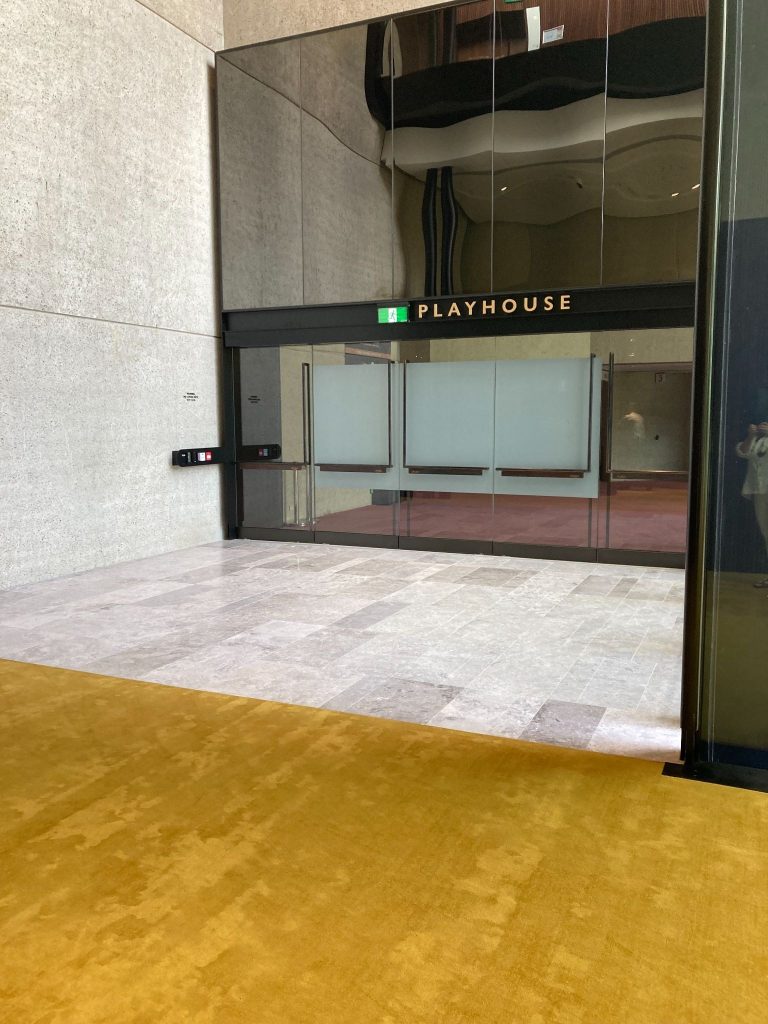
What this means in practice is that the precast concrete is consistent with the concrete walls of the existing QPAC buildings, but also means you can travel between Glasshouse and the Playhouse seamlessly from level two without feeling a jarring disconnection between the interior designs.
That stunning façade
But before you even get to this level, it all begins with the front of the building.
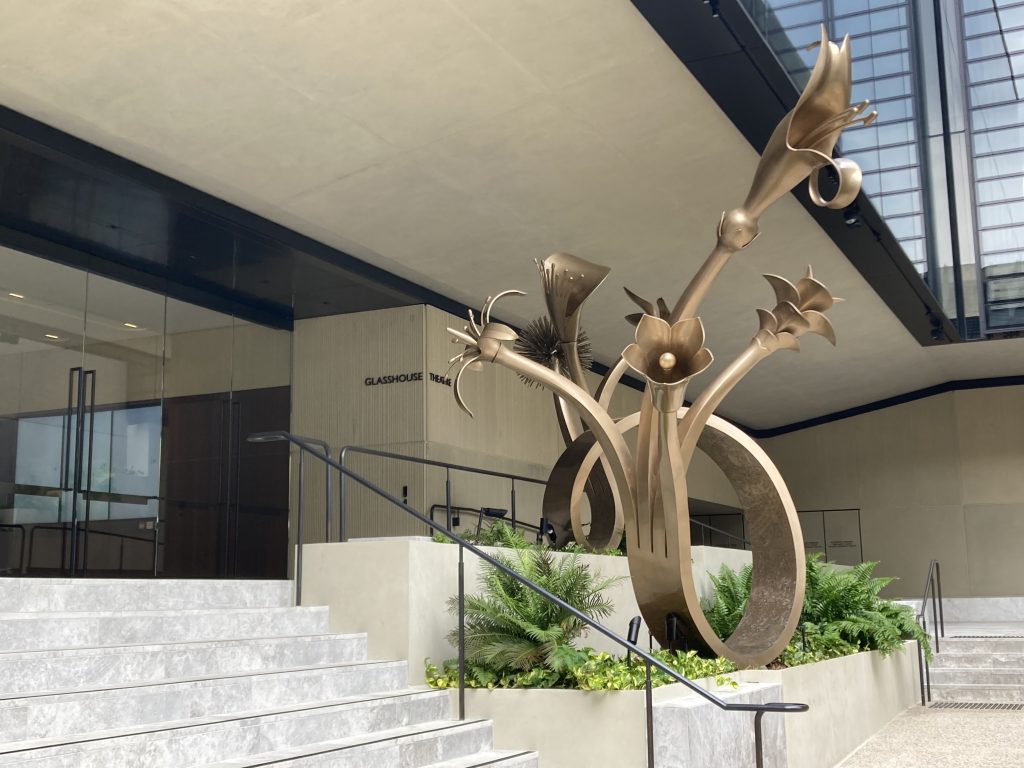
In front of the entrance is an arresting four-metre high sculpture by Torres Strait Islander artist, Brian Robinson. Floriate is like the local flora mated with a hydra and proliferated – featuring seven flowering indigenous plants that have cultural significance as food sources, tools and medicine, while also representing the ecosystems of Maiwar (Brisbane River), around 200 metres away.
Continuing the Indigenous aquatic links is Glasshouse’s signature design feature – and the main differentiator between the Glasshouse and the Robin Gibson buildings – that showstopping exterior, which is genuinely breathtaking to look at. The design intent was to maximise daylight, offer South Bank views to patrons and pose an invitation for the public to engage with the theatre.
This magnificent undulating façade was inspired by the prose poem Kurilpa Country by local artist, activist and academic Lilla Watson (her artwork of the same name can be found in the State Library of Queensland). The poem references the rippling waters of Maiwar, swimming fish and the Kurilpa water rat, which is endemic to the area.
But beauty never comes easily. The curved forms of the glass panels are a veritable feat of engineering. Designed in Austria and built in China, the 217 glass panels are 50 millimetres thick, stacked two high and comprise four panes each with an air gap between. At 7.2 metres they were too long for the Chinese kiln, which had to be extended for the project.
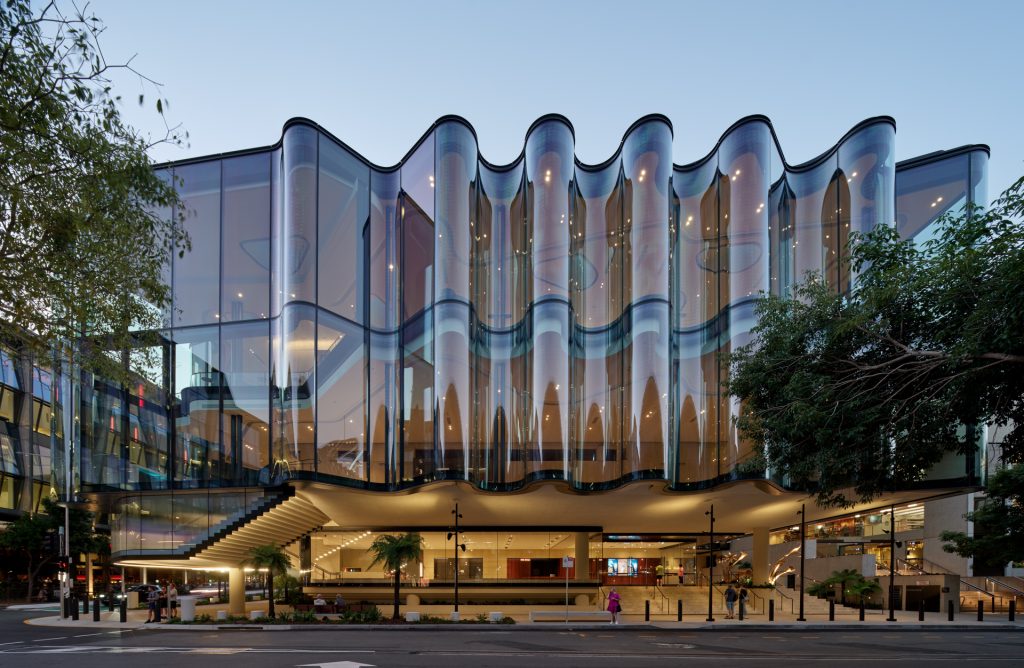
Installing them was even more challenging. The transverse slab is cantilevered around six metres out from the building’s two street frontages (on Grey and Russell Streets) in order to maximise the space while still fitting the Playhouse Green site. But to minimise the visual impact of the tapering cantilever, a ‘glass veil’ was deemed the best way to ensure people could see through to the theatre beyond.
The glass was hung from the roof structure. The thinness of the end of the cantilever meant that the concrete was poured to sit up a fraction, with the firm of specialist engineers, Seele (which also designed Apple’s 5th Avenue building), calculating the exact distance the weight of the glass would pull the slab down to leave the whole thing level. Precision engineering in action…
As an additional delightful effect, the shape of the glass results in a curious optical illusion, whereby if you walk right into the curve from behind you suddenly can’t see the glass anymore.
And, finally, the potentially fierce Queensland afternoon sun has been considered too, with a black inlay embedded into the glass on the building’s western side, informed by sun motion studies and orchestrated to reduce the thermal impacts of the sun and optimise the building’s energy performance.
Front of house spaces
If you had to put money on the two biggest bugbears for theatre-goers across the land, at least during interval, surely it would have to be the ease of getting to the bar and accessing the toilets (especially the Ladies). Though not necessarily in that order, of course.
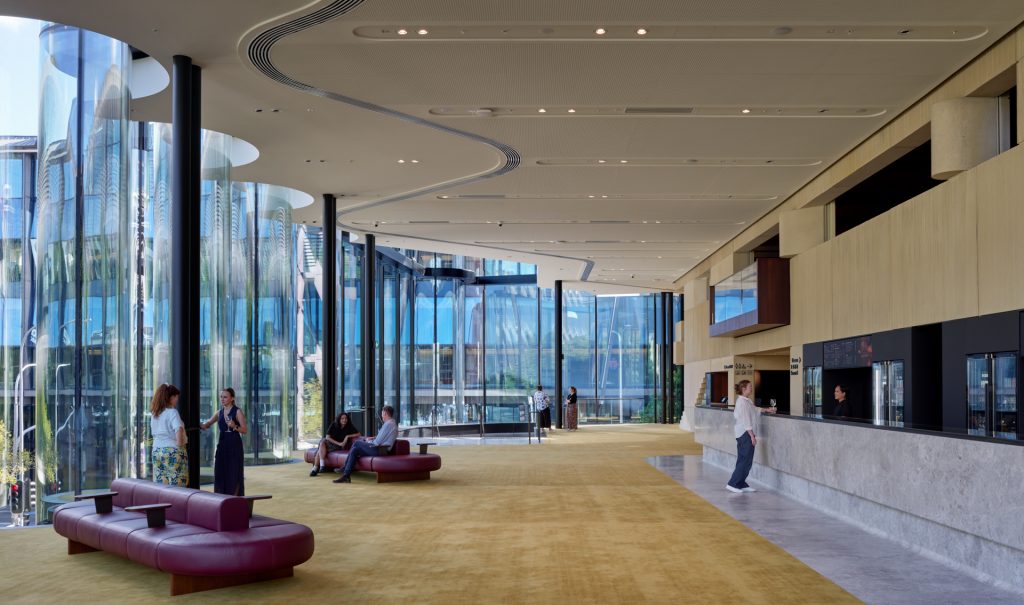
Blight Rayner Architecture and Snøhetta clearly heard these concerns loudly and clearly. The expansive bar on level two takes up practically the entire width of the foyer space. It’s the same size as the one in the Lyric, while only needing to cater to half as many people. The toilets are right next to it. As long as every production provides enough staff serving, neither of these common complaints will be an issue at Glasshouse.
But even if you do still struggle to get to the front of the queue, or perhaps aren’t interested in a beverage or snack, the front of house is an undeniably pleasant place to wait for the next act. Responding to site research from former QPAC Elder in Residence Aunty Colleen Wall, there is an emphasis on designing with Country. The connection of ground to sky is amplified when you look up, with seven skylights representing water catchments across the state.
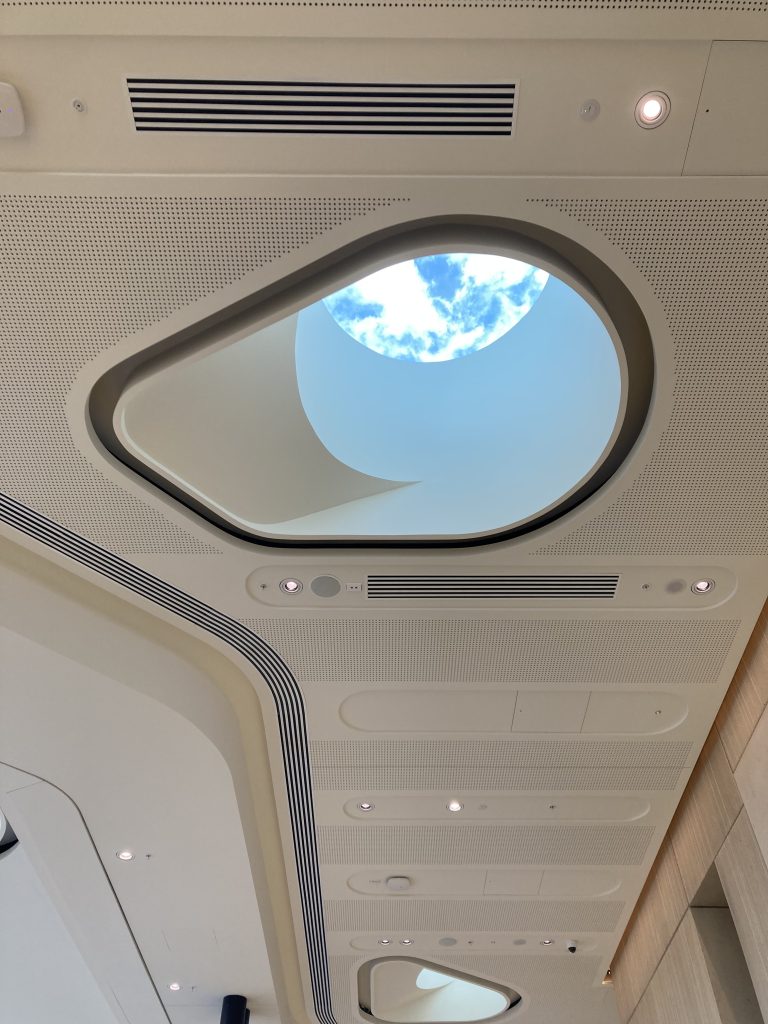
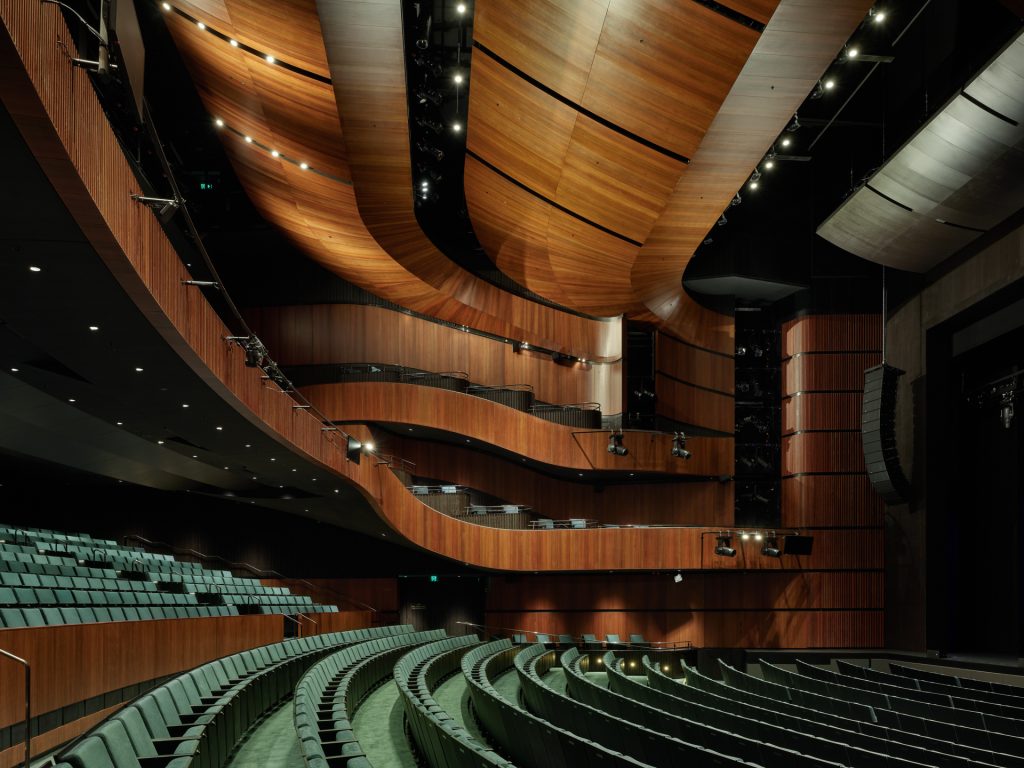
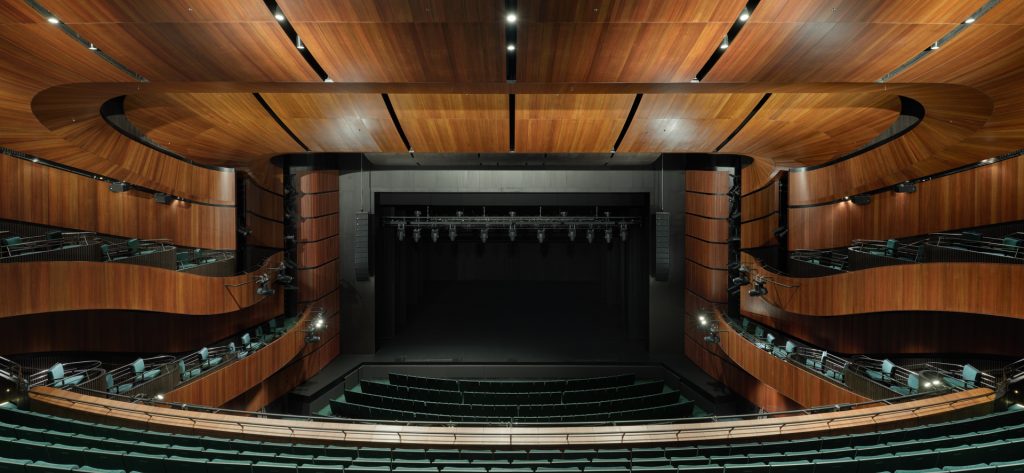
As for foyer design notes, the overarching theme is light and airy – with golden carpets and grey marble a striking contrast to the theatre interior, which features grey ironbark walls and a rainforest green carpet.
Understanding the auditorium
Inspired by noted UK-based theatre impresario Cameron Mackintosh, the teams from Blight Rayner Architecture and Snøhetta looked to make the interior as intimate as possible, and designed it to make “every patron feel intimately connected to the stage, wherever they are sat in the auditorium“.
To achieve this, the auditorium’s back wall was brought three metres closer to the stage. With 1000 seats in the stalls and 500 in the balcony, the furthest seat from the stage is just 28 metres away.
“The auditorium was conceived as a highly adaptable performance environment capable of hosting a wide spectrum of art forms. The theatre was designed to operate like a finely tuned musical instrument – adjustable to support world-class opera, ballet, dance, symphony, theatre and musical productions,” says Managing Director of Snøhetta Australasia, Gumji Kang.
Under and in front of the stage, the pit has three floor sections, so that it can accommodate orchestras of different sizes, and the auditorium features a novel under-seat air-conditioning system – an absolute boon for anyone who’s ever suffered the discomfort of a full-length show seated directly beneath an overhead cooling vent.
Not all smooth sailing
The backstage spaces for performers and production staff could take up a whole article on their own, as could the technological whizzbangery.
However, the gestation and final opening of Glasshouse hasn’t all been one cheery fairy tale. For instance, there were a few quibbles about the name. The stunning façade of the space perhaps made the choice a no-brainer, but some in the industry queried it considering that Port Macquarie had already used the name for its venue. And then there was the question of community consultation. In March, the ABC reported that a consultation process opened for a month in April last year, with the public asked to vote on Glasshouse, Lantern, Watershed, Russell Street or offer their own suggestions.
Documents released under the Right to Information laws later revealed that the Queensland Arts Minister John-Paul Langbroek had actually approved the Glasshouse name two months earlier. QPAC CEO Rachel Healy reportedly voiced her concerns about the name clash with Port Macquarie and favoured the Watershed or Oodgeroo to honour famed First Nations poet Oodgeroo Noonuccal.
That the latter option was dismissed was especially frustrating for high-profile arts luminary and proud Quandamooka man, Wesley Enoch, who told ABC 612 Brisbane, “To watch a door close as a sign of disrespect to this woman is quite galling actually, really galling.”
The community vote did point to Glasshouse as the preferred option, with Langbroek stating, “We checked with Queenslanders who also overwhelmingly backed the name and beyond that we have been overwhelmed with support for the name across the state, country and world. We got it right, it is the perfect name.”
Lucky that.
Bigger problems
An ephemeral thing like a name is one thing; a physical entity that doesn’t quite live up to its promise is another.
Glasshouse has now been open for over a month and has seen several productions grace its stage. And audience reports have noted some concerns. Despite the promise of superior sight lines across the board and “every patron feeling intimately connected”, there were tickets for balcony seats that specified, and indeed offered, a ‘limited view’.
While the Opening Gala, directed by Queensland Theatre’s artistic director Dan Evans, was very well-received and featured Leigh Sales as emcee, and notable local talents like Kate Miller-Heidke and Trent Dalton, reading excerpts from his best seller Love Stories, the opening concert, Verdi’s Messa da Requiem, brought a few structural issues to light.
Acoustics were said to have varied throughout the venue with the four major singers perhaps needing to be mic’d, with the sound not big enough for the space. While the word is that this may have been purely due to technical teething problems and the acoustics are still being played with and calibrated, the layout of the orchestra pit may be a greater ongoing concern. The conductor of the Requiem, Simon Hewett, noted that due to the size of the pit and the expense factor, he only had 70 musicians, when a piece like this really needs around 120.
While a limited number of musicians can work for a Mozart concert, Glasshouse has been promoted as able to stage big productions, when as it stands this could be a challenge.
Again, though, perhaps this can be worked around. Of perhaps the most concern currently is the location of the exits in the stalls. While the Lyric, for example, has several exit options down the sides of the main auditorium, there is just one either side of the main body of seating at Glasshouse, with reports of bottlenecks and people being stuck for some time during interval. Having a huge bar and easy-access toilets is great, but if you can’t get out of the theatre to get to them, it becomes something of a moot point. Not to mention a safety issue…
But it’s a new venue, it’s beautiful looking and hopefully one that will sort out any lingering issues in all due course.
Top image: Photo: Christopher Frederick Jones.
You Might also Like

Related Stories

© Niche Media 2026