

What the world sees in Australian design
What the world sees in Australian design

Share
Sitting on an international awards jury gives Eleni Stefania Kalapoda a unique insight into how the international design community views Australian architecture. In this article for ADR‘s thought leadership and opinion series, The Podium, she shares the standout qualities that resonated with the FRAME Awards 2026 Grand Jury.
An international jury meets every project as a stranger. There is no site visit, no conversation with the client, no local reputation to lean on: only drawings, photographs and a few hundred words that must make the case alone. That is precisely what makes global awards such a revealing mirror. They show not how a nation sees its own design, but what survives the journey abroad.
This year I served on the FRAME Awards 2026 Grand Jury for the Institutions categories. The winners were announced on 22 October in Eindhoven, during Dutch Design Week, drawn from more than 1000 submissions and assessed by 100 jurors across ten panels. Jury discussions remain confidential, as they should. But the public results, and the Australian projects that reached the shortlist, speak eloquently about what the world now sees in Australian design. Three qualities stand out.
Reuse as a design language
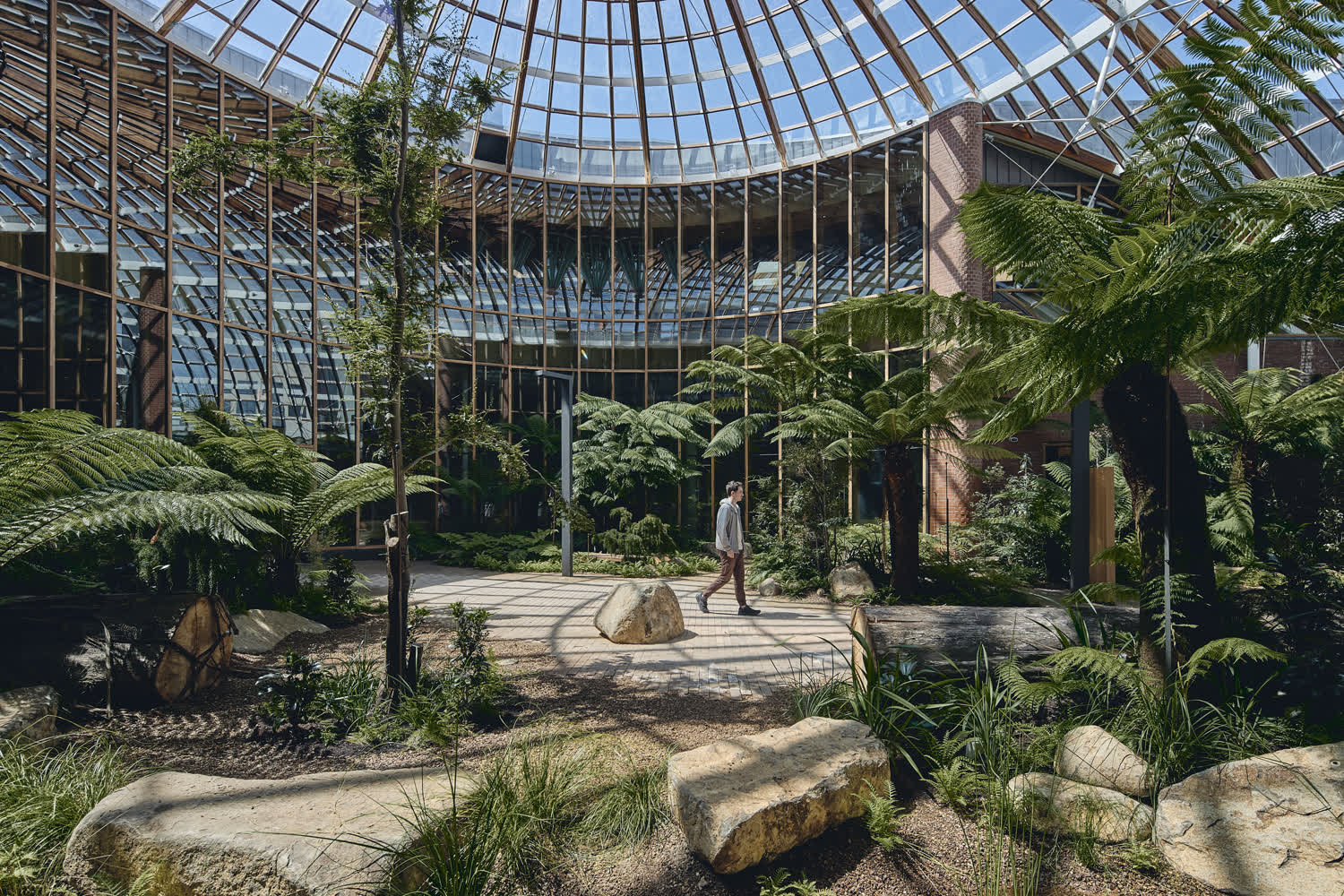
The first is a quiet confidence in transformation. The Forest, Woods Bagot’s reimagining of a former forestry building for the University of Tasmania in central Hobart, reached the FRAME shortlist for Learning Space of the Year, months after receiving the Premier Award at the 2026 Australian Interior Design Awards. Its palette reads like a manifesto: Tasmanian oak for columns, beams and panelling; carbon-neutral bricks; hempcrete at what the university describes as the largest commercial scale in the Southern Hemisphere; and an estimated embodied-carbon saving of more than 40 percent compared with similar new buildings. Robert Morris-Nunn’s original Forest Dome has been honoured rather than erased, and its planted entry remains open to the city.
What makes The Forest legible to an international audience is that its sustainability is not an appendix. It is the architecture itself. Reuse, local timber and low-carbon materials are presented not as compromises, but as the very source of the building’s warmth and character. Around the world, that shift is now unmistakable. FRAME described this year’s winners as “finding new purpose in existing structures”, and Australia’s entries spoke that language fluently.
Circularity, taken at its word
The second quality is a willingness to take circularity literally. NewNew, the pavilion curated by Nexus Designs with Cultivated for the Green Design Show at Melbourne’s Decor + Design 2025, was among this year’s FRAME winners in the Shows categories: the clearest Australian success of the 2026 awards. Built with Mark Tuckey and Crafted Hardwoods, it brought together reclaimed timber flooring, recycled polypropylene cladding and restored commercial furniture drawn from Cultivated’s stock of more than 300 pallets of rescued pieces. It was conceived as a zero-waste project, designed to be dismantled and reborn rather than discarded.
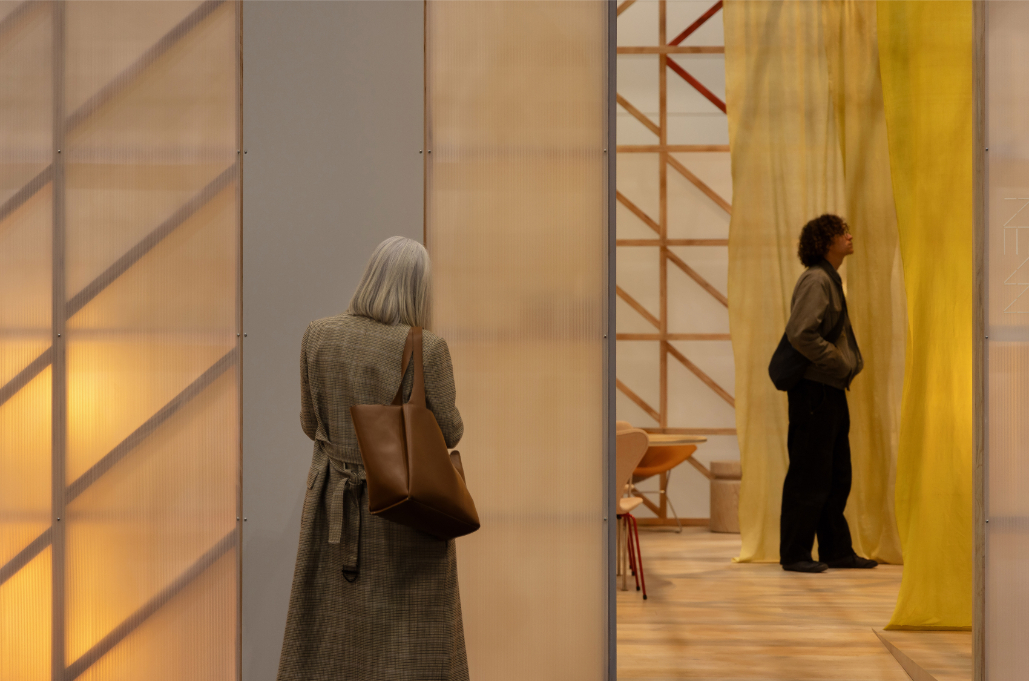
In FRAME’s published commentary, juror Fatma Al Mahmoud praised NewNew for “embedding circularity in every detail”, observing that its domestic setting “shows that reuse can feel calm, complete and appealing rather than temporary.” That final thought matters. Temporary installations are among the most wasteful forms of design, built for days and discarded in hours. Here, an Australian team turned the most fleeting typology into a model of enduring values.
Generosity at civic scale
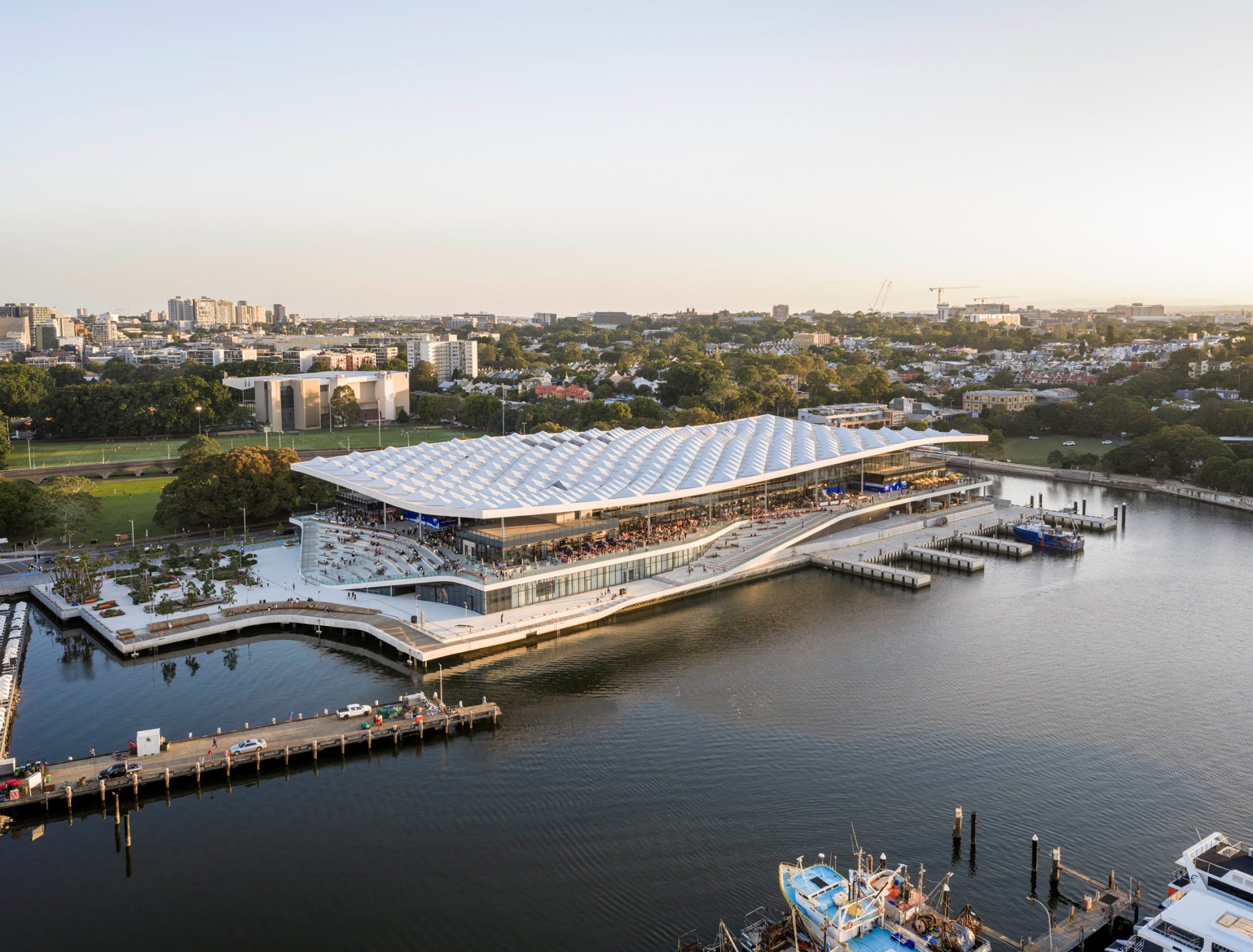
The third quality is generosity. The new Sydney Fish Market at Blackwattle Bay, by 3XN GXN with BVN and ASPECT Studios, was shortlisted for Multi-Brand Store of the Year, an unexpected category for a piece of civic infrastructure, and a telling one. Beneath a continuous timber canopy of nearly 20,000 square meters, assembled from hundreds of glulam beams and prefabricated roof cassettes, the market opens onto more than 6000 square meters of public foreshore, with biofiltration beds, wetland planting and habitat along the water’s edge.
At heart, a fish market is a working building. Sydney’s has become a public room for the harbor: a place to trade, to eat and simply to linger, and a new thread in the city’s waterfront. Juries increasingly seek out exactly this double life, in which a building serves its program and, at the same time, gives something back to the city around it.
Completing the Australian presence, the Singapore Airlines SilverKris Lounge in Perth by DP Design was shortlisted for Mobility Space of the Year, a reminder that the moments of arrival and departure are now judged with the same care as any cultural space.
What travels
Taken together, these projects suggest that what the world sees in Australian design is not a style but a set of priorities: materials with provenance, buildings that carry their histories forward, and public space offered with rare generosity. Those priorities have deep roots at home. Frameworks such as the NSW Government Architect’s Connecting with Country ask designers to begin with land, water and the knowledge of First Nations communities, rather than with form. Earlier in my career, I contributed to a sustainability framework for Australian and New Zealand projects grounded in Indigenous knowledge. What struck me then still strikes me: when design begins with place, it tends to arrive at restraint.
That restraint is precisely what international juries have learned to value. Across this year’s winners, the most persuasive projects were those that touched the ground lightly and let the landscape, the existing fabric, or the community lead. In my published citation for this year’s Cultural Space of the Year, Anji Hood in China, I described “a landscape-led rural intervention” whose canopies “follow the contour lines” of the tea terraces, “avoiding large earthworks”. It is not an Australian project, yet it could have been written in praise of the values Australian practice so often brings to the table.

A challenge, not a compliment
None of this should be mistaken for a victory lap. Recognition abroad measures what Australian design does well, but it also raises the bar. If reuse, circularity and civic generosity are what the world now admires, they must become the norm across ordinary schools, clinics, stations and homes, not only in the projects that reach international shortlists. The most important Australian buildings of the coming decade may never enter an award. They will simply be the everyday ones, built with the same care.
International juries can only judge what reaches them. This year, what reached them from Australia was a quietly radical proposition: that the most contemporary thing a building can do is waste less, remember more and share generously. The rest of the world is paying attention.
Eleni Stefania Kalapoda is an ARB-registered architect and urban designer. She began her professional experience through collaborations with the Renzo Piano Building Workshop team on the Stavros Niarchos Foundation Cultural Center. She later worked at Foster + Partners (KSIA) and Perkins Eastman NY (Resorts World NY and Landmark Adaptive Reuse Schemes) on projects at the building and city scale. She served on the FRAME Awards 2026 Grand Jury and as a sustainability expert on a RIBA London Awards jury that assessed Lion Green Road, winner of the 2026 RIBA Stirling Prize. She is a LEED v5 Subject Matter Expert for the U.S. Green Building Council, a member of the Autodesk Advisory Council (2025–27), a 2026 WICE Awards finalist and a 2026 Beverly Willis Architecture Foundation Emerging Leaders Fellow.
Top image: Sydney Fish Market, designed by 3XN GXN in association with BVN Architecture and landscape architects ASPECT Studios, and delivered by Infrastructure NSW on behalf of the NSW Government. Photo by Rasmus Hjortshøj.
The Podium is ADR’s op-ed and thought leadership series providing a platform for some of Australia’s leading designers and built environment professionals to share their views on the topics that matter to the A+D sector. If you’d like to submit an article, reach out to us at ausdesignreview@niche.com.au with the subject line ‘The Podium’.
You Might also Like


© Niche Media 2026