

Future proofing – Future Country opens in Melbourne
Future proofing – Future Country opens in Melbourne

Share
Following the inaugural biennial program, My Country, from 2024, Future Country is the second iteration of a program in which eight emerging First Nations artists work with highly respected mentors and industry leaders, culminating in a group show at the National Gallery of Victoria (NGV)’s Ian Potter Centre.
Relationships between sponsors and the art world go back for centuries, but the very idea of mingling these two elements can be contentious. From Renaissance patrons to corporate entities today, there will always be those uncomfortable with big business extending its influence into what we see in our galleries and museums.
Surely, though, if ever there was an instance of a corporate outfit using its powers – and its cold, hard cash for good not evil – it would have to be for a program that provides opportunities to emerging practitioners or traditionally marginalised voices to not only have their work seen and heard, but to also benefit from the wisdom and experience of their more established peers.
In 2026 Future Country, backed by clothing giant Country Road along with the NGV First Nations Commissions, offers eight such partnerships:
- Boneta-Marie Mabo, Nywaigi/Meriam/Manbarra (Qld) and Megan Cope, Quandamooka (mentor)
- Carly Tarkari Dodd, Kaurna/Narungga/Ngarrindjeri (SA) and Yhonnie Scarce, Kokatha/Nukunu (mentor)
- Charlotte Allingham (Coffinbirth), Wiradjuri/Ngiyampaa (NSW) and Karla Dickens, Wiradjuri (mentor)
- Jahkarli Felicitas Romanis, Pitta Pitta (Vic) and Brook Andrew, Wiradjuri (mentor)
- Katie West, Yindjibarndi (WA) and Clothilde Bullen, Wardandi (Nyoongar)/Badimaya (Yamatji) (mentor)
- Nunami Sculthorpe-Green, Palawa/Warlpiri (Tas) and Lola Greeno, Trawlwoolway (mentor)
- Paul Girrawah House, Ngambri-Kamberri/Ngurmal (Walgalu)/Pajong (Gundungurra)/Wallaballooa/Erambie/Brungle (Wiradyuri) (ACT) and Brenda L Croft, Gurindji/Malngin/Mudburra (Australian First Nations), Anglo-Australian, Chinese, German, Irish, Scottish (mentor), and
- Stephanie Ali, Burarra (NT) and Doreen Jinggarrabarra, Burarra (mentor).
The resulting projects run the gamut from a continuation of traditional craft practice, with skills handed down from mother to daughter, to installations referencing the damage inflicted by colonialism, to a reimagining of cultural artefacts, to gleeful subversions of contemporary comic book figures.
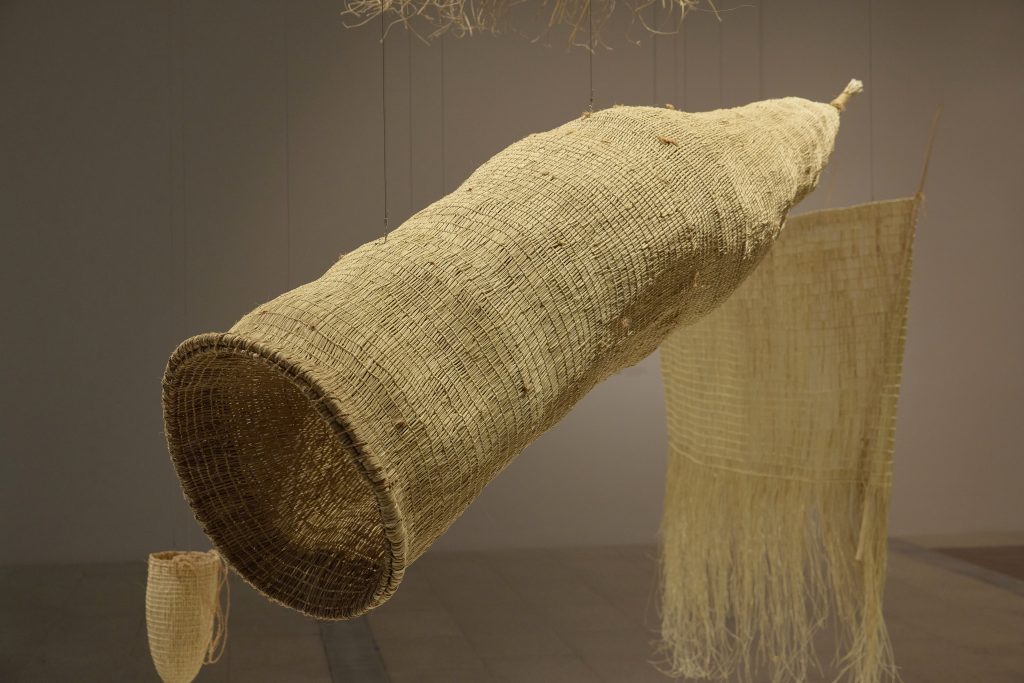
Weaving the past into the future
Grounding the exhibition firmly in the millennia-old custom of utilitarian cultural practice, the first installation is courtesy of Stephanie Ali, mentored by her own mother Doreen Jinggarrabarra in traditional weaving practices. The dilly bags, mats and fish traps and fences that comprise the work speak to kinship, practicality, thousands of hours of painstaking application and skills handed down through generations, from grandmothers to mothers to daughters and beyond.
As a striking contrast, behind Ali’s work is a huge photographic print from Jahkarli Felicitas Romanis, a print that takes up practically a whole internal wall but then spills partly across the floor too.
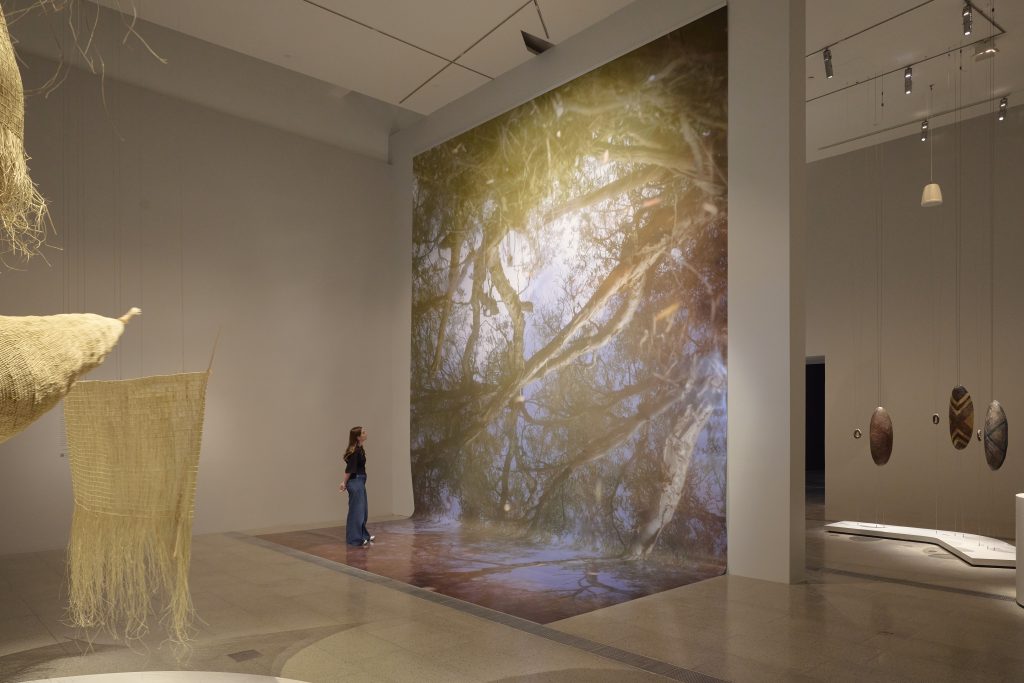
The image is of a pivotal waterway running through her ancestral lands of Pitta Pitta Country. Deliberately robust, the print is made to be walked upon, the intent being to remind viewers of their connection to the land and their responsibility to care for Country, whether they have traditional ties to it or not.
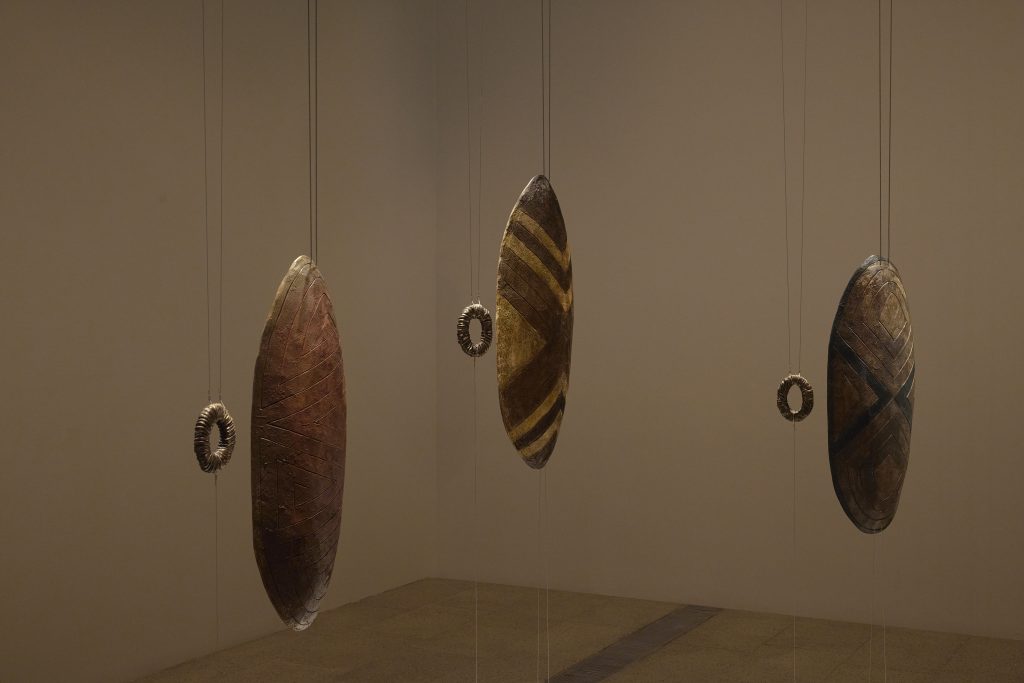
Giving weight to ancient artefacts
Working with Professor Brenda L Croft of ANU’s School of Art and Design, Paul Girrawah House, like Ali, has also referenced traditional cultural objects, but imbued them with an unexpected sense of permanence. Extending his regular practice of tree carving and coolamon creation, he has crafted a series of brass cast coolamons, celebrating his ancestry and subtly reinforcing cultural longevity and relevance.
Boneta-Marie Mabo’s work is more overtly political – Colonial Threads is a rusty old crib filled with 238 white cotton ragdolls, representation the same number of years of white colonisation, while also referencing child incarceration, the traditional criminalisation of girls and Mabo’s connection to Palm Island.
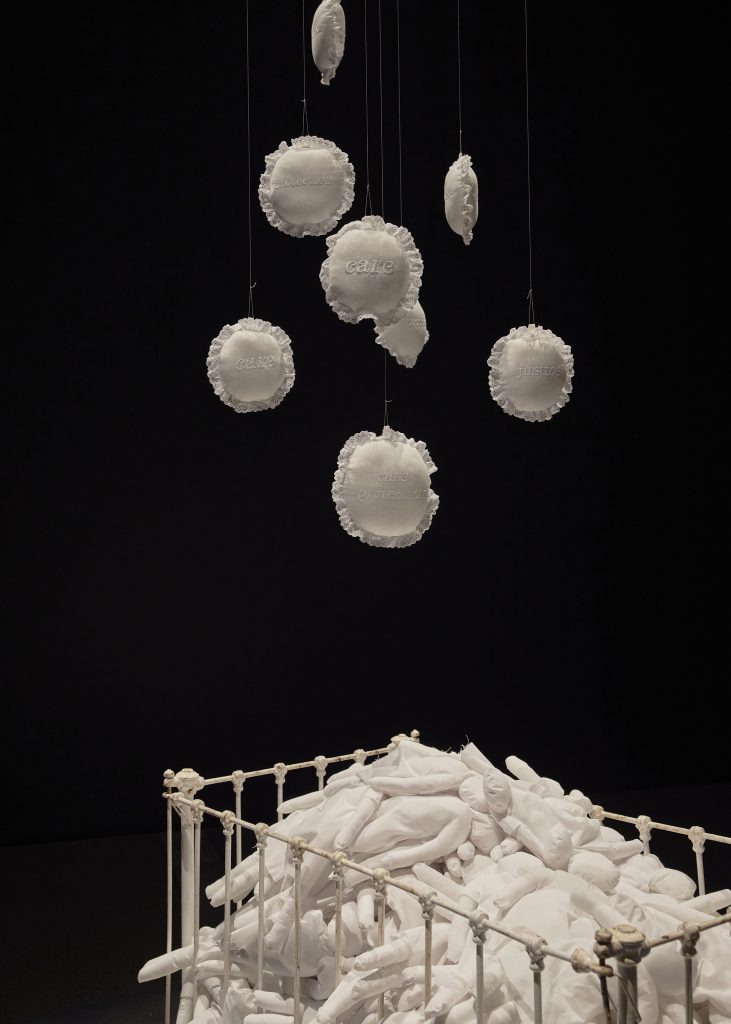
Crafted from wool, the dolls also speak to the history of Aboriginal labour and colonial agriculture. Mabo was mentored by Megan Cope, whose own practice is informed by historical rituals. Her magnificent installation, A Great Depression (2024) is currently showing at TarraWarra in System Release, which coincidentally opened the day after Future Country and is the first iteration of the gallery’s International series since it was rudely interrupted by the pandemic.
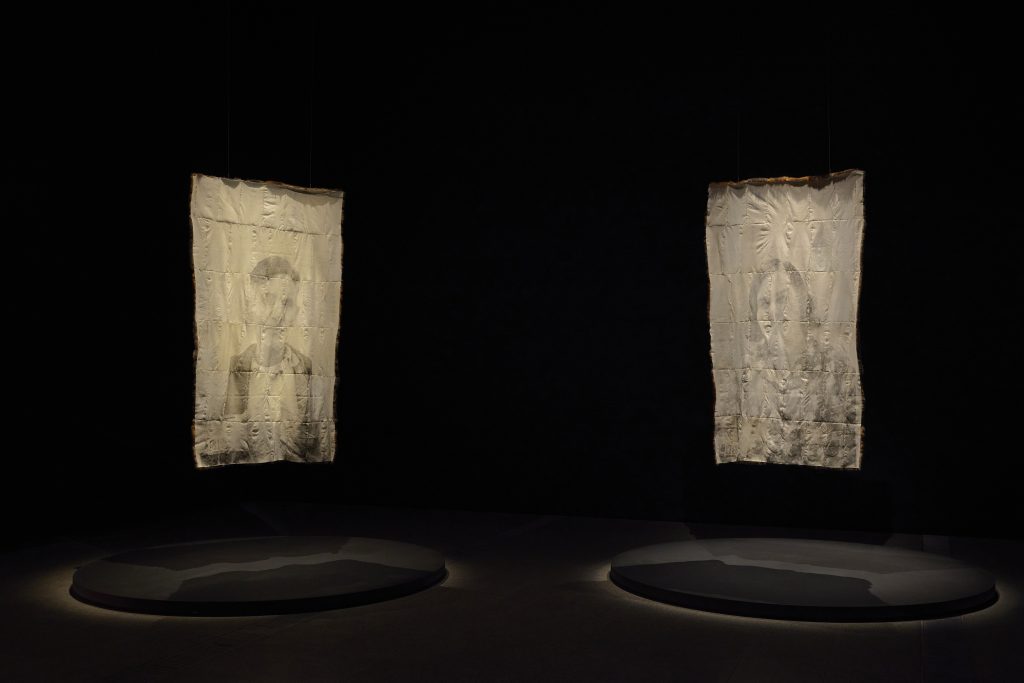
Colonial Threads shares a space with, for this viewer, one of the most impactful pieces in the exhibition – Carly Tarkari Dodd’s Great grandfather Seth (2025) and Great nanna Bella (2025), comprising two hanging possum cloaks – the underside of which bear images of Raukkan mission photographs taken (without consent or agency) of her grandparents. Surrounded by cloaks handstitched by Dodd’s family, her two forebears are given a literal warm hug, and are recentred as important and beloved human individuals, rather than subjects to be coldly documented and measured.
In exploring the project, Dodd even discovered that she is related to mentor Yhonnie Scarce, adding poignancy and a whole new level of meaning and connection to the work.
Seriously sassy
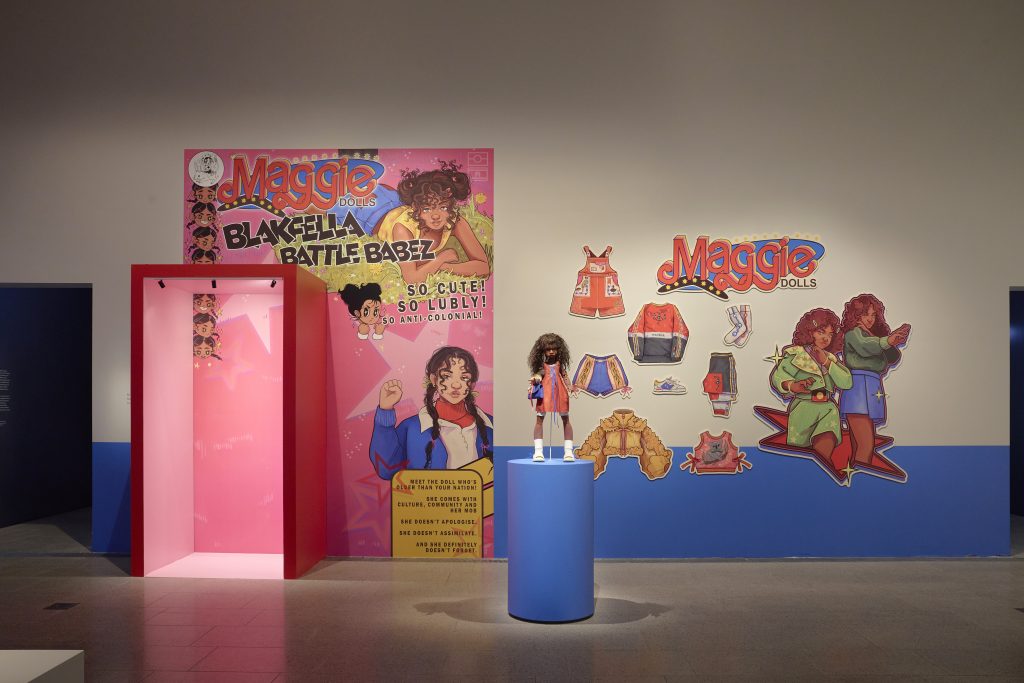
By far the cheekiest and most deliciously irreverent contribution comes courtesy of Charlotte Allingham, aka popular artist and illustrator Coffinbirth, whose sculptural work Maggie Doll! is a bold and brilliant vision of an Indigenous answer to popular Anglo toys – compounded by wall images furthering her exploration of the Blakfella Battle Babez (‘So cute! So lubly! Anti-colonial’) for which she has become renowned.
Meet the doll who’s older than your nation!
She comes with culture, community and her mob
She doesn’t apologise.
She doesn’t assimilate.
And she definitely doesn’t forget.
– from Maggie Doll! 2025
Wonderfully empowering and charismatic, the images leap off the gallery walls and demand to be enjoyed. Pairing Allingham with the marvellously provocative Karla Dickens as mentor is yet another inspired partnership.
She sells seashells
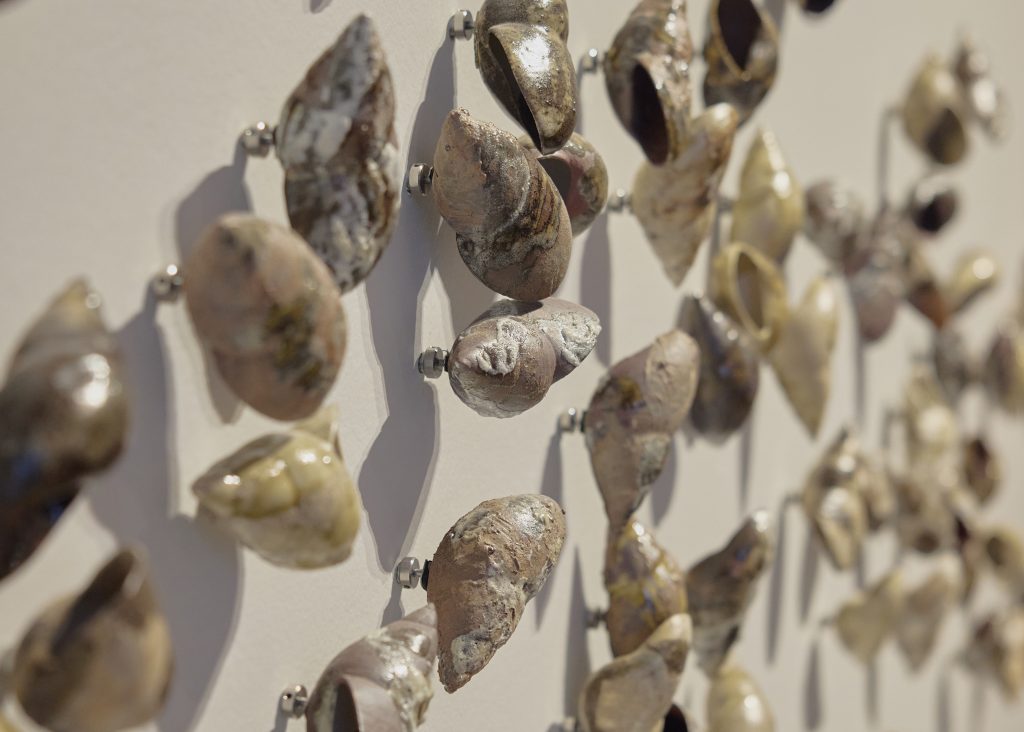
While Nunami Sculthorpe-Green was mentored by Lola Greeno, someone she describes as ‘the most senior shell stringer on lutruwita/Tasmania’, her installation also recalls the work of the aforementioned Megan Cope. A wall covered in nearly 200 slip cast marina shells functions as an homage to those who have practised shell stringing over time as well as those keeping the discipline alive today. The distribution of the shells also calls to mind tidal flows and how shells dot the landscape when the coastal waters ebb and flow.
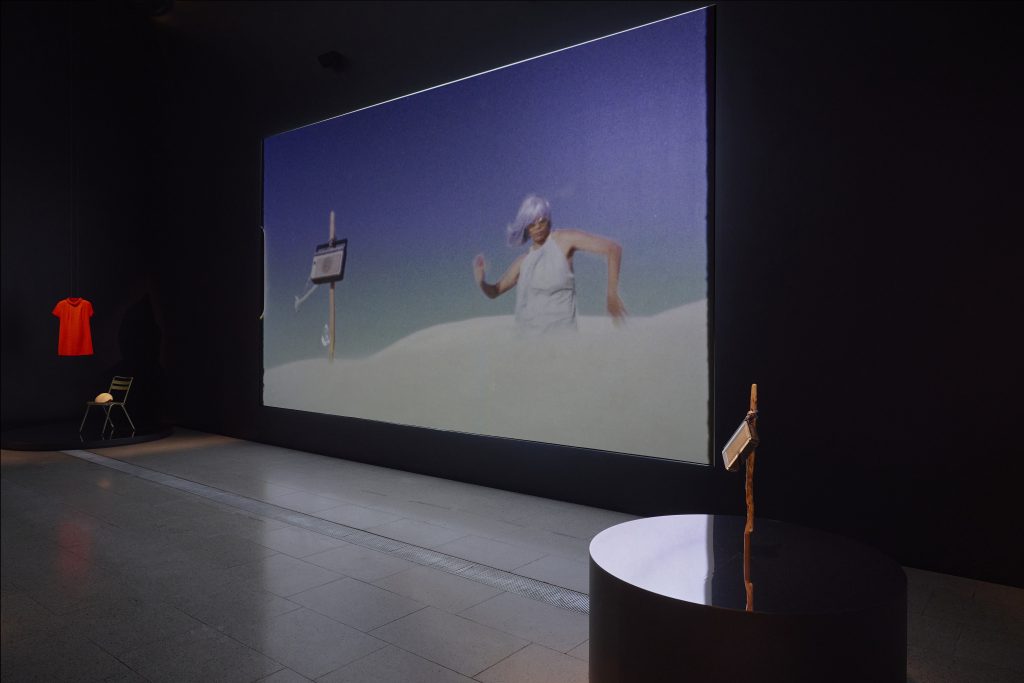
The final installation is Sheila’s dream (2025), a video work with accompanying plinths featuring a handful of the artefacts from the visuals. Mentored by Clothilde Bullen (who recently returned to the AGWA [Art Gallery of Western Australia] from the MCA [Museum of Contemporary Art] to take up the role of AGWA curator and head of Indigenous Programs), Katie West’s work looks to her grandmother to honour her, and understand and direct an overdue focus on the traumas and injustices she experienced.
Using the language of dreams, grief and memory, West takes on the form of her own predecessor in a series of images and segments that, like Dodds’ possum cloaks, serve to remove previous generations from the colonial lens to which they have been subjected and reposition them as essential and highly valued ancestral figures, whose descendants remember them and cherish them anew.
Future Country is at The Ian Potter Centre: NGV Australia until 13 September 2026, 10am to 5pm | free entry.
| Top Image: Detail, installation view of Charlotte Allingham (Coffinbirth)’s work Maggie Doll! (2025) on display in FUTURE COUNTRY: Country Road x NGV First Nations Commissions from 20 March – 13 September at The Ian Potter Centre: NGV Australia, Melbourne. Photo: Sean Fennessy. |
You Might also Like


Related Stories

© Niche Media 2026