

PTID redefines the commercial lobby at 567 Collins Street

Share

A Melbourne CBD intervention achieves warmth, intimacy and a 50 to 75 percent reduction in embodied carbon through keeping what already exists.
Across Australia’s major cities, the pressure to reposition ageing commercial assets has become one of the defining challenges of the built environment, and all too often the default response is demolition, a cycle that strips buildings of their character while generating vast quantities of material waste. At 567 Collins Street in Melbourne, design practice PTID has charted a deliberately different course, one in which retention becomes the primary design instrument and architectural restraint yields outcomes that are richer, warmer and more responsible than conventional redevelopment could have produced.
The building’s existing form was, as project director Ben Lornie describes it, a “strong, sharp and angular expression of Melbourne, its lighting cool, its material surfaces hard and uncompromising”. Rather than erasing that character, PTID used it as the foundation for something altogether more human. The goal was to create a warm, people-centred environment that genuinely invites occupation, transforming a thoroughfare into a destination.
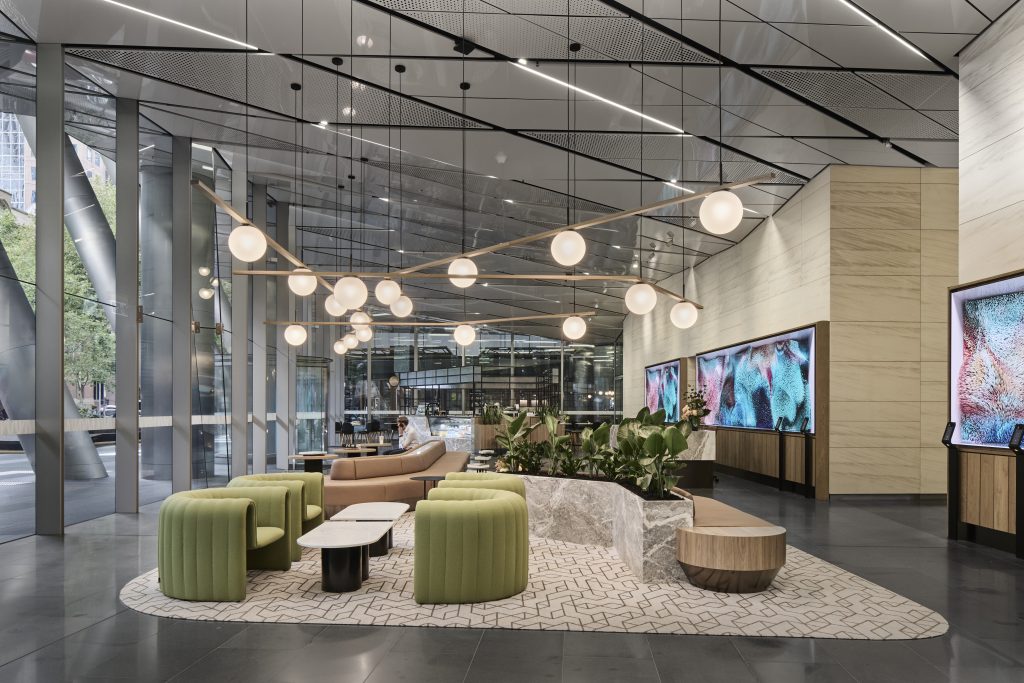
Further to its humanistic attributes, the environmental case for the project is notable. Rather than pursuing demolition and replacement, which would have generated an estimated 1200 to 2400 tonnes of upfront emissions, the design team rescripted the existing structure as a richly programmed urban ground plane. On its own, the strategy of retention achieves a projected 50 to 75 percent reduction in embodied carbon, numbers that reframe architectural restraint as one of the most powerful tools available to the profession.
Lighting the way without replacing a thing
Lornie says early light-modelling studies proved revelatory in shaping the project’s scope and ambition. “The team discovered that the lobby’s entire ambience could be transformed through low-level, warm illumination without replacing the existing lamping, preserving the ceiling and its embodied carbon in a single decision,” he says. “The lighting was very cool, material surfaces hard and uncompromising, and we wanted to create a warm human-centred environment that encourages people to dwell and inhabit the space.”
This kind of upstream thinking, where the most sustainable outcome is also the most design-forward, runs throughout the project as both a practical method and a philosophical position. The bluestone floor, initially earmarked for replacement, was retained and reframed as an urban backdrop against which new insertions could read with clarity and contrast.
“All new materials are low‑VOC (volatile organic compounds), sustainably sourced and designed for disassembly,” Lornie says. “Even the lobby furniture found renewed purpose, rehomed in spec fitouts, neighbouring hospitality venues or salvaged as boutique pieces.”
Raised platforms and layered woollen rugs define zones while introducing softness without disturbing the original surface beneath. Existing food and beverage tenancies were kept in their entirety, with refined overcladding and minimal insertions providing the necessary design uplift. Even the lobby furniture found renewed purpose, given new life in neighbouring fitouts and hospitality venues rather than directed to landfill.
This commitment to material longevity extends well beyond the lobby itself and into the longer life of the building.
A tapestry of warmth and human scale
Where the project truly distinguishes itself is in the atmospherics it achieves within a large and previously impersonal commercial volume. “A curved reception desk hewn from Fior di Pesco marble, anchored by a deep bronze plinth, draws the eye immediately upon entry and signals an entirely different register to what the building offered before,” Lornie says. Behind it, a custom digital art installation, calibrated to occupy just a quarter of the available wall surface, pulses with movement visible from the street, extending the precinct’s identity outward into the city.
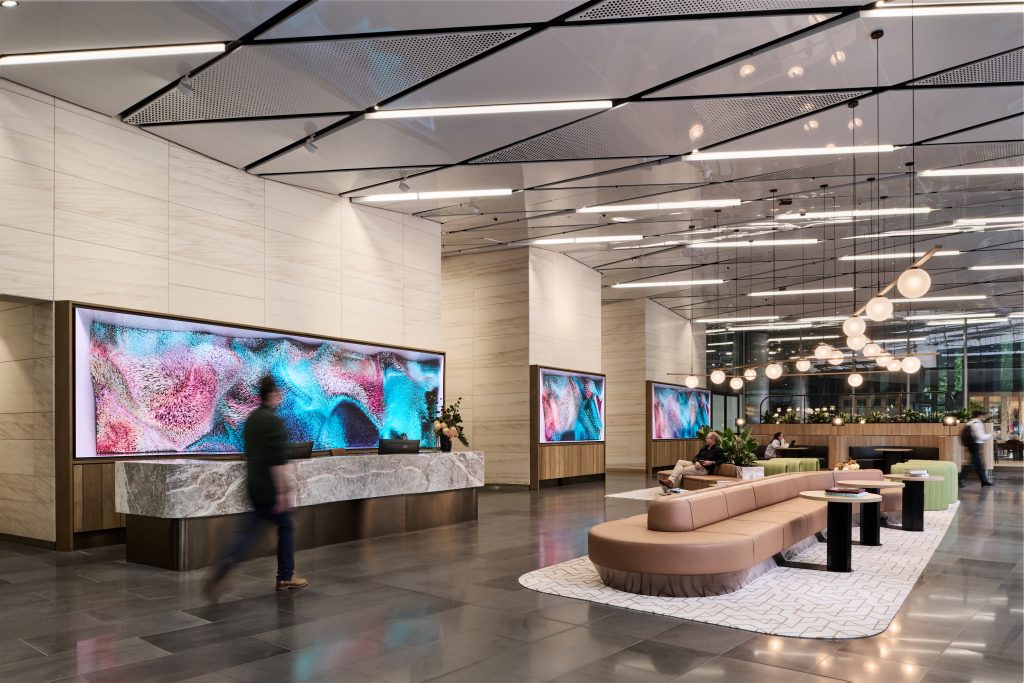
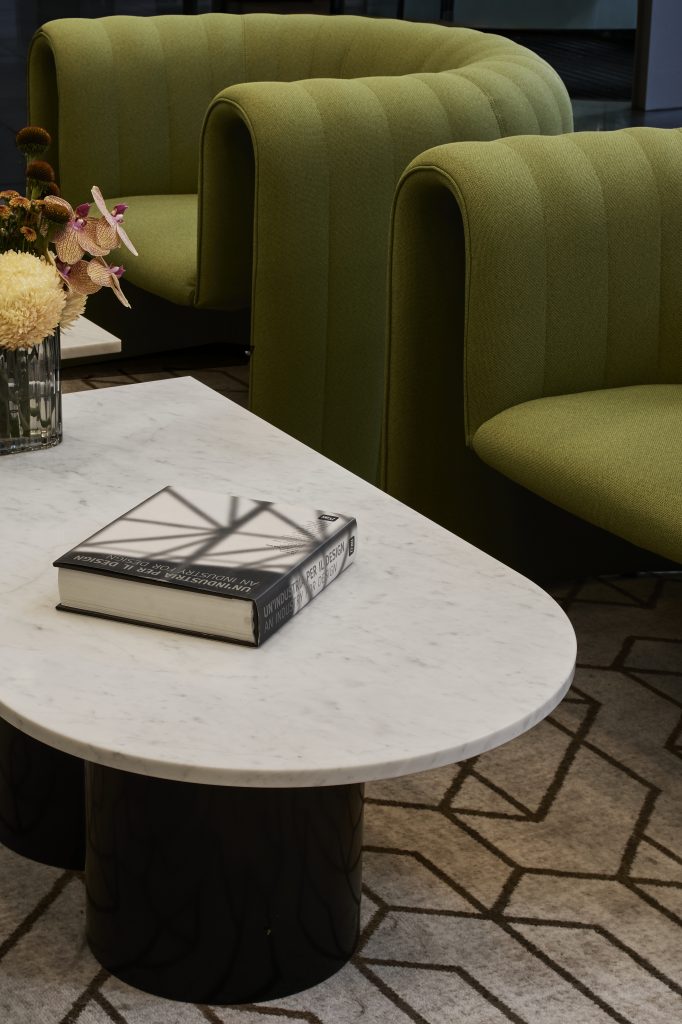
The arrival experience unfolds as a series of articulated banquettes that cross the lobby rhythmically, supported by integrated laptop counters and lush pockets of planting, punctuated with green armchairs and custom marble tables. Overhead, a bespoke constellation of opalescent orbs connected by Victorian hardwood members lowers the eyeline and creates an intimate, human-scaled envelope within the expanse. To the west, a raised platform hosts settings for meetings and chance encounters, its outward-facing booths lending a sense of semi-open retreat. To the east, a café completes the ecosystem, clad in matching marble with warm timber and brass accents that extend the invitation to dwell.
The result is a lobby conceived as a series of distinct atmospheres that Lornie says offers a sense of place that draws people in rather than just moving them through. “These curated experiences formed the key brief, each one with a unique atmosphere,” Lornie concludes. “The execution succeeds in bringing together these experiences and creating an intimacy through materials and lighting and occupation.
Photography by Tom Blachford.

© Niche Media 2026