

The builder who designed his forever home from the materials up
The builder who designed his forever home from the materials up

Share

A carpenter turned construction veteran, John Hill has spent a career absorbing the lessons of great architects, and has finally applied them to one measured yet disruptive house on a north-east Victorian farm.
There are builders who work for architects, and then there is John Hill, a man who spent four decades absorbing their thinking before channelling it, quietly and without fanfare, into the most personal project of his career. Nestled on a farm in north-east Victoria, Hill’s Barrabool House is the kind of building that takes a lifetime to understand precisely because it took a lifetime to build. Not just in the physical sense – though the collected timbers and bricks span 40 years of patient salvage – but in the deeper sense that every design decision carries the sediment of a career spent watching great architects solve problems with intelligence and restraint.
Hill’s professional orbit placed him alongside some of the more significant names in Australian architecture, ARM, Zarinan Gurrie, David Faggetter. For a builder, sustained proximity to that calibre of thinking forms an education no university course could replicate.
“Working alongside these architects was inspiring,” Hill says. “There always needs to be a balance between artistic expression and material limits.”
When it came time to design his own home, that balance became the governing logic. The result is a house that works with quiet authority, where practical intelligence and material beauty read as one.
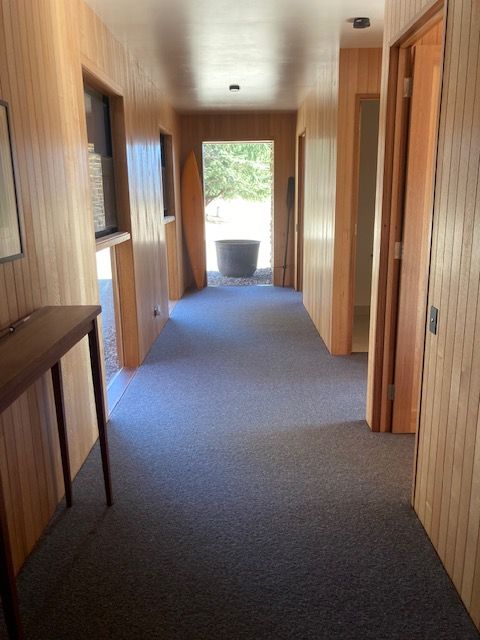
One of the home’s more striking departures from convention is its rejection of the formal entry. Where most Australian homes perform arrival through a foyer or threshold moment, Hill’s house simply opens. Every room holds at least one external door. Visitors arrive through a generous mud room, a move that feels both grounded and considered. There is no hierarchy of approach. The house places its faith in material presence and lived function.
Living with McGlashan Everist
One of the most formative chapters in Hill’s design education came through inhabitation. For 26 years Hill lived in a home designed by McGlashan Everist, the mid-century Melbourne practice the residential work of which continues to shape the language of Australian architecture. That long immersion, a daily exchange with a building over decades, formed a set of convictions now embedded in every wall and roofline of his own home.
“Being bathed in sunshine in the living areas during winter was a gift from McGlashan Everist,” Hill says. North orientation became essential, with eaves set at precisely 50 percent of wall height, a simple move that draws in winter light and blocks the summer sun. Bedrooms and living spaces open onto a continuous north-facing deck, an idea carried forward from that earlier house. The flat roof stayed behind, in its place a pitched roofline that draws from a different lineage of Australian domestic architecture.
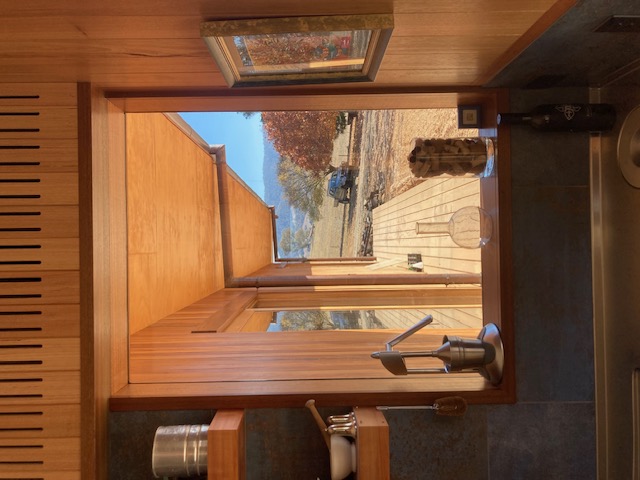
The roof stands as one of the building’s most compelling elements. Hips, valleys, flying ridges, broken hips and vented Dutch gables meet at a traditional 25-degree pitch, executed with the precision of a carpenter trained in the late 1970s. “At that time the tools were simple – a carpenter’s pencil, square, bevel, handsaw, circular saw and hammer,” Hill says. The roof acts as both personal expression and practical response. As rainfall intensifies, the pitch moves water quickly and with certainty. Its form also recalls early Australian homesteads, grounding the house in a lineage shaped by climate and craft.
When materials come first
To understand how this house took shape, the usual sequence needs to be reversed. Most buildings begin with a brief and a site, then materials follow. Hill’s home began decades earlier when he started collecting Australian hardwoods with the belief that quality timber deserves continued use.
To that end, Queensland Brush Box basketball flooring salvaged from an army barracks at Mount Martha juxtaposes bridge timber from the Port Kembla Steelworks. Hydrowood lining boards meet Queensland hoop pine ceilings. Myrtle joinery, Taradale stone from central Victoria, bluestone hearths from Pyrenees Quarries in Castlemaine and Geelong blue bricks coalesce to anchor the home.
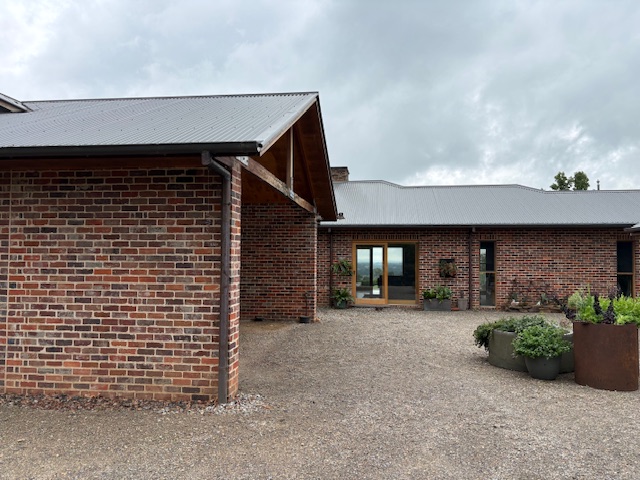
Hill describes those bricks as ‘three cycled’. They began life in a Geelong home more than a century ago, then moved into paving at his mid-century house and now form the south and east walls here. “Our reused materials have been collected over 40 years, because quality timbers and bricks deserve continued use,” he says.
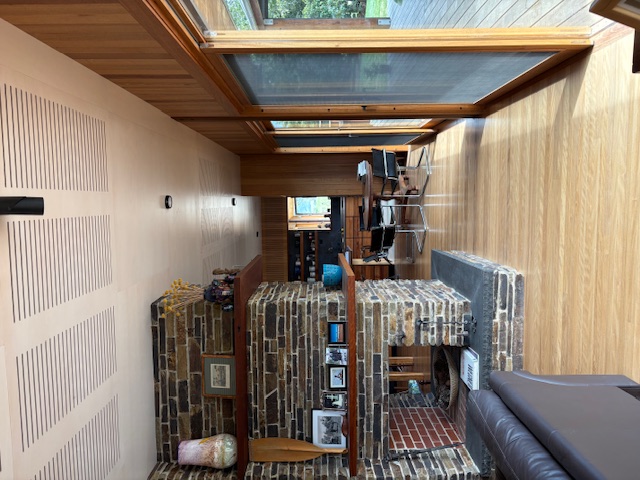
The architecture followed the materials, and that logic appears most clearly in the details that remain absent. Hoop pine ceilings meet Hydrowood lining boards with no cornice. Lining boards meet Brush Box flooring without skirting. Junctions stay clean because the materials hold their own. Skilled trades carried that thinking forward. Stonemason Frank Vickers laid the Taradale stone. Bricklayer John Morrison set the Geelong blues. Each trade brought a depth of craft that the materials demanded.
The industry’s default settings
The absence of particle board, craftwood and plasterboard reveals a deeper position forged by Hill’s completion of a recycled timber grading course that ensures structural compliance, a step that reflects both rigour and a willingness to step outside industry norms. “Over many years in the industry I have seen Australian hardwoods consistently outperform other materials,” he says. “They are more resilient in damp conditions, carry a strong aesthetic and avoid harmful chemicals.”
Wood fibre insulation from Styco sits within thicker walls that also shape the visual language of the house, allowing lining boards to overlap window frames without architraves. Acoustic material in living areas softens sound across hard surfaces. Humidification within the air-conditioning system stabilises timber across floors, walls and furniture. Each decision reflects a long understanding of how buildings behave across time.
In the kitchen, a range hood that was formed from two salvaged roof vents from an old Geelong pub, adds a historic charm. Copper downpipes age alongside exposed hardwood trusses and large timber posts. “The house is designed to deepen with time, to weather and patinate as materials settle into place,” Hill says. For him, that outcome is shaped by decades of watching Australian hardwoods endure.
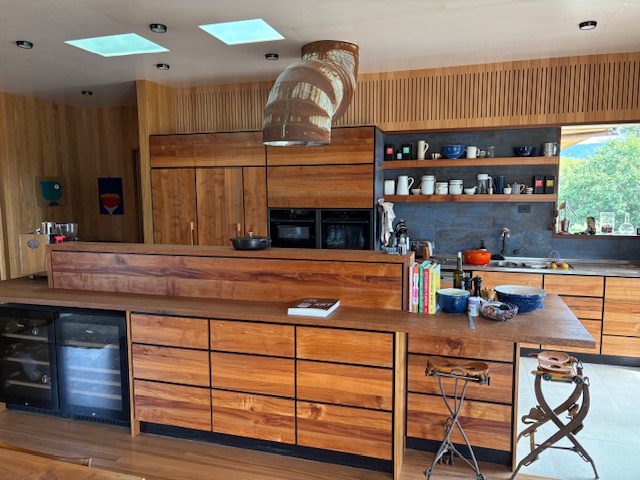
What emerges is a clear position shaped through experience. The most radical move a builder designer can make lies in attention to materials, craft, light and the rhythms of season that turn a north-facing room in a Victorian winter into something generous and enduring.
You Might also Like
Related Stories

© Niche Media 2026