

Science Gallery’s EMERGENCE[Y] this June

Share
From fungal fashion to Martian winds, a landmark new exhibition explores what it means to adapt, survive and create at the edge of planetary crisis.
Tucked within the University of Melbourne’s innovation precinct at Melbourne Connect, Science Gallery Melbourne has long occupied a compelling space between disciplines, and its boldest exhibition to date opens to the public on 6 June 2026.
Running through to 5 December, EMERGENCE[Y] unites an ambitious roster of international and Australian artists whose work sits at the intersection of biotechnology, ecology, artificial intelligence and material science, prompting visitors to consider, with some urgency, how humanity may survive and even flourish amid accelerating planetary transformation.
Curated by Science Gallery Melbourne Head Curator Tilly Boleyn, with input from academic experts and young people, the exhibition draws its energy from a simple but weighty premise: that adaptation is simultaneously a biological imperative and a creative act. The breadth of work on show reflects that duality with considerable range.
Art made from another planet’s weather
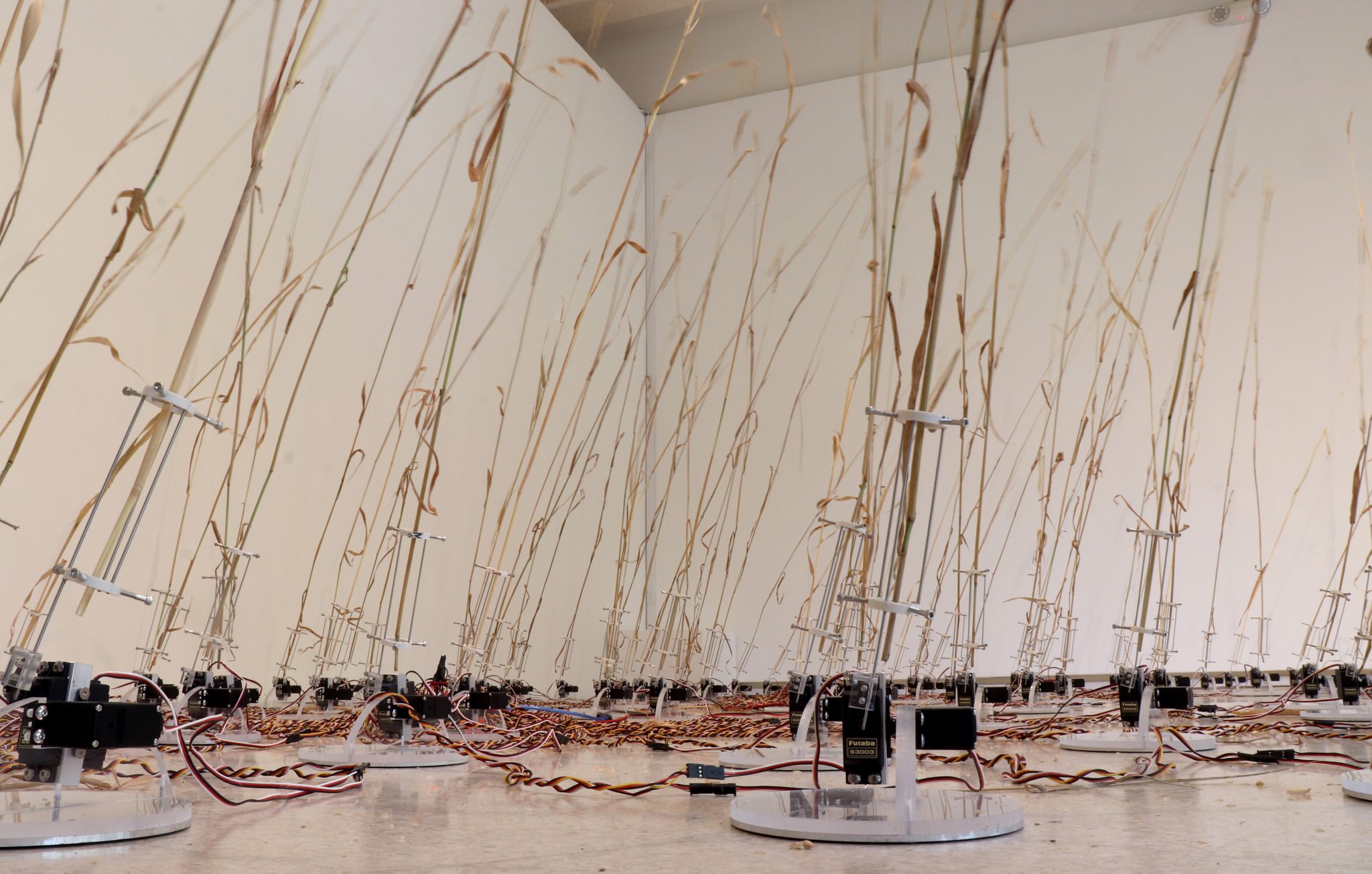
Among the most arresting works in the exhibition is tele-present wind by Minneapolis-based artist David Bowen, developed in collaboration with NASA’s Jet Propulsion Laboratory. The installation consists of 126 mechanical devices, each connected to dried grass stalks, which move and sway in real time according to wind data collected by the Perseverance Mars rover. The result is a field of motion drawn entirely from another planet’s atmosphere, an extraordinary proposition that makes the abstract idea of interplanetary connection viscerally legible.
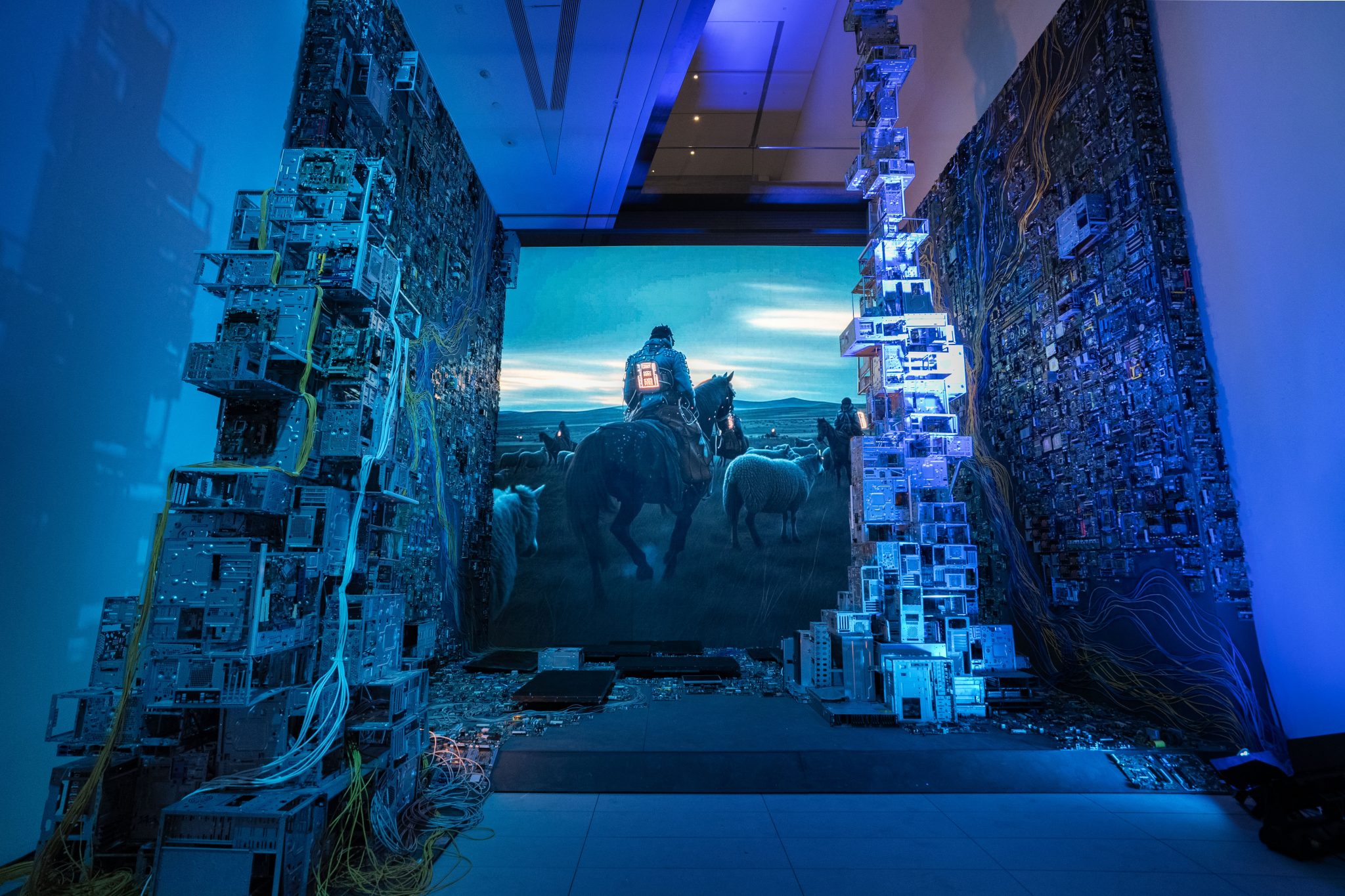
Equally compelling is the Australian premiere of Tuengel, a video installation by prominent Chinese new-media artist and academic Dr Wang Zhigang. Constructed from e-waste and set within a post-apocalyptic electronic wasteland, the immersive work imagines a future in which humans, animals and intelligent machines coexist among the ruins of obsolete technology. The installation’s Melbourne debut coincides with the broader Rising Melbourne program, lending additional cultural weight to what is already a striking body of work, where biology becomes material.
The exhibition’s engagement with material science is anchored by two inventive contributions. ACT multidisciplinary artist and designer Alia Parker has developed a collection of fire-resistant clothing made from a composite of mushroom mycelium and post-consumer cotton textile waste. Mycelium’s natural properties, including fire retardancy, water resistance and compostability, make it a material of genuine practical promise in a world contending with increasingly severe fire seasons, and Parker’s garments translate that potential into something wearable and thought-provoking.
Patricia Piccinini, one of Australia’s most celebrated artists, has contributed a major new commission developed during a year-long residency with Science Gallery Melbourne, which included time spent in the stem cell research laboratories at the Murdoch Children’s Research Institute. Her new sculpture, Células Madre, revisits her seminal 2002 work Still Life With Stem Cells on its 25th anniversary, reframing it through the lens of two decades of technological advances in regenerative medicine. The two works will be shown together, offering visitors a rare opportunity to trace the arc of a practice that has always taken science as both subject and collaborator.
Rounding out the exhibition is a lush vertical farm created by Greenspace in partnership with the University’s Faculty of Engineering and IT, which invites visitors to experience sustainable food systems in an urban setting, and Coral Sound Resilience by German artist Marco Barotti, a project rooted in acoustic ecology whose sound sculptures are being permanently embedded in damaged reefs around the globe.
EMERGENCE[Y] is open to the public from 6 June to 5 December 2026 at Science Gallery Melbourne, corner Grattan and Swanston Streets, Carlton. Entry details at melbourne.sciencegallery.com.
You Might also Like

Related Stories

© Niche Media 2026