

Kincaid’s prefab terraces are rewriting the rules

Share

How a Melbourne builder cracked the prefab code to deliver architecturally-led homes in a fraction of the traditional time.
When five terraces suddenly appeared in Stockland’s Highlands estate in Melbourne’s north, neighbours may have wondered from whence they came. The answer, according to Kincaid chief operating officer, Joel Martin, lies in a manufacturing philosophy that the industry has been slow to embrace and a rethinking of what prefabricated housing can look like.
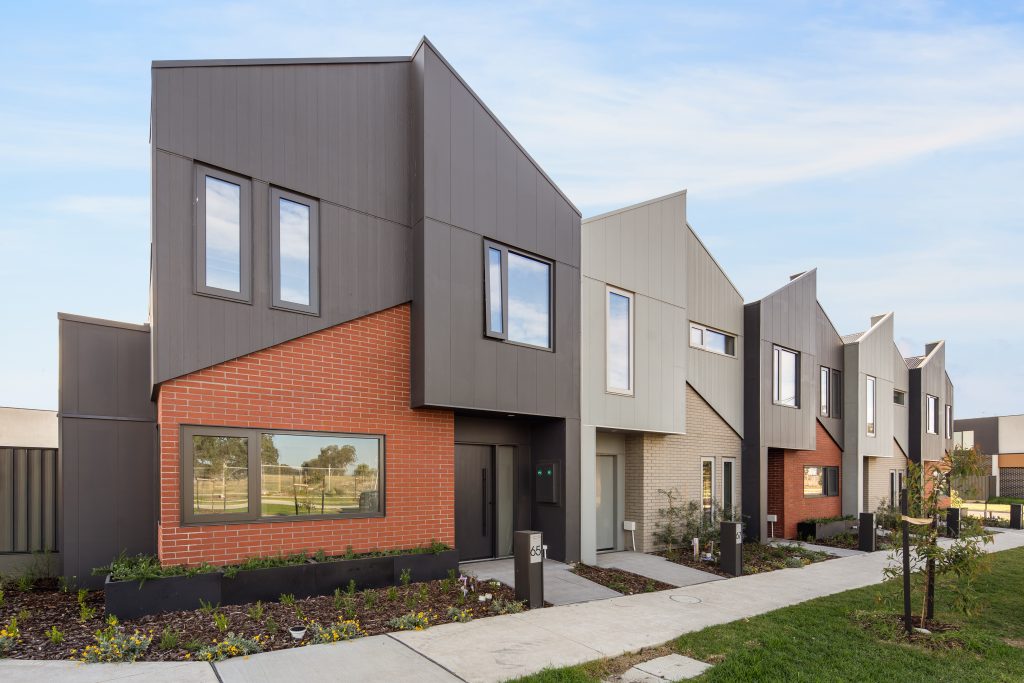
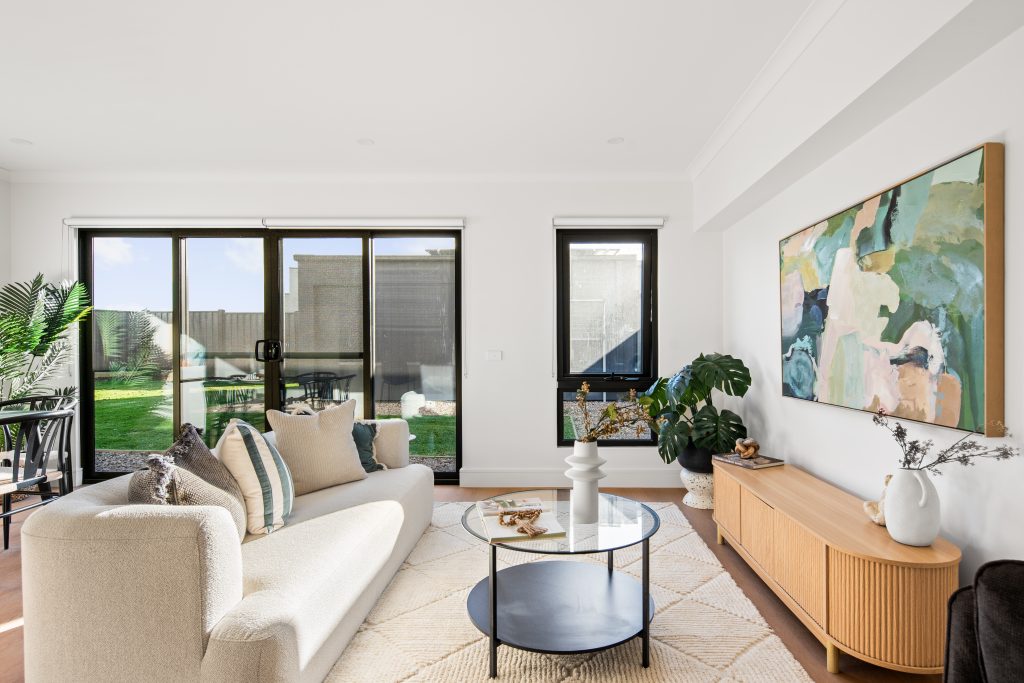
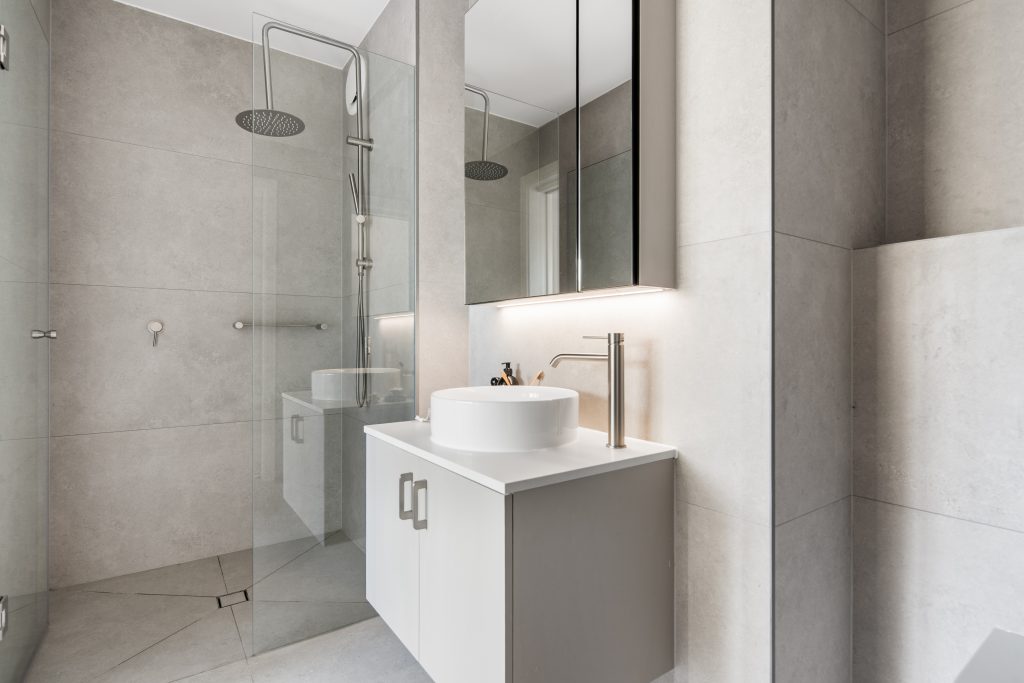
Completed in just three months, the homes represent Kincaid‘s first fully prefabricated terrace project, delivered in partnership with Chinese panel manufacturer Signex. Each dwelling achieves an 8-Star NatHERS energy rating, features floor-to-ceiling porcelain tiles in bathroom pods, commercial-grade double-glazed windows and semi-solid doors, specifications that Martin is quick to point out, “routinely exceed what lands in a comparable traditional build”. His words have been proven by the project’s sellout status within three weeks of going to market – an impressive result, to be sure, but the path to get there was anything but straightforward.
Design first, prefab second
For Martin, the central principle guiding the project was non-negotiable from the outset. “If you don’t make it look like prefab, we think you’ll be quite successful in the marketplace,” he says. Kincaid spent 12 months working with the Signex team to develop the panellised system, basing it on the builder’s best-selling Tribeca design and stress-testing every junction, material interface and proportion before a single panel left the factory floor.
The result is a façade that pushes and pulls in ways conventional prefab rarely attempts: brick slips with purpose-designed L-shaped corner treatments, James Hardie cladding and a materiality deliberately calibrated to read as considered architecture versus off-the-shelf efficiency. “Prefab just wants to be up and down with no pushing,” Martin explains. “It took us quite a while to work that out.”
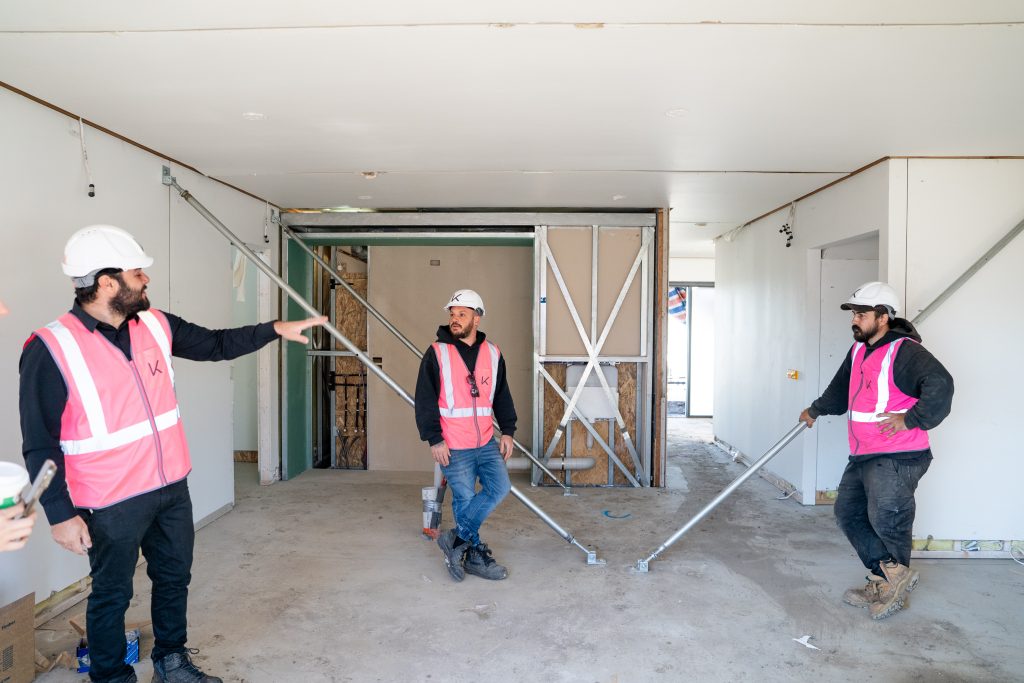
The bathroom pods, manufactured complete with vanities and shower screens before any surrounding walls existed, offered a peculiar sight on-site as fully fitted wetrooms standing in open air above a raw slab. Once craned into position and enclosed by the wall panels, they represent one of prefab’s clearest arguments: a level of finish, tiling and specification that would be commercially unviable to replicate in a traditional greenfield build.
Speed, specification and the housing equation
Amazingly, each dwelling took approximately five days to erect, and Kincaid is confident that this timeline can be reduced to three as panel sequencing is optimised. For the investor market, the arithmetic is compelling. A traditional townhouse of comparable specification typically runs for 10 or 11 months on site, during which financing costs accumulate, rental income is deferred and market risk compounds. Delivering in three months collapses that exposure significantly.
“If you can deliver in three months, what a great story,” Martin says. “It gets your investment working, your rental moving for you.” The homes are around 80 to 85 per cent prefabricated, with local trades handling kitchen fitout, flooring installation, electrical connection and roofing. Importantly, the sequence of trades remains conventional, which Martin identifies as one of the model’s underappreciated advantages for the broader industry.
The ESG (environmental, social and governance) story is also unusually clean. Waste on-site was limited to timber offcuts and soft plastic wrapping from the panels, both recyclable. Stockland, as the land developer, responded warmly to those credentials.
Scaling the model
The five homes at Highlands were a proof of concept – and a deliberately cautious one. Martin is candid about the risk embedded in being first. “No one has done it before,” he says. “The way to mitigate risk was to spend 12 months with the supplier on design elements and critiquing every design.” Real-world conditions still delivered surprises. An unusually wet construction window last year exposed vulnerabilities in how panels managed water ingress, leading to design revisions now being incorporated into the next run, such as water-resistant board in place of standard plaster, interlocking floor details and membrane capping across panel tops.
A further 12 lots at Highlands are already secured and on sale, with a start date targeted for August and completion by Christmas. Beyond that, Kincaid is in conversation with Stockland and other major developers about expanding the model across multiple sites. The design itself, Martin says, is doing much of the heavy lifting. “We’re gaining a lot of interest from developers purely on the architecture,” he says. “When you throw in the time and the speed to completion, it’s a very compelling conversation.”
The homes may have gone up in three months, but the argument they make for a different way of building will take considerably longer to settle into the industry’s thinking. For now, Kincaid’s bet is that delivering something beautiful, and quickly, is the most persuasive case of all.
For another stunning prefabricated project, keep it locked on ADR.

© Niche Media 2026