

Architecture firm BVN launches free, open-source De-Fit Guidelines to help contractors reduce waste
Architecture firm BVN launches free, open-source De-Fit Guidelines to help contractors reduce waste

Share
With the construction industry contributing nearly 40 percent of all annual waste within Australia, sustainable measures are needed to reduce the amount of construction material destined for landfill, in turn feeding a more circular economy.
The interior fitout sector is a complicated, labour-intensive aspect of the construction industry and poses a very practical challenge: how can the waste material from refitting the inside of a building be sustainably managed and recycled?
This question is one that global architecture and design firm BVN have sought to answer with its freely accessible new De-Fit Guidelines for Commercial Fitouts, a how-to guide to minimise material waste and facilitate circular pathways for used material and products in the commercial fitout sector.
De-fitting an interior space – the process of removing a commercial fitout at the end of a property lease – is simultaneously one of the most wasteful and least considered phases of a building’s lifespan. Yet this overlooked component of the interior fitout sector represents a promising opportunity to engage in circular practices by redirecting materials away from landfill and back into the cycle of materials across the construction industry.

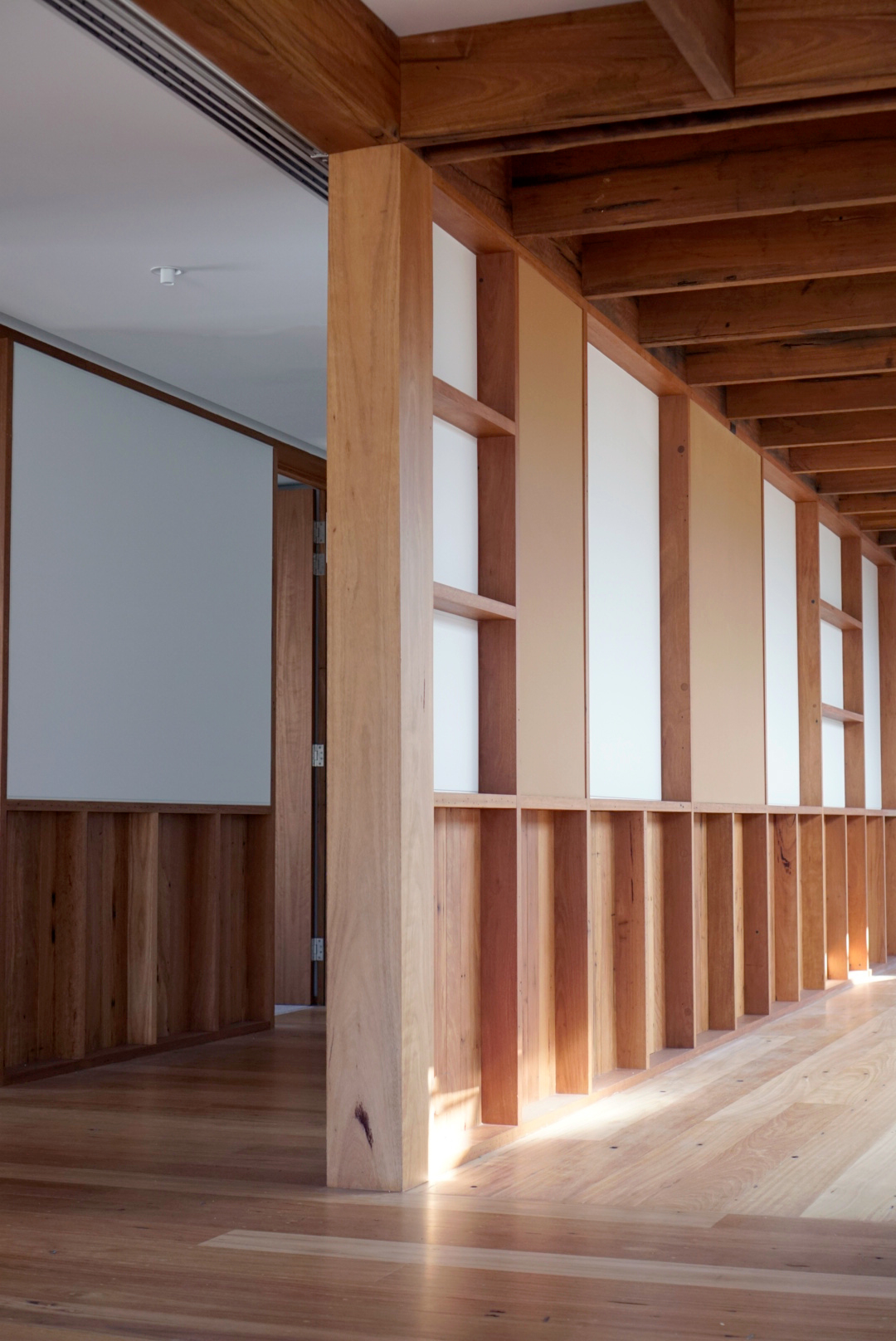
Level 41 of GPT Design Suites headquarters, cited on page 49 of the BVN De-Fit Guidelines. Photo: Tom Roe.
BVN’s Guidelines for Commercial Fitout, authored in partnership with built environment strategy enterprise FTD Circular, is targeted toward architects, contractors, building owners and tenants to help reduce waste materials from the outset of a tenancy lease.
Launched at an industry event hosted in BVN’s Sydney studio, the guideline will also be the focus of a Brisbane launch this September. Australian Design Review spoke with three BVN project leads to learn more about how waste materials can sustainably re-enter the circular economy.
Rethinking the construction process and industry approaches to waste
Though the least visible aspect of the building process, commercial interior demolition constitutes an enormous portion of waste nationwide, making BVN’s guideline a necessary resource.
As BVN practice director Amelia Lipa details, “Construction and demolition waste accounts for 39 percent of Australia’s waste in total. Most building materials are sent to landfill before their functional lifespan. In fact, 50 percent of materials removed during building retrofits could be recirculated.”
Lipa emphasises the reason for this is the increasing trend of buildings becoming disposable, at best designed to last 40 to 60 years. “Each element has a different lifespan,” Lipa adds, “but fitouts typically are only lasting five years.”

Level 41 of GPT Design Suites headquarters, cited on page 49 of the BVN De-Fit Guidelines. Photo: Tom Roe.
This high rate of lease turnover means frequent construction demolition and, with that, more waste. BVN regenerative practice coordinator Adrian Taylor underlines this with reference to a report from the Green Building Council of Australia, titled Australia’s Waste[d] Opportunity 2025.
“It found that in the next five years, 64 billion dollars’ worth of material is being thrown in landfill that could otherwise be recirculated. All of these factors combined, really, say that there’s not only a huge sustainability push to [de-fit sustainably], but it’s also a huge economic push.”
A freely accessible guide for anyone to action positive change
“There is no pathway to Australia’s climate goals without a thriving circular economy,” says BVN principal Sally Campbell. “And the first part of a circular economy is responsible de-fit.”
The most important part of achieving this, Campbell elaborates, relies on construction managers being able to source these materials in the first place, making them available for entry in the circular economy.
The problem is not well-suited for an easy solution, with Campbell underlining that the majority of materials in the process of a commercial de-fit are simply dumped in a landfill. What makes this process so hard to course-correct is that de-fitting is “not naturally part of the construction or demolition process,” Campbell says.
“So what we wanted to do was assemble a kind of practical how-to guide that anybody could pick up and use as a tool onsite to guide them through a de-fit process.”
BVN’s wide-ranging industry contacts and extensive on-the-ground experience of the construction industry gave them ample high-value insights to create their de-fit guidelines. The end result was designed from the get-go to be freely available, as well as deliberately open source.
Women’s Health Centre, cited on page 42 of the BVN De-Fit Guidelines. Image supplied by BVN.
“We’re not the experts in this space,” Campbell admits, “but we have the privilege of being able to deal with experts. We see different people in different pockets doing amazing things, and for that reason, we made it an open-source guide. Anybody can download this and use it as a tool onsite.”
A key focus point in the guide’s production process was accessibility, making its how-to components as plainly actionable as possible. It’s a solution that Taylor says came about as the result of similar guides merely speaking to the many policies surrounding the circular economy.
“What circularity looks like is quite tough to approach,” he says. “Even though there are guides out there that say, ‘It’s really great if you could reuse these things, if you could divert these from landfill,’ they don’t really get too close to how it actually happens. Or the many hands that are required to do that.”
The guide was written with a keen eye on a broad audience, with particular attention paid to how the de-fit process will affect builders, project managers and subcontractors. Often, the de-fit and re-fit process is ascribed solely to the designer and client, but the repercussions of this cleanup process impact everyone involved, both onsite and in the architecture studio.
Ensuring everyone at every level claimed some piece of the responsibility in a sustainable de-fit is what drove BVN’s decision to make the guidelines freely available.
“We’re giving it away so it’s not just useful for us,” Taylor asserts. “We need a whole bunch of the industry to be engaged in the circular economy and practising this as well.”
If you want to learn more about BVN’s Guidelines for Commercial Fitout, you can download your copy here.
Lead image of Telstra Workplace, Sydney, cited on page 46 of the BVN De-Fit Guidelines. Photo: Tom Roe.
You Might also Like


Related Stories

© Niche Media 2026