

Rethinking density: designing for people and the planet
Rethinking density: designing for people and the planet

Share
If we are going to transform the way we live, let’s do it well. The push to higher-density living in Australia is a chance to reset for a better-quality future – in both liveability and sustainability.
By 2050, two-thirds of the world’s population will live in cities. In Australia, capital cities are growing as fast as three percent annually while dwelling values are at record highs and new home construction has fallen to a 40-year low.
If Australia is serious about solving its housing crisis, reducing emissions and supporting an ageing population, then rethinking how we live is unavoidable. Density will be part of that future – but it doesn’t have to mean compromise. Despite common misconceptions, well-designed high-density living can be safer, more sustainable and more comfortable than suburban sprawl.

The rise of multi-generational living – and what it means for design
In Australia, over one in six people are already aged 65-plus and the 85-plus population is projected to double by 2042, topping one million. Coupled with cost-of-living pressures, this is driving a rise in multigenerational households: around 20 percent of Australians now live in one, and in Sydney this number is one in four. The latest ABS data also shows that households containing three or more adult generations increased 22 percent in just five years.
When several generations share a home, the design requirements change. Some families are building secondary dwellings or granny flats to accommodate adult children or ageing parents. Others are retrofitting lifts into multistorey homes to improve accessibility and safety, enabling older parents to move in – or to remain in their homes for longer.
Many new townhouses now include pre-installed lift shafts, making future upgrades simple as residents age. And in Australia’s numerous three- to four-storey apartment blocks built without lifts, retrofit solutions such as external shafts – common in Europe – offer a pathway to accessibility without full redevelopment.
Together, these advances show that density doesn’t have to mean compromise. Smart technology and forward-thinking design can create reliable, inclusive and sustainable buildings for generations to come.
Residential towers: designed for every generation
These shifts in how families live highlight a broader design challenge: our buildings must support Australians across every stage of life. Residential towers can play a key role. With lifts removing the need to navigate steps and amenities often located close by, well-planned towers can make independent living easier for older residents while also supporting the needs of younger families.
Advances in building technology have also improved safety in residential towers – secure access systems, CCTV in shared areas and real-time monitoring are increasingly common.
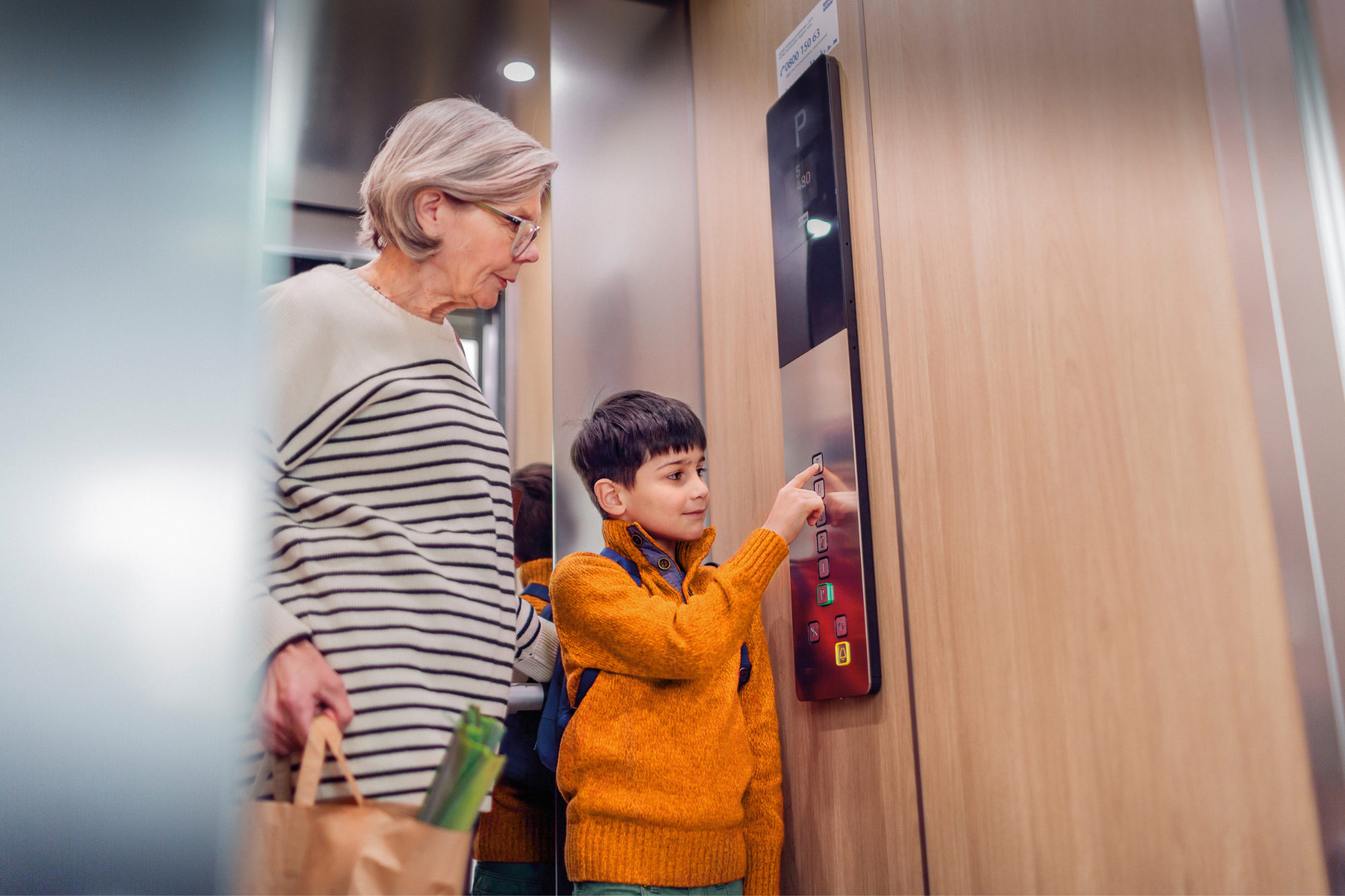
For older Australians, these features provide confidence to live actively and independently. For families, they offer reassurance that children or teens coming home from school pass through secure, supervised spaces.
Rather than isolating people, thoughtful technology can create a sense of community oversight that supports independence at every age.
In the expanding smart-building sector, technology is also improving comfort and convenience for all ages – from predictive maintenance that identifies faults before they occur, to IoT (internet of things) systems that pre-position lifts, optimise lighting and monitor HVAC.
Sustainability must be designed into every floor
The built environment accounts for 40 percent of Australia’s emissions and nearly a third of its waste. If density is to be part of the solution to the housing crisis, it must also be part of the climate solution.
Regenerative technologies are helping shift the balance. When a lift travels with a heavy or light load, regenerative drives capture excess energy and feed it back into the building. HVAC systems can now recover heat that would otherwise be wasted, reducing demand. Modernising existing equipment – upgrading components rather than replacing whole systems – keeps infrastructure in use longer and dramatically cuts emissions and waste.
These innovations show how density can support both people and the planet. Reliable, accessible and sustainable buildings are not only key to solving Australia’s housing challenges – they are central to creating urban communities where people can truly live well.
Density without compromise
High density does not have to mean congestion or inconvenience. Predictive technology that quietly supports daily life, combined with sustainable design that reduces carbon, can create homes that support diverse populations and allow people to move with ease.
High density should mean stepping into a building that supports us at every stage of life – safe, sustainable and seamless. If we are going to transform the way we live, let’s ensure it leads to a better quality of living for everyone.
Marek Oppeln-Bronikowski is Managing Director, KONE, Australia and New Zealand.


You may also like: Establishing a sense of place: Build-to-rent comes alive through narrative intent
You Might also Like

Related Stories

© Niche Media 2026