

A new ritual taking shape in the home
A new ritual taking shape in the home

Share
Wellness shifts from aspiration to expectation as Nook infrared saunas move into the architectural brief, bringing with them a sharper focus on ritual, recovery and daily reset.
In the current design landscape, where wellbeing is now a major consideration in most briefs and clients have a sharper sense of how they want to live, the infrared sauna has found its footing as a considered inclusion rather than just a novelty. Through a wellness lens, it addresses a growing desire for personal spaces that restore energy and encourage routine.
For Nook communication and marketing consultant James Billingham, that shift feels both inevitable and overdue. “Having a sauna at home is a luxury that’s becoming achievable where it’s never been affordable before,” he says. “If you’ve only got 20 minutes, you can get in it. You don’t have to drive, book, commute and come back. It becomes part of your routine.”
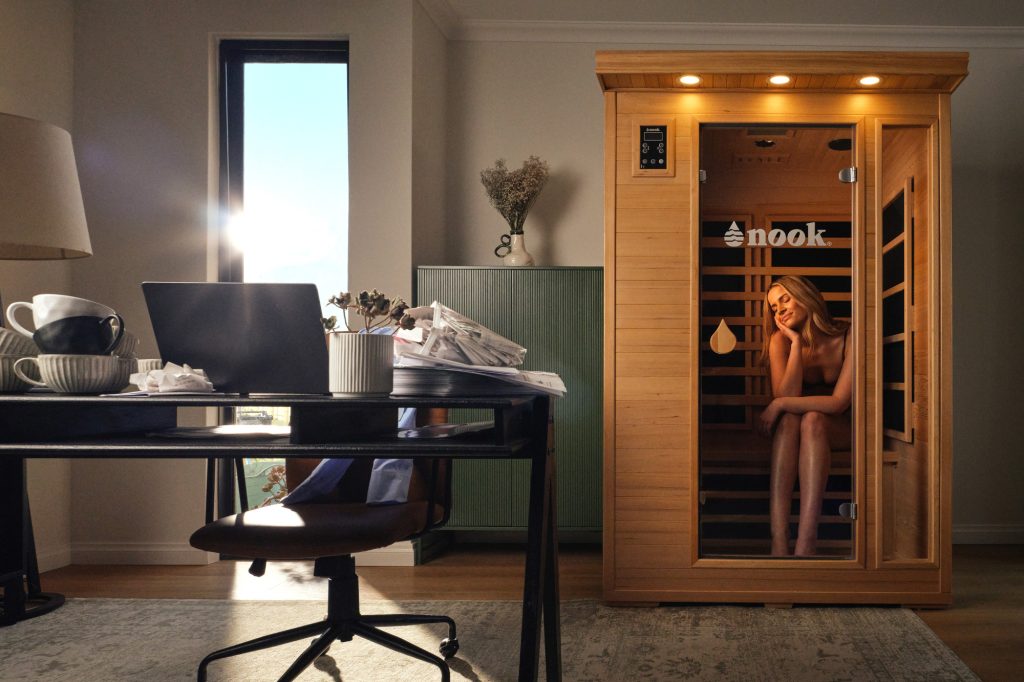
Designing for habit
As designers adapt to a growing sect of wellness-oriented clients, the questions they ask relate more to inclusion than just integration, such as: Where will the sauna sit? How will it feel? What role will it play in the rhythm of the home?
Billingham views it as a circular behaviour, where accessibility drives consistency and consistency builds value. “A lot of the benefits come from three or more times a week,” he explains. “When it’s at home, that becomes realistic. When it’s outside the home, it drops off.”
As rising digital fatigue reshapes the way people seek relief from daily pressure, the sauna finds its place within a design context that values containment and clarity of purpose, with James Billingham noting, “People are getting more attached to their devices and that adds more stress. We see the sauna as a place to reset.”
Simplifying the specification
For architects and designers already balancing dense layers of decision-making, Nook’s approach leans in the opposite direction, stripping back options to create clarity.
“We don’t want to add to those ten thousand different decisions,” Billingham says. “We keep it straightforward. We have three: a core, an elite and an ultra. That restraint shapes our design process in a practical way.”

It also builds confidence when presenting to clients. Each model delivers the same core benefits, with variations expressed through materiality and finish.
Beyond the product itself, the service carries equal weight. “They pick a sauna, and we do everything else,” Billingham says. “We deliver it, we install it, we show them how to use it, and we take away all the rubbish.”
Service as a design enabler
In residential projects, where timelines can stretch and coordination can become a silent pressure point, Nook’s level of service removes friction at a critical stage, protecting the integrity of the design.
Nook operates with its own technicians across each state, a decision that Billingham credits as central to the company’s growth. “These are employees of Nook. They know our saunas inside and out,” he says. “It’s consistent. It’s not one time good and one time bad.”

That consistency holds particular value for architects and builders who stake their reputation on the finished outcome. A poorly executed installation can unravel months of careful planning, but a controlled process reinforces trust.
Billingham describes the approach as deliberate, even if it comes with operational complexity. “It’s logistically hard. It means a big payroll. But the benefits on the back end are enormous.”
From luxury to expectation
As wellness continues to shape residential design, the sauna edges closer to becoming a standard inclusion within higher end homes. Its appeal stretches beyond physical benefits into something more atmospheric, creating moments ensconced in ritual within one’s own architectural space.
Survey data from Nook’s customer base reinforces that sense of permanence. “Ninety-seven percent said they still use it at least once a week,” Billingham says. “Over 90 percent said it created better habits.”
While many wellness products lean into connectivity and data, Nook takes a more restrained approach. The technology lies in the performance of the infrared system rather than in screens or interfaces.

“We actually think about where the world’s going technologically and believe we need spaces that detach from it,” Billingham says. “You can listen to some music or a podcast if you want, but it’s more about a reset, than anything.”
As architects continue to shape homes that respond to both physical and emotional needs, the infrared sauna finds its place with increasing clarity. It offers a contained intervention with lasting impact and speaks to how people want to feel in their own space.
For those looking to integrate one into their next project, Nook offers trade access and support through every stage, from specification to installation, bringing a complex element into the design with a sense of ease.
To view the new platinum standard in infrared sauna technology visit the Nook website today.
You Might also Like




Related Stories

© Niche Media 2026