

30UNDER30 alumni among finalists of celebrated Rigg Design Prize
30UNDER30 alumni among finalists of celebrated Rigg Design Prize

Share
A highly regarded accolade in contemporary Australian design, the Rigg Design Prize celebrates its landmark 10th anniversary in 2025 with a grand prize of $40,000. Among its decorated assembly of 35 finalists are three of Australian Design Review’s 30UNDER30 program alumni.
Presented at the Ian Potter Centre in Melbourne’s National Gallery of Victoria, the exhibition will run from 19 September 2025 to 1 February 2026 and seeks to draw wider attention to emerging talent within Australian arts. On display are a diverse range of mediums, including glass, ceramics, furniture, woodwork, textiles and lighting, with every unique entry representing novel approaches to form and function.
Among this year’s finalists are three alumni from Australian Design Review’s influential 30UNDER30 collective, a recognition program celebrating the leading lights of Australian design in the early stages of their careers. Among the finalists of this year’s Rigg Design Prize are 2024/25 30UNDER30 alumni Dalton Stewart and Annie Paxton, and 2022/23 alumni Nicola Charlesworth and Kim Stanek represented by their practice Object Density.
Building on a legacy of innovation and exceptional design that has grown since the Rigg Design Prize’s inception in 1994, the theme of this year’s prize is ‘Next in Design’. The 2025 line-up seeks to recognise the verve and vitality of emerging designers, who all play a crucial role in shaping Australia’s design culture and ecosystem.
We speak to the 30UNDER30 alumni shortlisted in this year’s acclaimed pool of finalists.
The relationship between personal histories and material textures
A striking fusion of textures and materials, Annie Paxton’s metallic masque structure borrows its name from the work of influential US architect John Hejduk. “They collapse this idea of time, ritual, material and spatial memory into performative real-scale maquettes that gesture at the ritual – the performance – of containment,” Paxton explains.
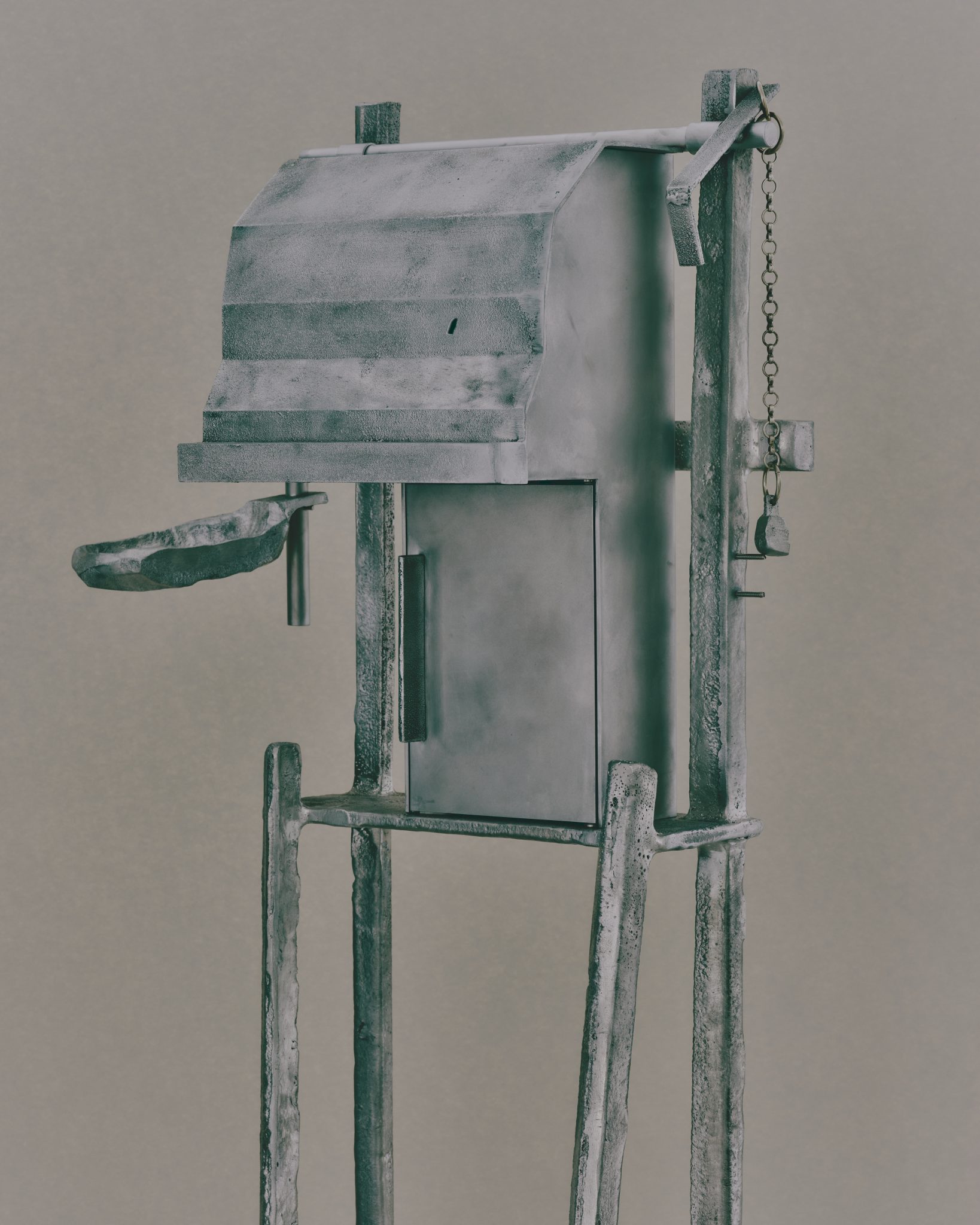
Annie Paxton’s submission for the 2025 Rigg Design Prize. Photo: Pier Carthew.
Paxton’s practice is grounded in what she recognises as “the reciprocal nature of experience”, namely the process of constructing the spaces that construct us. “It’s a bit of a romantic state of mind that is fundamentally tethered to an understanding of objects and spaces as charged conduits of a sort of ‘psychological life’, to quote [French philosopher Gaston] Bachelard,” she explains.
At the heart of her creative process are numerous vital questions, pertaining to the act of holding onto memory and the presentation – or obscuring – of the possessions within our private lives. The answer, Paxton feels, stems from the way that we hold onto the formative experiences in our own personal history.

2025 Rigg Design Prize finalist and 30UNDER30 alumn Annie Paxton. Photo: Bianca Wesson.
“[These possessions] signal the art of collection that is an inherently active process of assemblage and association,” she says. Questioning how we place value, and what we place it on, they ask us to exhibit our own ritual – our own patterns of collecting.”
On a material basis, Paxton identifies references to modernist designers Eileen Gray and Pierre Chareau, with the masques she has created relayering various textures and ‘folds of time’ across their intricate armatures.
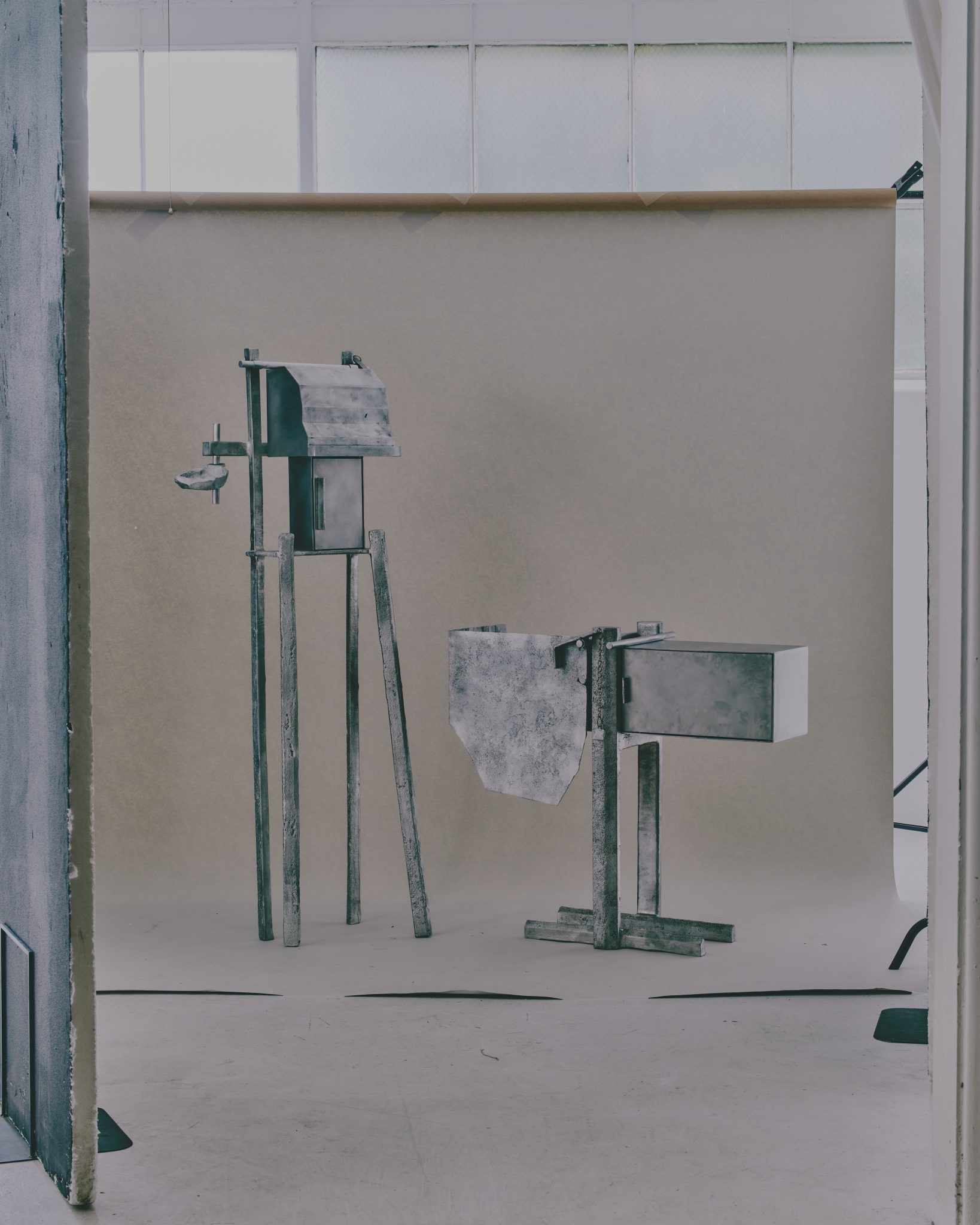
The structure occupies two distinct forms. Photo: Pier Carthew.
The planar aluminium and cast aluminium that comprise her final design are seamed with obscured veils and hinged panels. “They articulate, adapt and re-form,” she says. “Both structure and skin are assembled, stitched, cast, poured – a series of metal crafting processes, sewn together in a choreography of parts.”
Investigating the place of memory within structural forms
Dalton Stewart’s design submission, titled Basalt Shelf: Cadavre Exquis, informs an ongoing project that he began a couple of years ago. The work serves as “an interrogation of the natural, cultural and built legacy of Baal and Bluestone in Melbourne,” he says, as well as “ its geological significance in the city’s history. But also as this idea of an artefact that has cultural memory and significance.”
The repetitive structural elements of Stewart’s submission serve his central investigation of how design can constitute a vessel for cultural memory. In particular, he wanted to examine how materials can possess this emotional and artistic value outside of a purely building-rooted context.
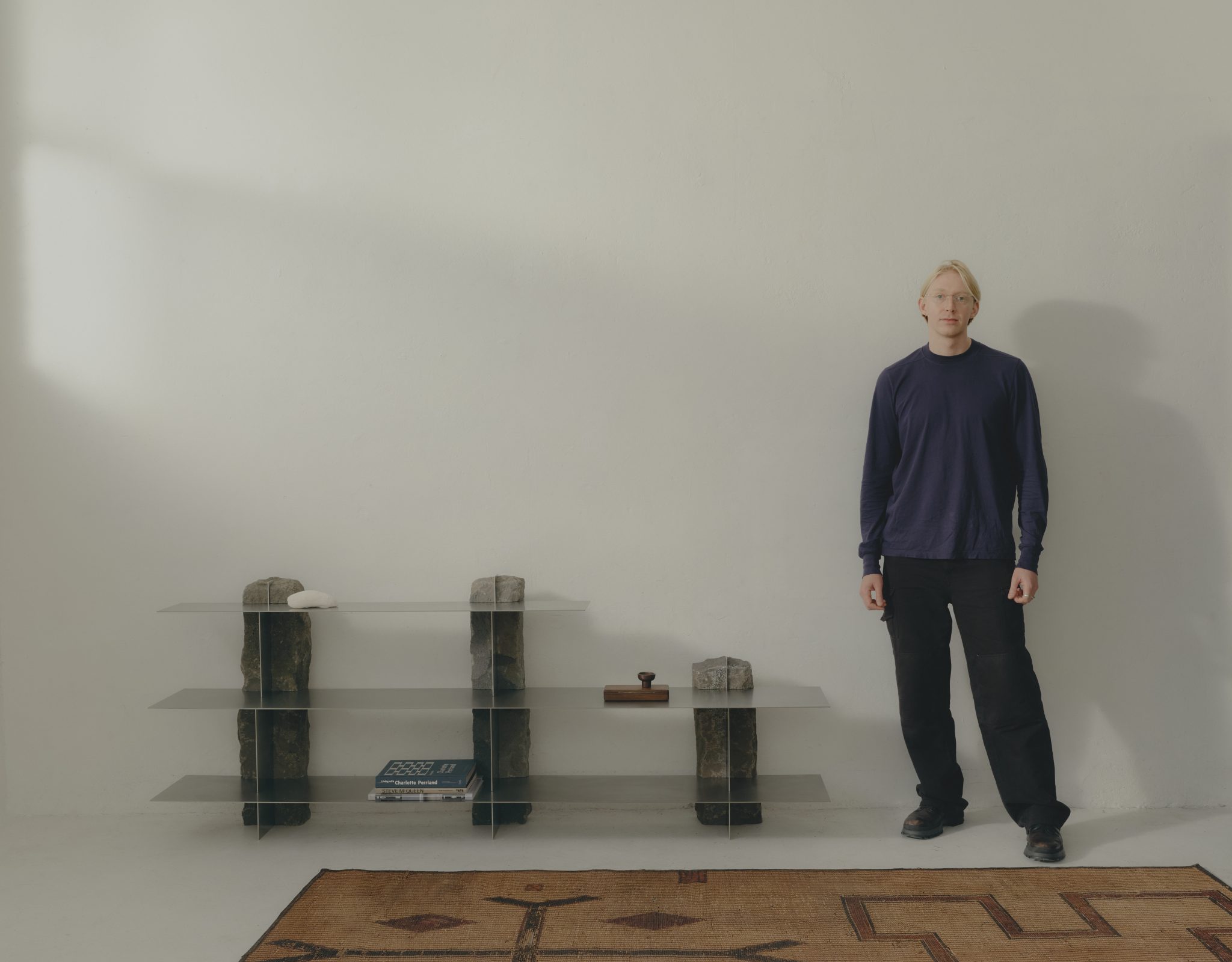
Dalton Stewart beside his submission for the 2025 Rigg Design Prize. Photo: Pier Carthew.
“Instead,” Stewart suggests, “these materials relate to a new framing as domestic objects, not significant places. But it also talks about architecture as an endurance, or crystallising a kind of collective memory of a place.”
The fusion of stone and metal was a conscious choice for Stewart to resonate within a dialogue between the natural world and man-made structures. Beyond that, he has been inspired by the experimental shelves of Charlotte Perriand, which translated and abstracted Japanese architecture.
“They offer me a precedent to think about how architecture could be translated into domestic objects,” Stewart explains. “Another element of my work is that it’s a processing practice, which influences the kind of methodology for manufacturing. So, in this project, the fabrication constraints – for example, dry joinery and the thickness of the mill saw blade – then determine the thickness of the metal. That becomes generative in how form is thought about and iterated.”
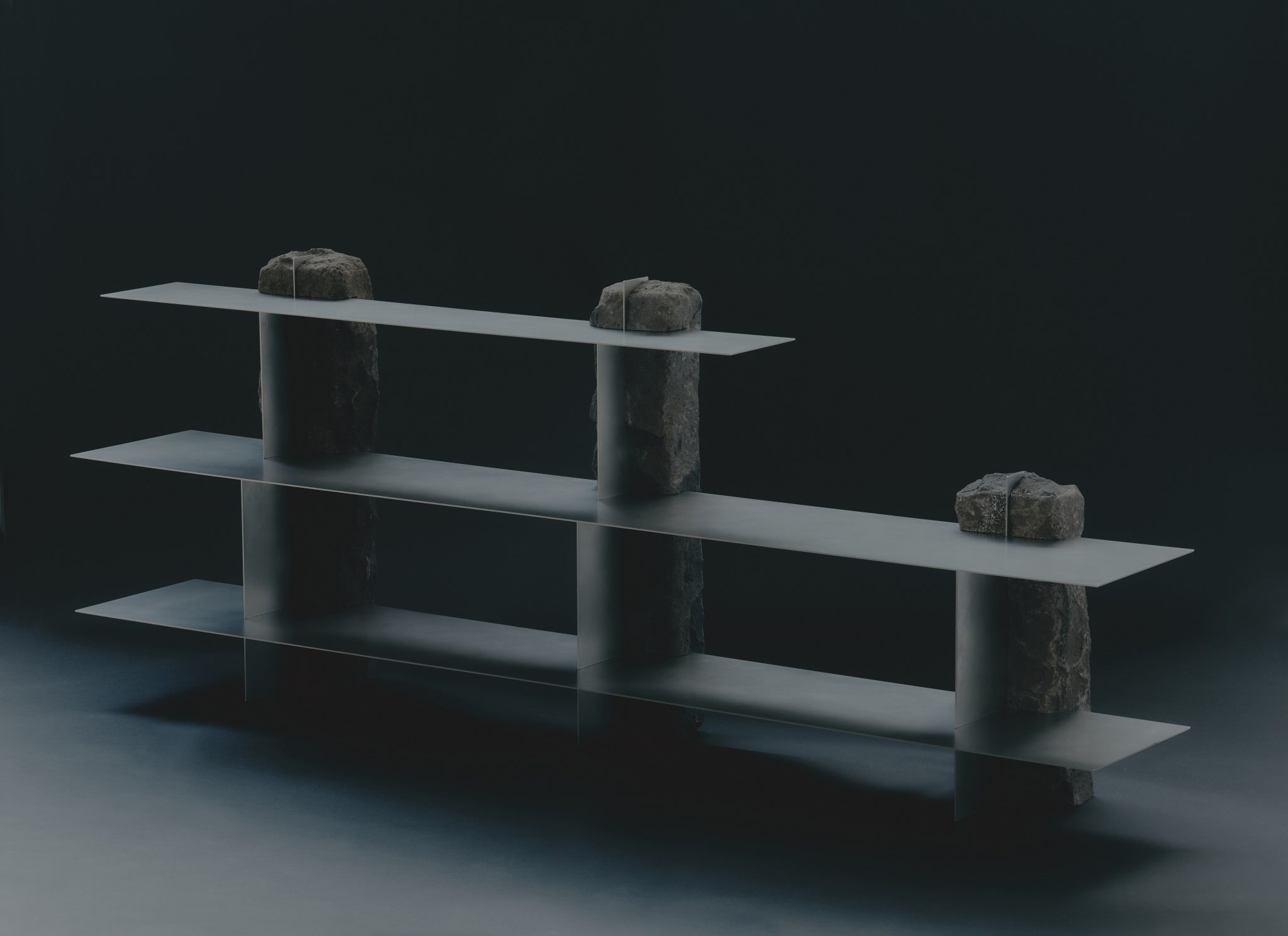
Dalton Stewart’s 2025 Rigg Design Prize submission Basalt Shelf: Cadavre Exquis. Photo: Pier Carthew.
Reflecting on his experience of being a finalist at this year’s award, Stewart says that having his work presented “is a pretty amazing opportunity, in terms of the award’s historical context”.
He adds, “I feel really honoured for my work to be positioned alongside so many other great designers, who I’ve looked up to for years through the Rigg Design Prize.”
Intricate interplays of land and sea
Based in Illawarra, New South Wales, design duo Nicola Charlesworth and Kim Stanek established their practice Object Density in 2019. They also took home the competitive Object, Furniture and Lighting – Rising award at the 2024 Interior Design Excellence Awards (IDEA).
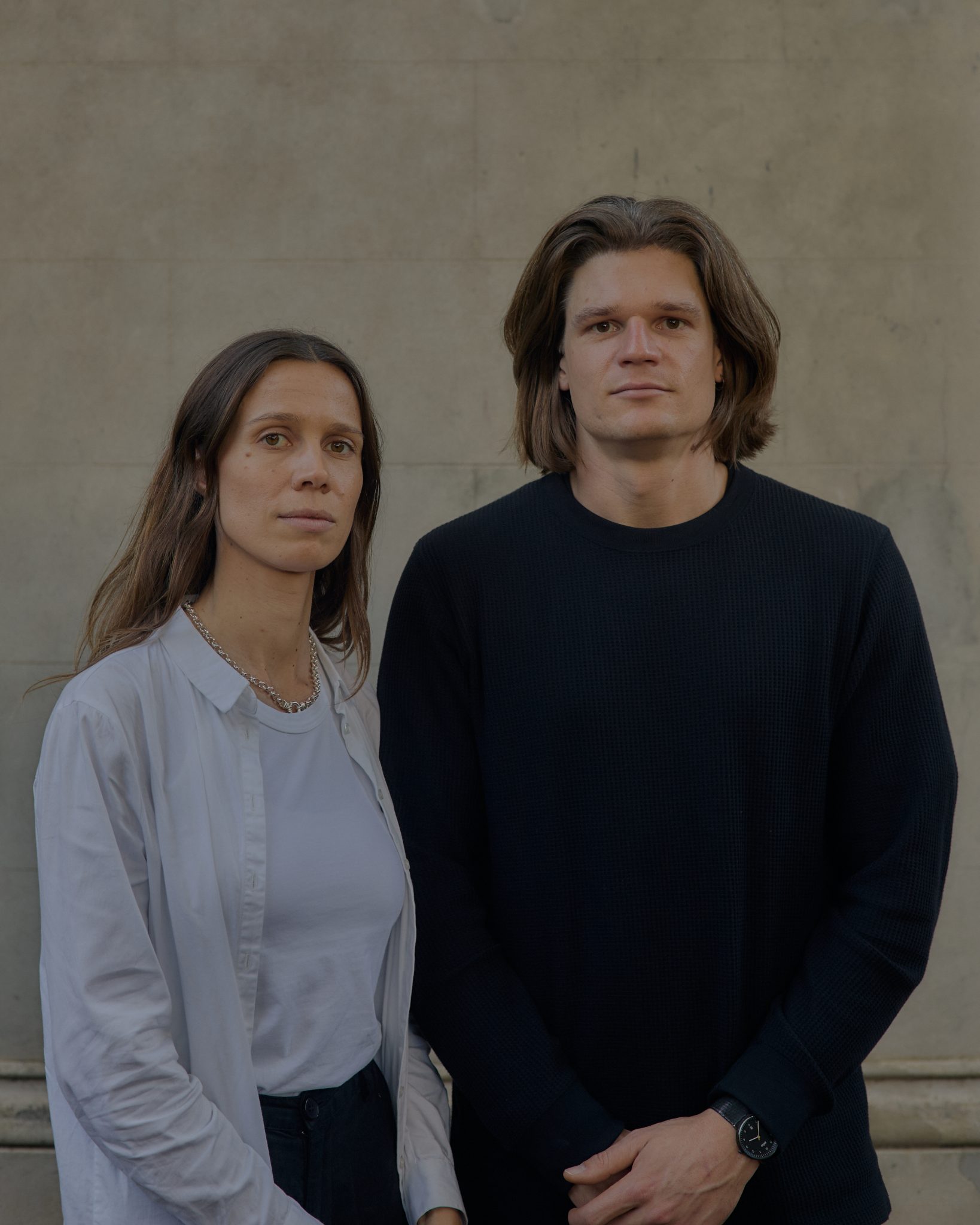
Design duo Nicola Charlesworth and Kim Stanek of studio Object Density. Image supplied by National Gallery of Victoria.
A credenza titled Salt, the pair’s submission for this year’s Rigg Prize, explores the relationship between an Australian sense of place and texture in relation to the Greater Sydney coastline. Indeed, these themes of identity and materiality are commonly explored in their practice, yet Salt stands as a unique piece within their body of work.
“Being so tied to the places we grew up and continue to cherish, this credenza speaks to both individual and collective identities: our coastline as an ‘aquatic common’, a place of shifting boundaries and shared experience,” the pair say.
The bespoke form and intricate detailing of the duo’s final design piece was inspired by the dynamic erosion patterns of the Hawkesbury sandstone and native eucalypts, informing a compelling study of the interplay between land and sea.
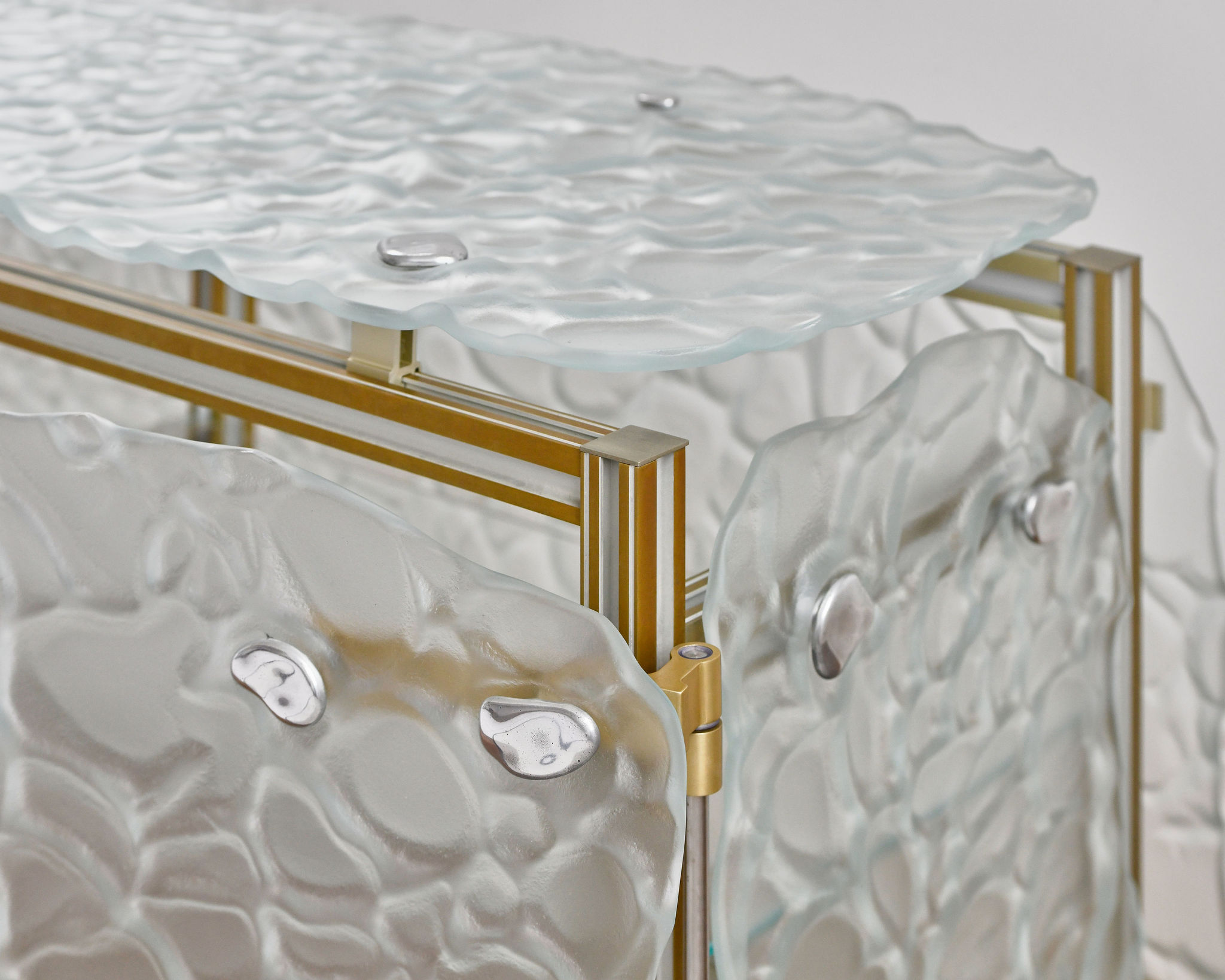
Object Density’s submission for the 2025 Rig Design Prize, Salt. Photo: Kyle Ford.
The piece’s surface exterior is constructed of slump-formed glass, a technique achieved by photographing and digitally translating sandstone patterns, and then kiln-firing flat glass to adopt those textures.
“Inside is an aluminium frame that has been anodised and coloured with natural dyes made from the leaves and bark of three local species,” Charlesworth and Stanek say. “Custom cast aluminium ‘puddles’ pin the glass to the frame, catching the light like water pools in tidal rock.”
The pair say their excitement to be among this year’s finalists was hard to contain, and they have much to look forward to ahead of the final winner announcements.
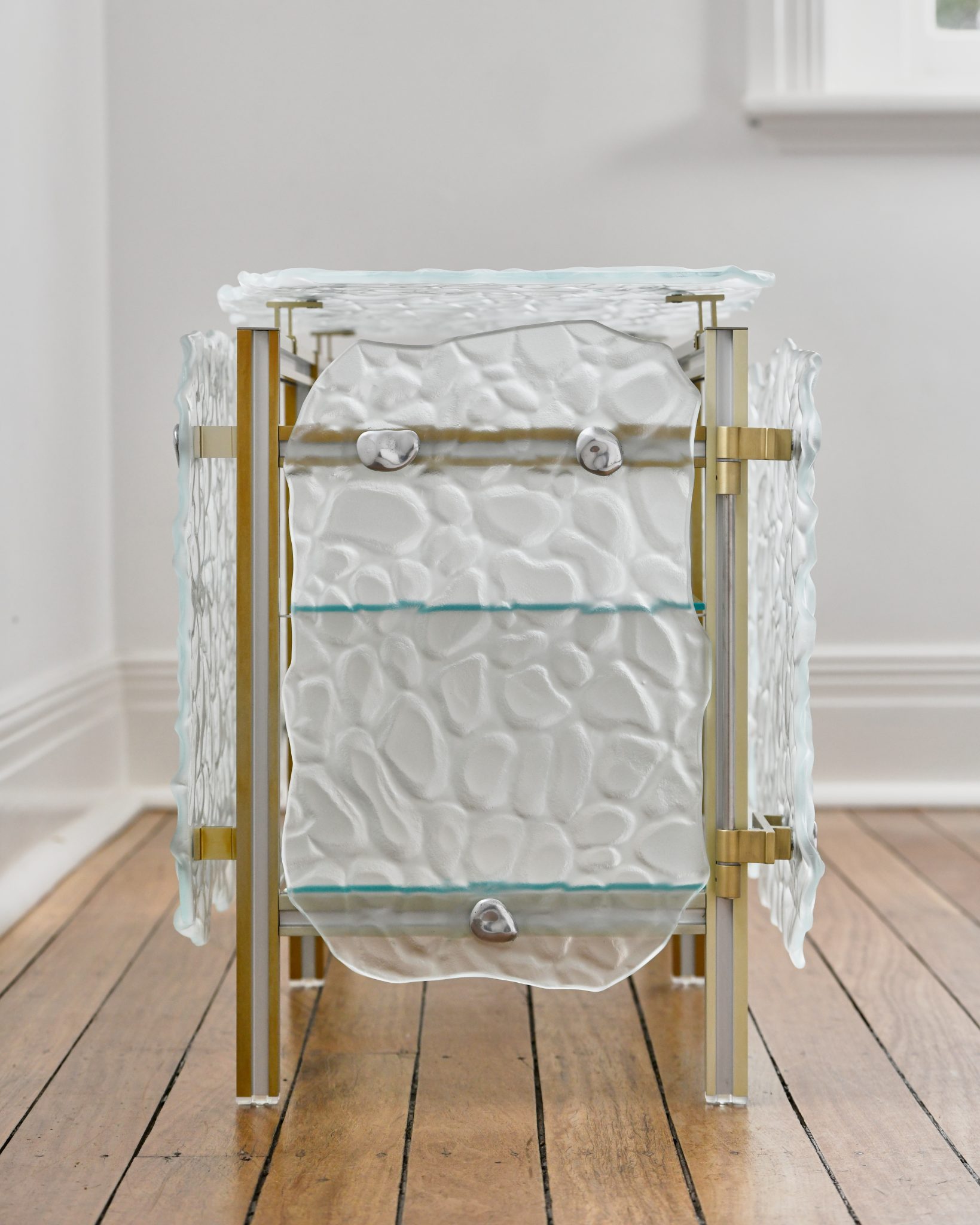
Object Density’s submission for the 2025 Rig Design Prize, Salt. Photo: Kyle Ford.
“It was such a surprise and honour to have received the invitation, and we still can’t really believe it’s all happening this week,” Charlesworth and Stanek say. “This credenza was an ambitious piece to make and we are truly proud of the end result, so to have this exhibited in a location such as the NGV is somewhat mind-boggling.”
The designers recognise the huge range of practices and personal styles represented in this year’s line-up, leaving them with little insight as to who will be taking home the top prize. All they hope is that the winning piece is one that champions homegrown design excellence, ‘a work that shows innovation in material use, concept and execution’.
Lead image: Salt by Object Density. Photo: Kyle Ford.
You Might also Like



Related Stories

© Niche Media 2026