

Finding humanity: how architecture firms earn authority in the age of AI
Finding humanity: how architecture firms earn authority in the age of AI

Share
With AI reshaping almost every aspect of our world, we are in a moment of tension between the way we have always done things and how we live and work moving forward. Those of us leading marketing, bids and growth are not immune from this shift.
For the first instalment of Australian Design Review‘s new thought leadership series, The Podium, Peta Michaelides, associate principal and senior BD and marketing manager at Skidmore, Owings & Merrill (SOM), outlines how architecture firms can hold on to their own voice in a sea of AI-generated content.
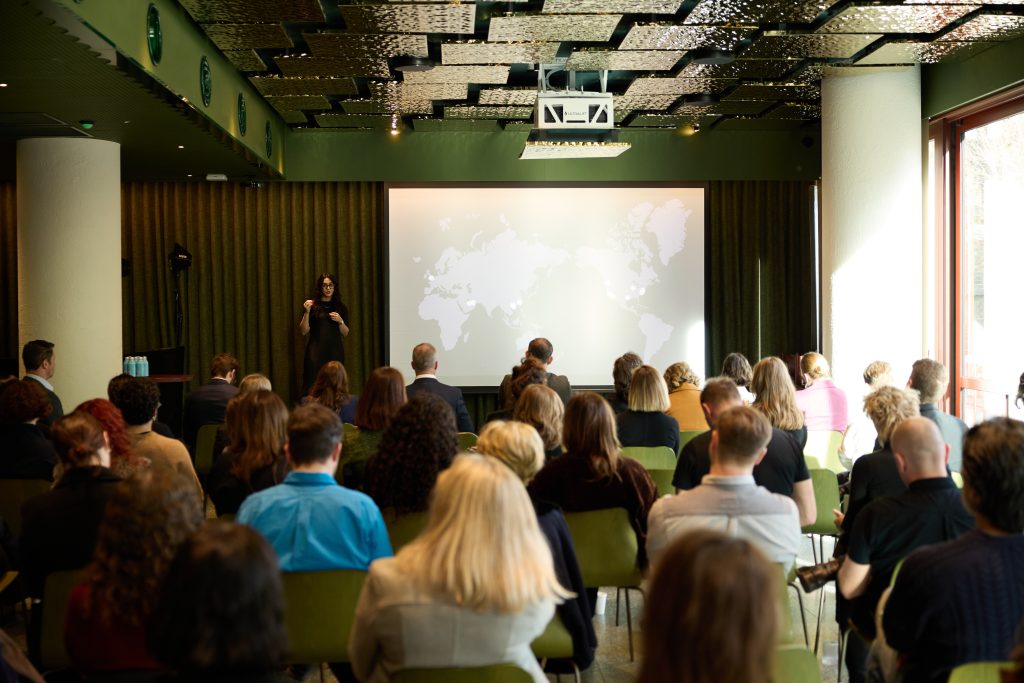
At a recent special event presented by OpenAsset – a digital asset and proposal management platform for architecture, engineering and construction firms – in Melbourne, I spoke on this topic alongside leading voices in the built environment from ARM Architecture, Architectus and OpenAsset, joined by a community ambassador for the Claude partner and consultancy, FutureDeployed.
Our industry has always been fast-paced; the days of delivering a proposal in a physical box are long behind us, and AI has only supercharged that evolution. But it has also created a new problem. Producing content for RFPs (requests for proposals), bids and proposals is easier than ever. We’re now wading through a sea of AI-generated material that reads beautifully, but says nothing distinctive. When everyone is speaking the language, how do you make your firm stand out?
The answer that is coming to the forefront is human connection. The real question clients are asking isn’t which firm has the best renders or deck – it’s who will I be working with for the next three, five or 10 years? Success comes down to being able to engage on a human level.
There is now a general expectation that AI-generated content will be part of any submission and, as a result, clients are becoming more discerning, and submission briefs are changing. Increasingly, clients are now saying: don’t just design for me. Let’s generate ideas together. Let’s brainstorm, let’s workshop, and see how we work together as individuals and as humans. It’s not just a design competition anymore, but also a thinking competition.
What clients are really asking for is to be part of the process. Something architects take for granted is how rare it is to get a genuine peek behind the curtain of the design process – and that’s exactly what clients are drawn to. Feeling like they’re contributing partners in the room for the brainstorm moments matters more to them than a flawlessly finished presentation deck. From a pitch perspective, that changes our win strategy to focus less on the polished output, and more on visible thinking that gets you there.
The best ideas are still human ideas. We use LLMs (large language models) to interrogate these ideas, to question every assumption we’re making, to pose critical questions about our pitch, find the client’s pain points and pressure-test the strategy. Used this way, AI doesn’t do the thinking for us – it strengthens our human thinking.
A greater challenge is arising even before the pitch. Increasingly, clients are using AI to shortlist firms before they’ve even issued an EOI. AI is determining which practices get approached in the first place. This means the digital front doors your team has spent years finessing (websites, capability statements, social channels) are being bypassed before a human ever clicks through.
We don’t need to abandon these assets – the ways we have traditionally marketed ourselves are still, and continue to be, effective – but we can sharpen them with more detailed, human stories and proof points in order to stand out. That doesn’t have to mean numbers and statistics, though those matter too. It’s the story behind how a project earned a 5-star Green Star rating, what the material and cost savings actually looked like to achieve it, or the methodology that solved a specific site problem. It’s naming the departments and stakeholders who worked on a project, because those relationships are proof points in themselves. This way we give AI more of the specific, human material it needs to point clients back in our direction.
AI tools are making it easier to surface that history quickly, clearing the administrative and mundane work out of the way and helping your team more easily access the enormous amount of material generated every day at your firm, including past projects, past pitches, past client relationships. Historically, a huge amount of that knowledge has lived in people’s heads or buried in old files rather than being easy to find.
With the right tools we can get to the start line quicker, understand the context of a project, and find the people who worked on it, so you can go and talk to them. Leveraging efficiencies gained through the use of AI frees up time to get back to building relationships, connections and generating great ideas, which is the part of the job that was never going to be automated in the first place.
I don’t want AI to do my thinking for me, and I don’t think our clients want that either. AI will keep getting better at producing flawless proposals – but the firms that earn authority won’t be the ones with a perfectly average AI generated pitch. They’ll be the ones who use every tool available to make their thinking sharper and unmistakably human. If you lead marketing, bids or growth at your firm, that’s a pitch worth making.
The Podium is ADR’s op-ed and thought leadership series providing a platform for some of Australia’s leading designers and built environment professionals to share their views on the topics that matter to the A+D sector. If you’d like to submit an article, reach out to us at ausdesignreview@niche.com.au with the subject line ‘The Podium’.
You Might also Like



Related Stories

© Niche Media 2026