

Can there be sustainable data centre design?
Can there be sustainable data centre design?

Share
In this article for Australian Design Review‘s opinion series, The Podium, managing director of Kingspan Insulated Panels Jonathan Wormwell unpacks the possibilities and challenges of data centre design.
In December 2025 the Australian Government published its national AI plan, which seeks to capitalise on this booming technology to benefit the economy, while safeguarding the population. A significant part of the strategy involves the construction of more data centres, both to support the growth in AI and to maintain data sovereignty.
However, concerns about the potential drain on precious resources such as water and energy, and the potential impact on local communities of these developments, has led to the Government also publishing five ‘expectations’ which, while falling short of being mandatory for now, do affect whether or not companies will have the social licence to operate in Australia.
Data centre design must evolve to take these expectations into consideration, allowing sustainable growth and supporting long-term resilience. This article explores how some aspects of that ambition may be achieved, and the crucial role that designers will have in securing an AI-ready future, starting with thoughtful building envelope design.

What are the expectations?
The expectations are intended to ensure that the huge amount of investment in data centre development results in digital infrastructure that supports the economy and local communities while minimising environmental impact – in other words, that it is conducted in a sustainable manner.
The first expectation is about prioritising Australia’s national interest. Enabling these buildings to be created supports Australia’s ability to maintain data sovereignty and protect national security. Having the right building design can help to secure priority regulatory assessments and fast-track projects. Aspects such as durability, resilience and fire performance all have a role to play in protecting the data that is held within each building, so the design and specification considerations should include product and material performance characteristics beyond the general regulatory requirements for other types of ‘big shed’ construction.
Expectation two is that these developments should support Australia’s energy transition. The amount of operational energy required to run these facilities is a major concern and could seriously impact Australia’s ability to meet its legally binding target to cut carbon emissions to 43 percent below 2005 levels by 2030, and to achieve net zero emissions by 2050. On-site renewable energy generation and the use of low-carbon technologies can help to mitigate this, but this will work best by taking a ‘fabric first’ approach and having a thermally efficient and airtight building envelope. This makes it easier to control the internal environment, so that cooling or heating measures are more effective. This reduces overall energy demand and allows remaining demand to be met more readily through renewable technologies – an essential aspect following the Government’s announcement in July 2026 that large-scale data centres would be required to meet their own energy needs and become ‘net-generators’ rather than ‘net-users’.
Third, an expectation has been laid that there will be sustainable and efficient water usage. This is another grave concern for many communities, where water is a scarce and precious resource, since data centres can pull significant quantities of local supply to help cool servers. Responsible data centre providers are already exploring alternative methods, such as ‘direct to chip’ liquid cooling, where a closed-loop system is used to circulate the same liquid. While the cooling methodology chosen may not fall under the remit of the building designer, there are still many aspects that can be brought in to help reduce demand on potable water, such as rainwater harvesting tanks, and greywater recycling for flushing toilet facilities.
The fourth and fifth expectations are to support investment in Australian skills and workforce, together with research, innovation and local capability. One way to bring this into the design stage is through the specification of locally made products where possible, which also helps to support the economy and reduce the embodied carbon footprint of the project by avoiding the impact of overseas imports. Another is to embrace modern methods of construction, which can help to build skilled teams and speed the construction process.

Design opportunities
Using locally manufactured modular, prefabricated systems can minimise both waste and embodied energy, while creating well-insulated and airtight buildings that help to reduce operational energy demand and facilitate the use of renewable technologies. The fast-track construction method allows buildings to be up and running more quickly, freeing up teams to move on to the next project. A modular approach also more easily enables expansion of existing facilities as well as the construction of new ones.
Other key considerations include fire performance to reduce the threat of both internal and external fire spread, as well as acoustic mitigation – a particularly important aspect for urban areas, as noise from these buildings can be a serious nuisance.
As well as providing all of these essential performance characteristics, systems such as insulated panels can offer a wide range of aesthetic possibilities, from providing substrates for façades to different colours and panel profiles.
Finally, designing in capacity for rainwater harvesting or greywater recycling can help to reduce the load on local supplies.
Can Australia lead the world in sustainable data centre design?
The boom in data centre construction represents both an opportunity and a threat. Properly designed and constructed, these buildings could become some of Australia’s best assets, bringing Australia front and centre on the world stage in the drive for digital evolution. The challenge is to ensure that poor design and irresponsible use of resources is not permitted. Fortunately, there are proven solutions already on the market that can help designers to meet the expectations laid out by the Government and demonstrate that data centre design and sustainability can indeed go hand in hand.
Jonathan Wormwell is the managing director of Kingspan Insulated Panels in Australia. He brings over 25 years’ experience in the built environment.
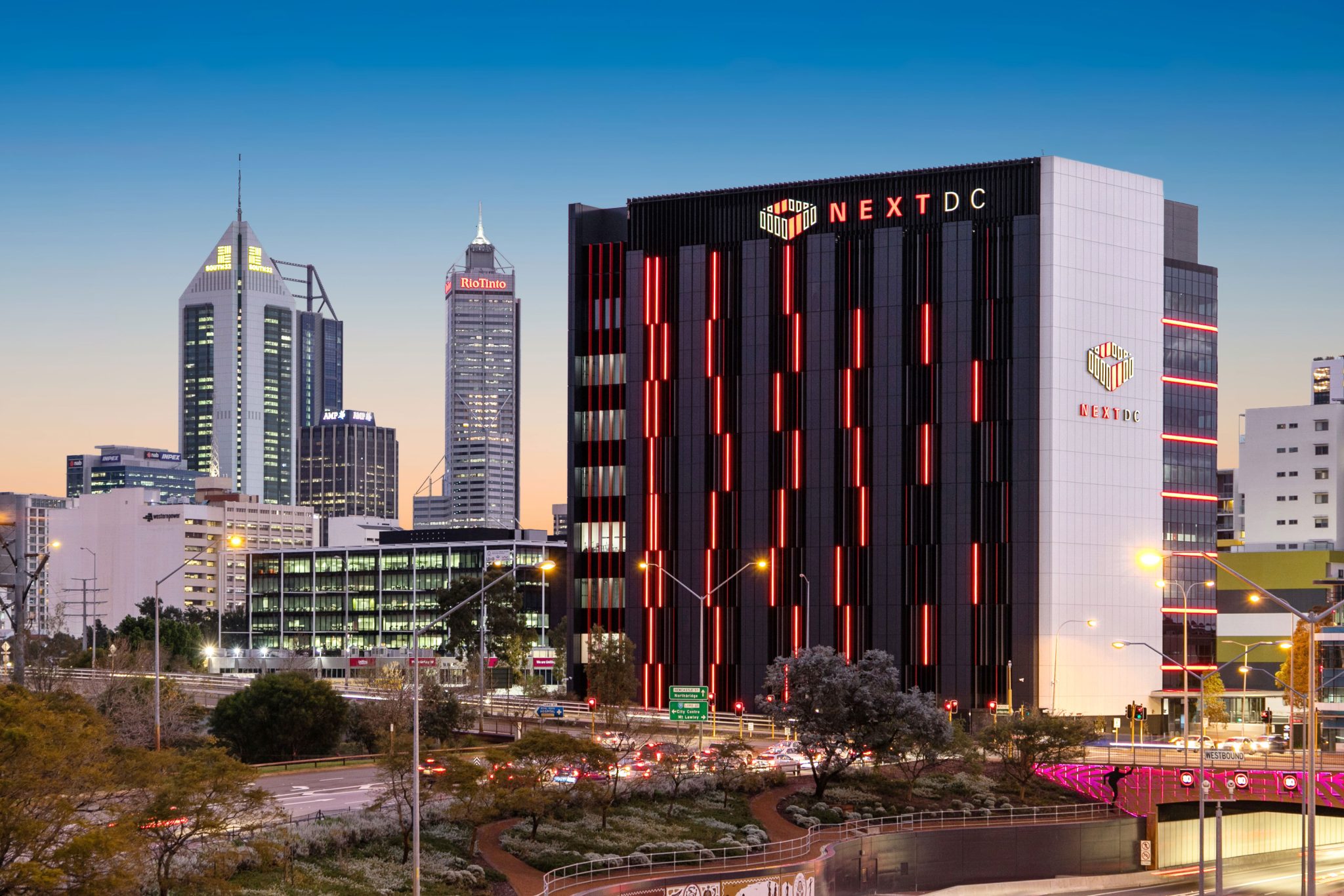
Top image: NEXTDC P2 data centre in Perth.
Images: Supplied.
The Podium is ADR’s op-ed and thought leadership series providing a platform for some of Australia’s leading designers and built environment professionals to share their views on the topics that matter to the A+D sector. If you’d like to submit an article, reach out to us at ausdesignreview@niche.com.au with the subject line ‘The Podium’.

© Niche Media 2026