

GHD’s dynamic post-COVID refurbishment
GHD’s dynamic post-COVID refurbishment

Share

Spearheaded by GHD design leader Joshua Rhodes, the Sydney-based architecture firm reimagined the eighth floor workspace of its bustling Brisbane office as a centre for collaboration and connection.
Nestled in a tight meander of the winding Brisbane River, with clear views of City Hall and the surrounding central business district, the Queensland headquarters of engineering and infrastructure specialist GHD has undergone an ambitious remodel.
Envisioning a prototype for the firm’s research into the future of post-COVID workplaces, design leader Joshua Rhodes sought to facilitate a flexible corporate environment that replaces traditional meeting rooms and accommodates organic intermingling.
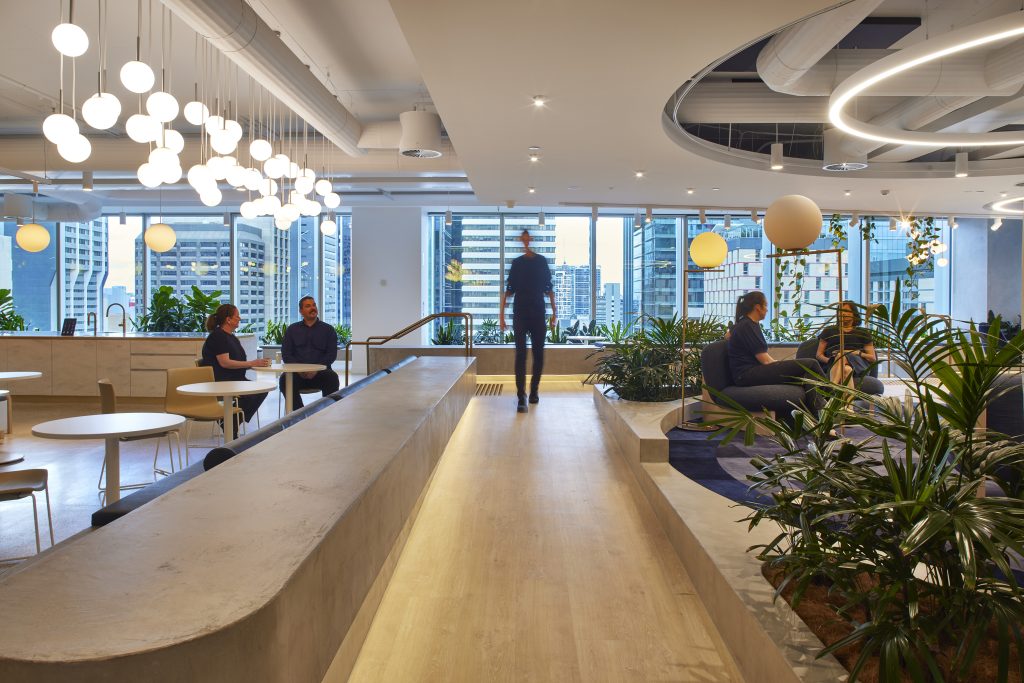
Centred on three interconnected zones – the Social Hub, Collaborative Lounge and Innovation Lab – the new refurb of the eighth storey office harmoniously fuses muted tones and a freeflow floor plan to encourage spontaneous moments of connection and conversation.
With material selections motivated by functional need as much as their adaptable qualities, the refurbishment involved repurposing existing furniture from earlier interior fitouts, in keeping with the firm’s vital sustainability principles.
The newly remodelled office space houses 700 staff members, serving as a thriving internal hub, as well as a design showcase for clients to observe GHD’s vital engagement with technology, green building practices and human-centric interior spaces.
Where architecture meets engineering
Covering a broad base of commercial sectors, GHD’s clientele spans everything from health to transport, as well as notable partnerships within the education sector. As an A+E (architecture and engineering) provider, the firm has many specialisations, which Rhodes says feeds into the GHD creative philosophy.
“Architecture with engineering opens up a lot of different avenues that you wouldn’t necessarily think of as architecture projects until you really get into it,” he says. “But we also do defence as one of our core things, with little sectors all around Australia and internationally as well.”
Rhodes reveals a recent project was the innovative vertiports at Dubai International Airport, a first-of-its-kind aerial taxi network in the United Arab Emirates. These groundbreaking, highly varied collaborations, Rhodes asserts, “give a really interesting breadth across GHD design”.
This highly attuned degree of adaptability placed the firm in good stead when it came to redesigning its own office. The self-imposed creative brief was to create a space that met the flexible needs of a post-COVID hybrid working model, catering for what Rhodes specifies as “a meaningful space for collaboration and connection within our offices”.
Internal findings within GHD concluded that while many employees adapted to the technological demands of remote work, the interpersonal qualities of a bustling on-site environment were lost along the way.
The solution, Rhodes found, was to provide staff members with different settings and distinct work modes, in order to reinvigorate the microcosm of engineers and multidisciplinary designers housed within the Brisbane office.
“So we needed a space that allowed us to actually meet the physical world,” Rhodes asserts, “and start to work together again in a meaningful way. We had smaller meeting rooms and large conference rooms – obviously, the typical kind of floorplates – but we didn’t have a space that was purposely designed and technologically enabled, post-COVID, to bring everybody together.”
Built around a two-year study into the future of working environments, led by GHD’s national practice leader Leone Lorrimer, the level eight redesign operated as a case study for how the study’s key learnings will be implemented into larger-scale external projects.
The total timeline for the build, from demolition to completion, was six months – with an added prior six months for Lorrimer’s research workshops, in order to establish the core need: “to get everyone back in connection and in contact with each other,” as Rhodes says.
“To start working together in a more meaningful way, especially in an A+E. That’s incredibly important; it is absolutely all about collaboration.”
Spaces that operate independently, but from a creative whole
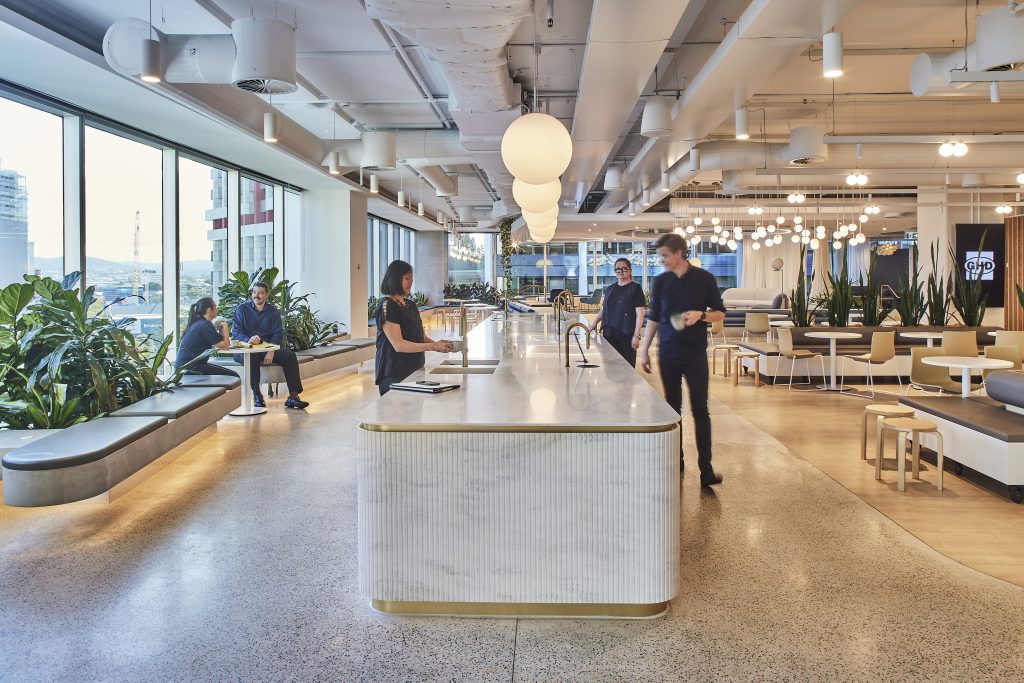
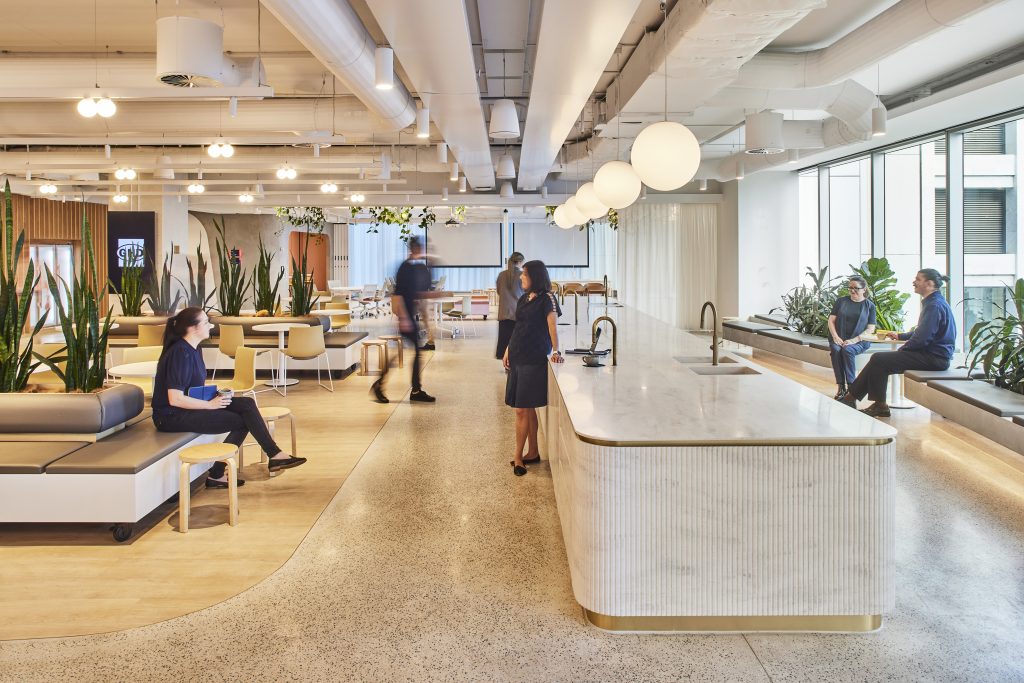
In choosing the materials and surfaces for the interior redesign, close attention was paid to the newly oriented function of the floorspace. Now separated into three zones, the office housed a café like Social Hub, a shared workspace in the Collaborative Lounge and a tech-driven Innovation Lab.
While all of the spaces served slightly different needs, and were able to operate independently of one another, they needed to be visually connected with recognisable aesthetic elements. Much of the furniture was therefore custom-made to suit the space, creating a heightened degree of flexibility and motion across the floorplan, allowing the setting to be adjusted and relocated with minimal disruption.
Speaking of the Social Hub, which is the first core element of the space upon entry, “You’ve got the island in the middle, which is for everyone to get around and have conversations in that kind of kitchen setting,” Rhodes says. “It’s a big collaborative piece with two coffee machines that are integrated into that bench. People go down there, have a chat and stand around this massive island. It’s a lot more collaborative than just having a kitchenette off to the side.”
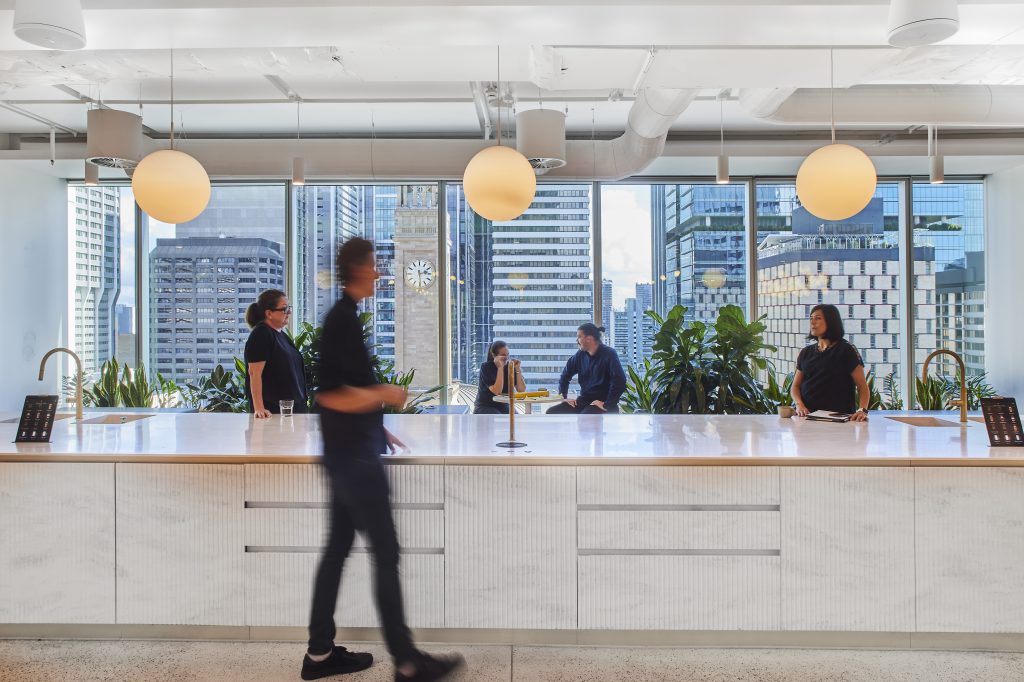
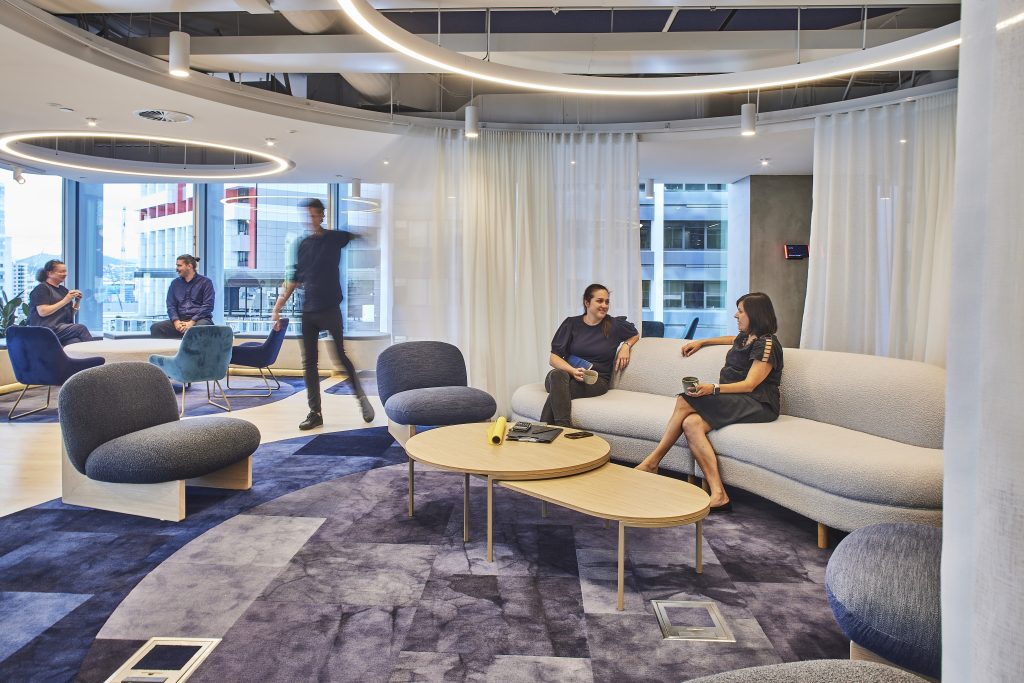
The attractive café atmosphere of this initial arena serves as the interior’s command hub, the pivot point around which colleagues gather to share insights and ideas. The collaborative nature of the space is enhanced by its flexibility, as the Social Hub subsequently opens into the Collaborative Lounge, a large pink-hued space at the opposite end of the interior. Connecting these two ends within a unifying centre is the technology-led Innovation Lab, which can be closed off with a curtain to create its own defined space.
As Rhodes says of the soft barriers between these partially fluid spaces, “The idea is that you understand there is something going on. It’s not about closing it off and putting it behind closed doors, but [rather], ‘Oh, there is something going on over there’.”
The selection of tones and hues returned to the original guiding research, creating a space that responded to the functional needs of an office designed from its inception to bring creatives and engineers alike together in the most organic way possible.
As Rhodes surmises, “The aesthetic – I don’t like to use the word aesthetic, it’s all function – was really built around defining space and being purposely responsive to the core function within each of those spaces. It was about creating natural tones and a more muted palette that was calm and not so black-and-white in the way that it sits within the space.”
The final form of GHD’s Brisbane office surely satisfies this brief, with its freeflow divisions between research and relaxation playfully removing floorplan barriers just as much as it defies the conventions of corporate interior design.
Photography by Tyrone Branigan.
Related: Read about Searle x Waldron’s IDEA-winning workplace project.

© Niche Media 2026