

The glazing detail quietly driving carbon in commercial fitouts
The glazing detail quietly driving carbon in commercial fitouts

Share
A single specification change is all it takes to make a significant carbon saving, and Crafted Hardwoods is proving that timber glazing systems are ready for prime time.
There’s a point in a project where the easy wins are done and the conversation turns to what really adds up. That was exactly the position Crafted Hardwoods found themselves in around 12 months ago, sitting with a highly engaged in-house design team working toward ambitious sustainability outcomes. There was a real sense of momentum in the room, and a willingness to push beyond the expected.
“That team wasn’t just ticking boxes,” recalls founder Geoff Swinbourne. “They were actively looking for where they could go further.”
The project had already specified Crafted Hardwoods for linings, desks and joinery. And it wasn’t long before the conversation moved to an element so standard it’s rarely discussed: the glazing frames. Could they be timber?
Glazing frames were not something Crafted Hardwoods had explored before, but it was a natural extension of the same thinking. If timber was being used as a sustainable, low-carbon material in one part of the space, why not extend its benefits, particularly in an application where it could have outsized impact?
“We didn’t hesitate,” says Swinbourne. “If there’s a good reason to explore something, we’ll lean into it right away. That’s just how we work.”
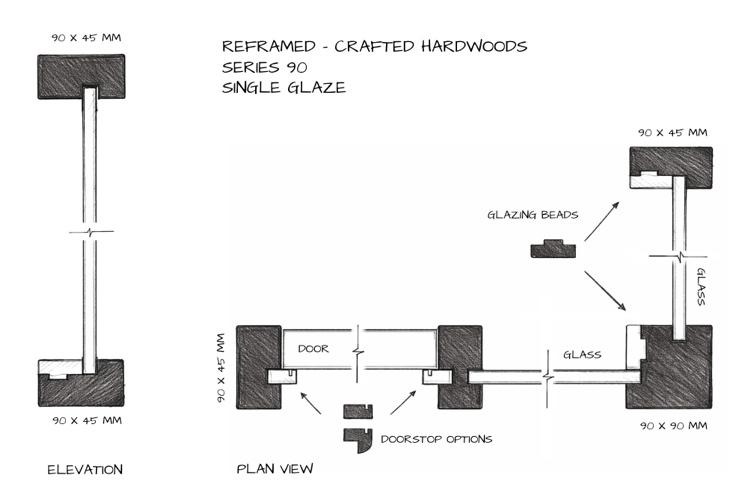
That brief led to the development of ReFramed, a modular timber glazing system specifically designed for internal offices and partitions. It has since become the default framing system for the client’s branch rollout and is now ready to be specified across a wide range of commercial fitouts.
What took timber so long?
Timber is one of the most valued materials in commercial interiors, often central to how a space is experienced. Yet even where it is confidently specified, it tends to remain within a familiar set of applications. So why has it rarely extended to something as ubiquitous as glazing frames?
Resistance to timber in partition framing has typically centred on a few familiar concerns: price, movement, inconsistency and the perception that maintenance is complex and disruptive. Today, many of those concerns have been addressed through advances in engineered timber.
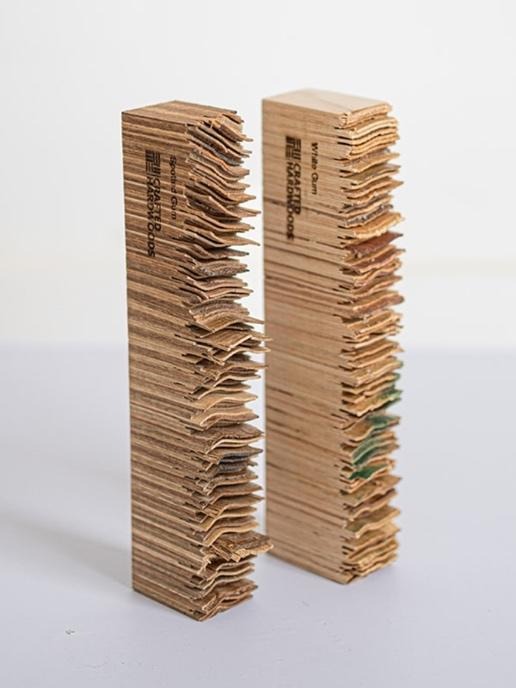
In systems such as those developed by Crafted Hardwoods, the material itself has been fundamentally rethought. Because the timber is produced through a process of rotary peeling and reassembly into large billets, the natural tendency of solid timber to twist is significantly reduced. The cellular memory of the log, which causes traditional timber to move under stress, simply has no place to express itself in this engineered form. “In solid timber, the log still wants to behave like a tree,” says Swinbourne. “Once you break that structure down and rebuild it, that behaviour largely disappears.”
Timber still moves, but in engineered products, that movement is minimal and predictable. And as the material has evolved, so too have the coatings, making maintenance far less of a concern than many expect. “People often assume timber is hard to maintain,” says Swinbourne. “But the coatings have come a long way. The one we use is VOC-free and cures instantly, which makes touch-ups and ongoing maintenance simple.”
But even as material performance improves, timber is still working against something else: a barrier defined by speed, cost and the systems already in place. Aluminium didn’t just perform well, it evolved into a fully systemised, widely understood solution, supported by established supply chains and installer familiarity. That’s what made it the default.
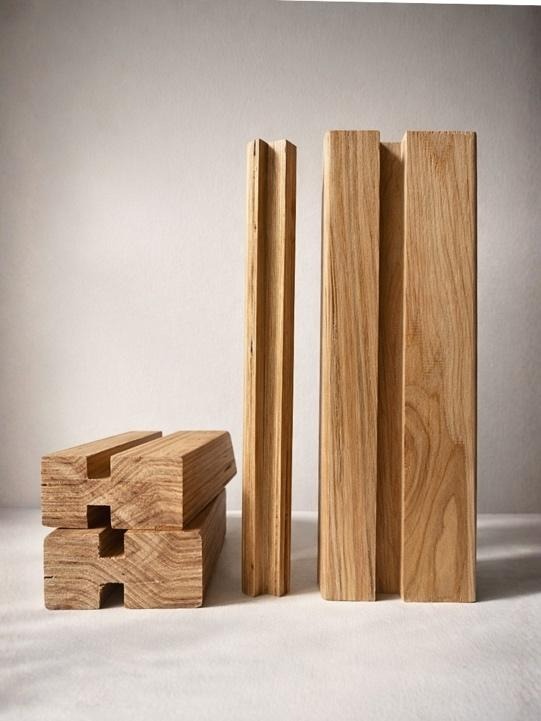
A kit of parts, not a joinery exercise
For Swinbourne, the commercial viability of ReFramed depended on one thing: it had to work within the same logic as aluminium. With labour costs representing one of the largest expenses in commercial fitout, a timber glazing system that demanded the precision and time of bespoke joinery would never gain traction.
“From the outset, we knew it had to feel familiar,” says Swinbourne. “We didn’t want the system to feel like joinery, it had to go together the way installers already expect.”
ReFramed follows the same principles as aluminium framing, with a modular approach that supports straightforward installation. The system is designed to integrate seamlessly into commercial partition layouts and is available in three profile series, 90, 105 and 150 millimetres, including options for double glazing.
Feedback from site has been strong, with installers responding positively to the change. Many have said they enjoy working with timber, describing it as a welcome shift from the usual materials, while the system itself remains familiar and easy to adopt.
The carbon case
For designers and clients working through embodied carbon calculations, ReFramed offers a clear opportunity to reduce embodied carbon through a relatively simple specification change. The glass stays the same and the dimensions remain comparable; it is the frame material that changes.
“It’s the kind of specification change that somebody could make at the 11th hour on a project and still achieve a meaningful impact on carbon calculations,” Swinbourne notes.
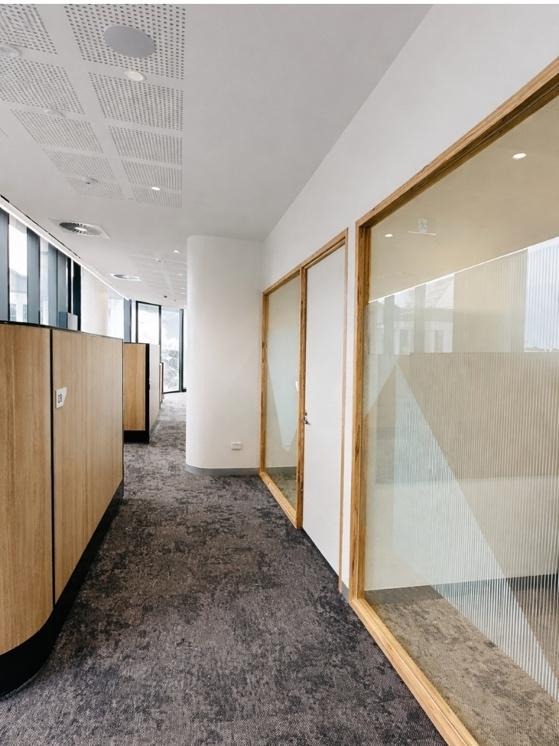
But perhaps the most compelling dimension of the ReFramed story is what happens at the end of a fit-out’s life. Crafted Hardwoods is developing a Timber Stewardship Program to recover framing at end of life and re-machine it into new products, retaining the material’s value across multiple use cycles.
“With the average commercial interior cycling through a refit every seven to ten years, we can’t afford to just be thinking about the first use,” says Swinbourne. “Profiles can be recovered and remade into new products, including dowels, handrails and battens, extending their life well beyond the original application and, in some cases, into products of even greater value.”
In a landscape where the design industry is under increasing pressure to address embodied carbon, ReFramed makes a compelling argument: that sustainability, circularity and commercial practicality are entirely compatible and that the answer may have been growing in our forests all along.
ReFramed is now ready to be specified across a wide range of commercial fitouts.
visit craftedhardwoods.com for more details.
Images supplied.
Read more on Crafted Hardwoods’ commitment to sustainable timber.
You Might also Like




Related Stories

© Niche Media 2026