

Designing the next chapter: an architect’s take on the evolving seniors living sector
Designing the next chapter: an architect’s take on the evolving seniors living sector

Share
With an oncoming seismic demographic shift, how can designers and developers deliver fit-for-purpose living solutions as we continue to collectively age?
In this article for The Podium, Australian Design Review‘s new thought leadership series, Brisbane-based FK principal and seniors living specialist Jessica Lee shares her views on the changing wants and needs of older Australians.
Increasing life expectancies and declining fertility rates are driving an ageing Australian population. According to the Australian Bureau of Statistics, more than 6.6 million Australians will be aged 65 by 2041, while older people are projected to make up between 21 percent and 23 percent of the total population by 2066.
Sector challenges and trends
Housing for older Australians already comes in many shapes and forms. From independent living units (ILU) to residential aged care (RAC) and over 50s lifestyle communities to assisted living apartments, ‘seniors living’ in all its guises responds to a wide spectrum of personal preferences, affordability parameters and care requirements.
What we’re seeing as a common thread linking these variations of housing products and support services is a growing focus on preventative measures – that is, accommodation solutions that help prevent cognitive decline, mobility issues or other ageing-related concerns. Seniors living design will need to increasingly consider how brain function, movement and independence can be supported as a preventative measure in relation to the mental and physical challenges often associated with ageing.

Redefining the forever home
What we’ve learned working with clients in the seniors living sector – and what we all perhaps intuitively understand – is that older people want to prolong their move into residential aged care. That makes designing someone’s final ‘forever home’ – to appropriately support their health and happiness into older age – a real responsibility.
Getting the forever home right starts with applying a design lens – as we would with any residential typology. The core principles of good design do not change, regardless of the end user or occupant; however, there are of course specific considerations for seniors living. A word of warning: avoid being drawn into ‘seniors stereotypes’ – in our experience, older Australians are becoming increasingly discerning and diverse and can’t be neatly placed into a ‘seniors customer’ box. But more on challenging assumptions later…
Grey nomad… housing?
What if housing for senior Australians was as mobile as the grey nomads traversing the country in their Winnebagos? It’s an interesting proposition that some developers, such as GemLife, are pioneering through seniors ‘land lease’ communities. The land lease concept – whereby a resident owns their home, but effectively leases the land on which it’s situated – isn’t new. But when paired with innovations such as GemLife’s patented modular multistorey construction methodology, which enables relocatable apartments within a permanent building structure, new possibilities for seniors living on constrained and infill sites emerge.
GemLife is already exploring vertical applications of its multistorey construction methodology on the Gold Coast. Under the model, the building structure and shared amenities remain permanent, while individual apartments are constructed in multiple, moveable modules. The overall façade can be disassembled too, allowing apartments to be removed in the same sequence in which they were installed.
The power of familiarity
While innovation and advancement are welcome in the sector, some things are better left unchanged. Customer research has shown that a sense of familiarity in housing design is deeply important to older Australians. Being able to enjoy a familiar context (for example, seniors living in the same neighbourhood as the previous family home) or well-loved design references (such as heritage design features) can greatly improve a resident’s sense of comfort and security. Familiarity can also be important for people with dementia, who tend to feel more settled in recognisable surroundings.
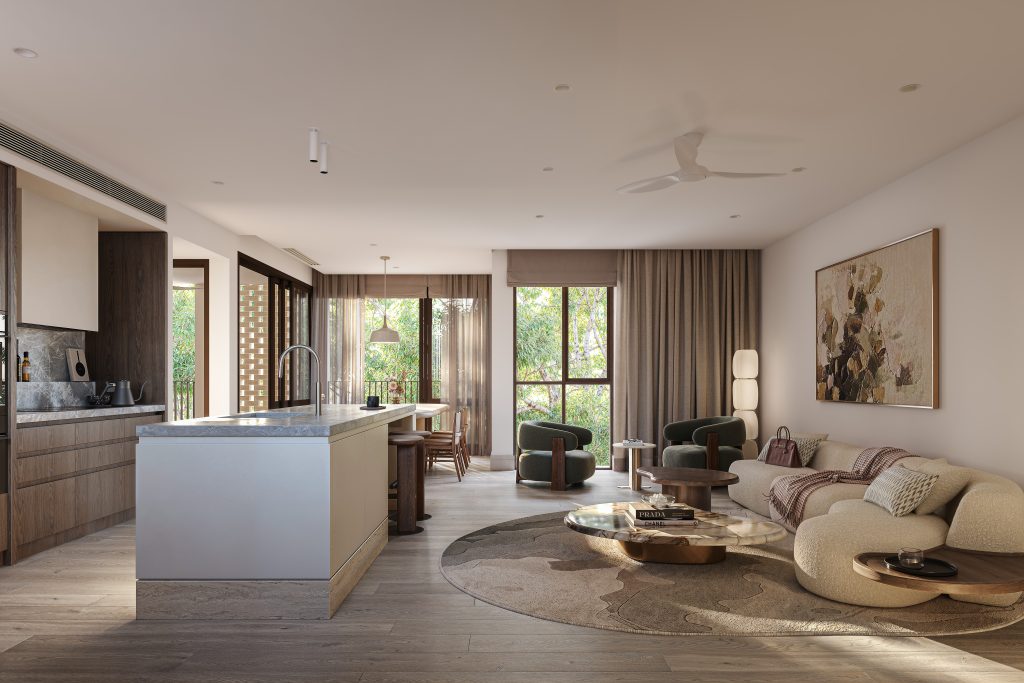
This principle is being applied at The Aurelian, New Farm, where an original Queenslander is being retained and reinstated as the development’s ‘front door’. Its familiar residential character creates a recognisable point of arrival for residents before they enter their contemporary apartments.
Challenging assumptions
Co-design workshops with prospective residents at The Aurelian, New Farm provided a valuable lesson in challenging assumptions about what older Australians actually want from their future homes. These workshops were a valuable lesson in challenging assumptions, because they revealed several surprising findings: for starters, our seniors did not want an on-site cinema, nor did they favour a wine lounge! But they were welcoming of optional smart technology upgrades – a particularly helpful insight that helped future-proof our design response.
These workshops further reflect the results of recent Ageing Australia research, which found that ‘ageing well’ for most respondents means living with purpose, connection and “having choice in how and where people live, staying involved in their community and accessing the right support to live safely and meaningfully as needs change”. All of which reinforces the need to ask, not assume.
Designing for a flexible future
If buildings are generally built for a 50-year lifespan, how will we design for a rapidly ageing population and each successive generation’s changing wants and needs? The answer lies in designing for flexibility. Just as the next wave of Baby Boomers entering seniors living will have specific preferences and requirements that need to be catered for, so too will the Gen Xers and Millennials coming in behind them. While the brief may change, the key tenet of good residential design won’t – comfort, functionality, security. Tomorrow’s seniors living will have to work hard to retain these core principles, while responding to what’s next.
Top image: The Aurelian, New Farm by Bolton Clarke in Brisbane. Supplied by Scharp, artist’s impression.
The Podium is ADR’s op-ed and thought leadership series providing a platform for some of Australia’s leading designers and built environment professionals to share their views on the topics that matter to the A+D sector. If you’d like to submit an article, reach out to us at ausdesignreview@niche.com.au with the subject line ‘The Podium’.
You Might also Like


Related Stories

© Niche Media 2026