

Tasmanian loudspeaker designers Pitt & Giblin bring warm sounds to cool spaces
Tasmanian loudspeaker designers Pitt & Giblin bring warm sounds to cool spaces

Share
With their modern-retro take on high-end speakers, Tasmania’s Pitt & Giblin have embraced aesthetic appeal without forsaking the principles of acoustic design, writes Engel Schmidl.
Room acoustics play a transformative, yet sometimes mysterious, role in how we perceive, interact and engage with a space. Often, however, the aural character of a space is a lower priority in the design process compared with how it looks.
Ross Giblin, co-founder of Hobart-based loudspeaker manufacturer Pitt & Giblin, says the quality of our acoustic environments is often subpar. A proliferation of hard surfaces, tinny or boomy speakers and poorly laid-out rooms have taken their toll on our ears, turning even the most visually appealing spaces into cauldrons of cacophony.
“People have settled for degraded sound,” says Giblin, who, along with partner Jack Pitt, launched their artisanal, small-batch speaker business in 2019.
“Architects today often neglect acoustics, maybe because treatments like acoustic panels aren’t visually appealing. But we’ve always believed that sound should be considered as seriously as any other design element. You can glance past shortcomings in aesthetics, but it’s difficult to turn your ears off.”

Childhood friends Jack Pitt and Ross Giblin launched Pitt & Giblin in 2019.
From hobby to commercial enterprise
Childhood friends, the pair turned their attention to making handcrafted, customised speakers around 2010.
“I guess we fell into it via a hobby, but the intent was always to start a business and forge a creative pathway for both of us,” Giblin explains.
The pair have backgrounds in professional audio and acoustic engineering, with Giblin handling industrial design while Pitt oversees the acoustic and electronic configuration of their speakers, which are all active – meaning they have built-in amplification and digital signal processing on board.
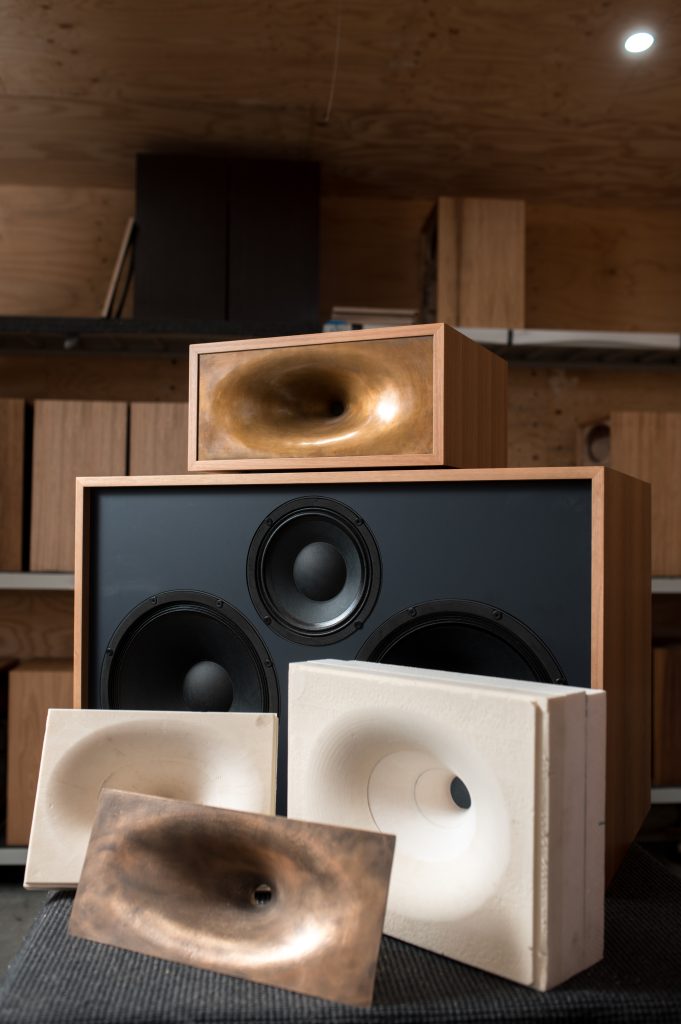
Pitt Giblin’s loudspeakers are made for a range of spaces.
He says the launch of their first speaker, the Superwax, in 2019, was the result of a decade-long process of thought, experimentation and iteration. It marked the beginning of the brand as a commercial entity.
“It’s always been a junction of design, making, engineering and science. And that process isn’t straightforward. We did go out and make stuff early on, but we always knew there would be a long R&D phase as we developed our ethos and rationale.”
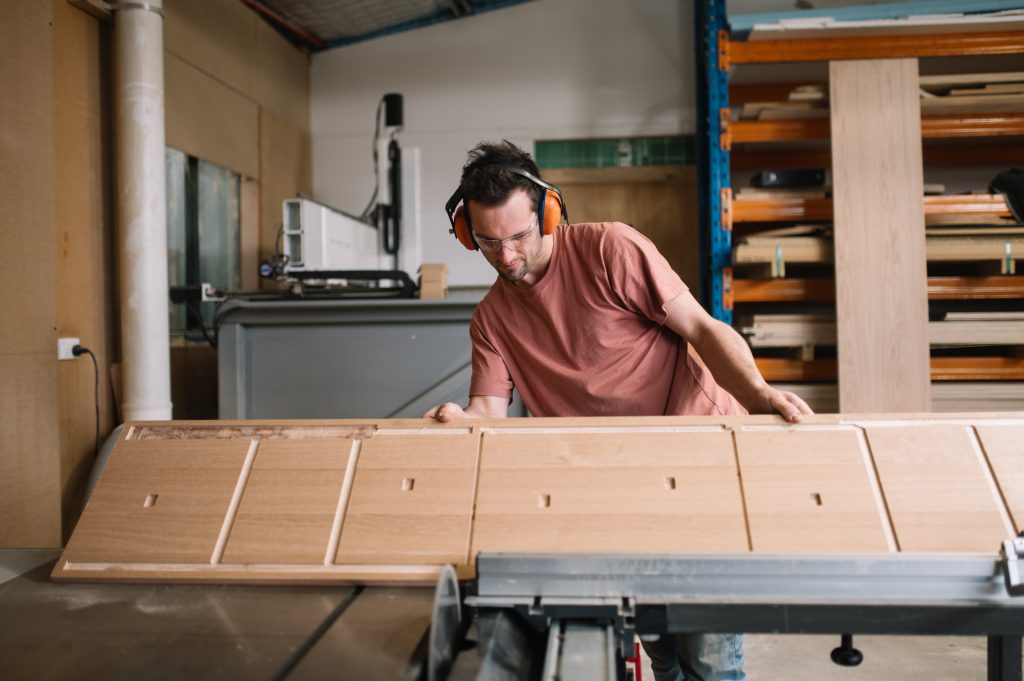
Ross Giblin handles industrial design at Pitt & Giblin.
They design and install a range of loudspeakers for all sorts of spaces, from homes to clubs. Last year, their Superwax Mini loudspeakers were delivered to venues in the Greek Islands, LA, and Sydney, while their Flares speakers found homes in Singapore and Hobart. They see each installation as an opportunity to rethink how sound can enhance the space.
“We won’t install speakers in public spaces without acoustic consultation and treatment. It’s not worth doing otherwise,” Giblin says.
The search for consistent sound
A crucial aspect of loudspeaker design is understanding how sound travels through space and reaches the listener’s ears. Unlike headphones, loudspeakers are in constant battle with their surroundings, emitting a full range of frequencies that interact in different ways with surfaces, room angles and listener positioning. Pitt & Giblin design their speakers with the imperfections of space in mind.
“From early on, we concentrated on constant directivity in loudspeakers, basically focusing on consistency rather than just response,” Giblin says. “A speaker might measure well dead-on, but if it has poor directivity, the experience falls apart as you move around the room.”
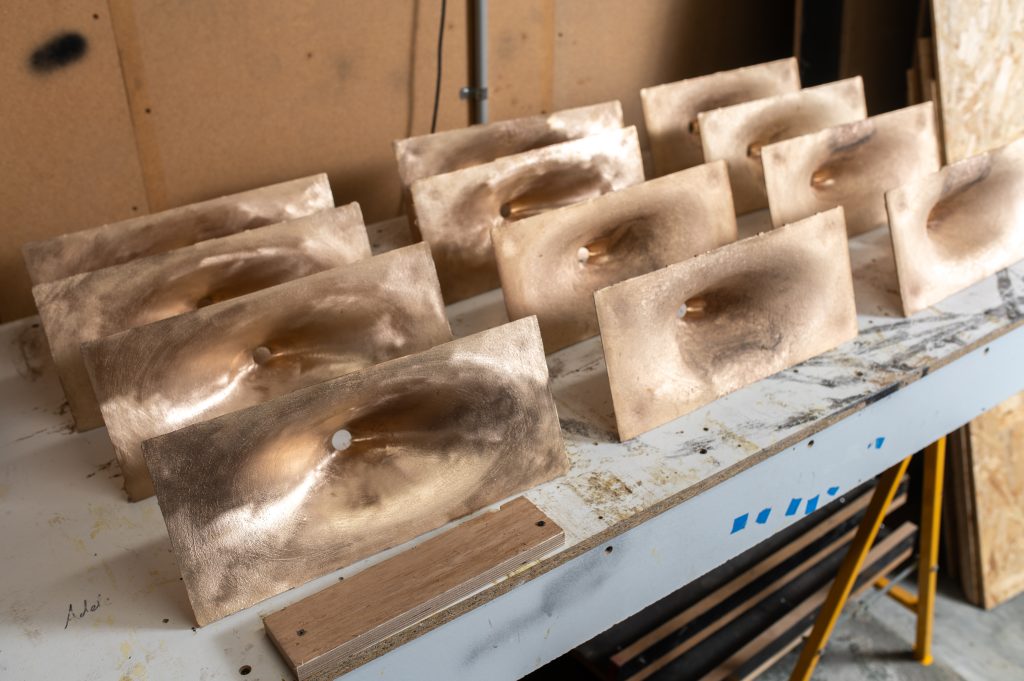
Almost all Pitt & Giblin speakers feature horn-like, dynamic waveguides.
A standout feature of almost all Pitt & Giblin speakers is their horn-like, dynamic waveguides, cast in aluminium and bronze or crafted in timber. The waveguide design is a perfect example of form and function harmonising to hit the right note.
Giblin explains that the waveguide design, led by Pitt, focuses on optimising geometry to maximise its acoustic projection. By taming irregularities and maximising consistency in response during the design stage, they are liberated in their choice of materials for the waveguides, as the effectiveness is a function of shape, not materiality.
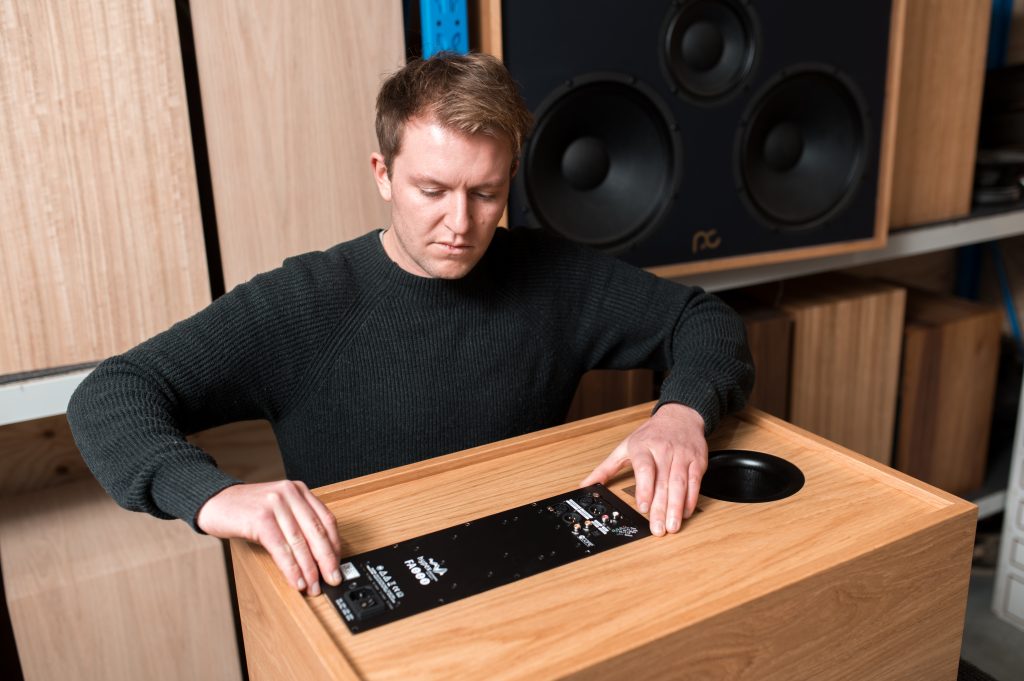
Jack Pitt oversees the acoustic and electronic configuration.
“The physical material doesn’t make a huge difference – provided it’s suitable. That’s why we can experiment with materials like cast aluminium. It’s unusual, but we’ve reached a level of development where we can make it work.”
The waveguide, woofers and internal electronics are all housed in furniture-grade cabinetry, assembled using a range of veneers pressed on A-grade birch plywood, with no MDF or particle board used.
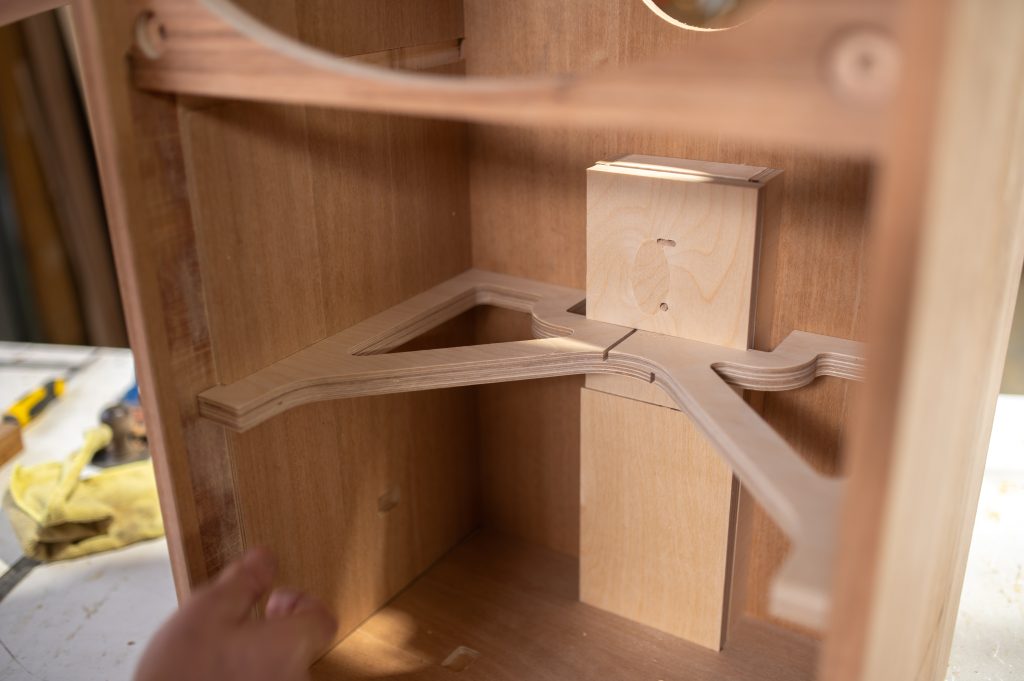
Pitt & Giblin speakers feature furniture-grade cabinetry, assembled using a range of veneers pressed on A-grade birch plywood.
A space for hearing
The well-worn maxim that ‘writing about music is like dancing about architecture’ holds true for audio gear manufacturers like Pitt & Giblin. Nothing beats hearing a pair of speakers as intended, in an inviting, acoustically designed space.
A living, breathing embodiment of the Pitt & Giblin philosophy is Ours, a purpose-built space in Hobart where listeners can experience their speakers in a casual, live music venue environment.
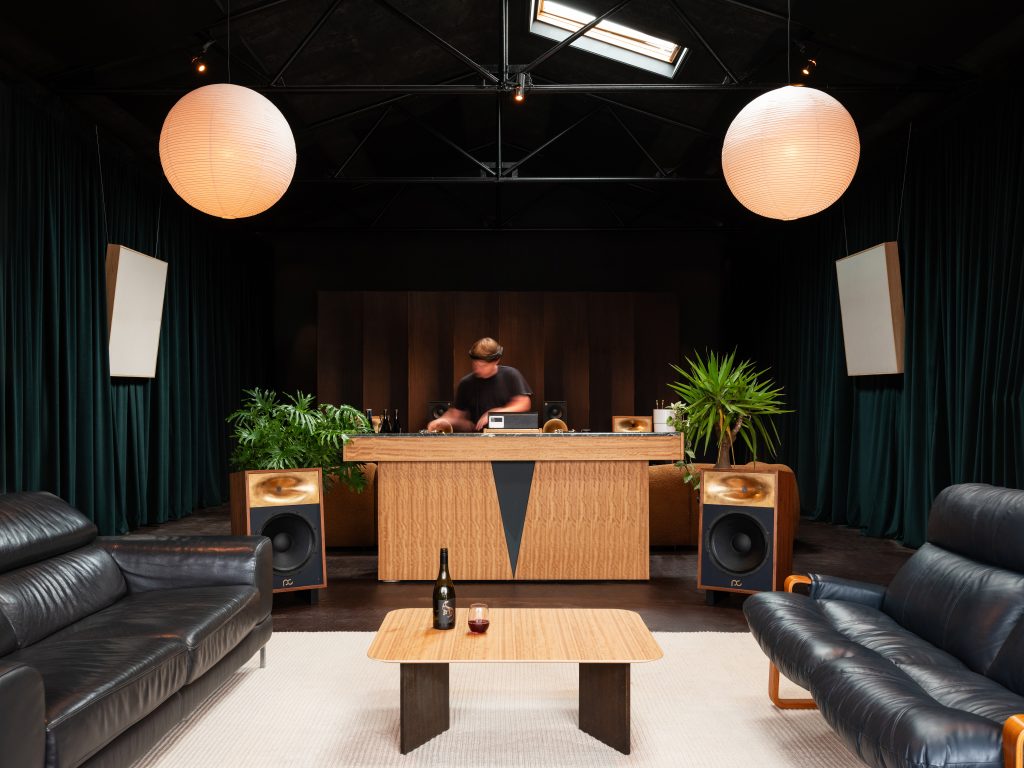
Ours, a purpose-built space in Hobart where listeners can hear Pitt & Giblin speakers in a live music venue environment.
“People who come to Ours are blown away,” Giblin says. “They say it’s ‘warm’ – even when it’s physically cold inside. What they’re feeling is the softness of the sound. And yes, in restaurants and bars, music often becomes an annoyance instead of an asset. When you get it right, though, music and conversation can coexist beautifully.”
Ours is far removed from the ascetic showroom-style listening spaces often associated with high-end audio. It demonstrates not only the technical excellence of Pitt & Giblin’s speakers, but more importantly, that great sound doesn’t have to come at the expense of comfort or style.

People who visit Ours describe it as ‘warm’, a feeling Pitt attributes to the “softness of the sound“.
Photography supplied.
Related: AcoustiCalm panels by Materialised are a bold new presence in acoustic design.
You Might also Like


Related Stories

© Niche Media 2026