

Mapping Hotel Indigo’s interiors at Melbourne Walk

Share
From the lobby to the bathrooms, the design details inside Hotel Indigo tell a story of Melbourne Walk’s urban context and heritage.
The first major development in Bourke Street Mall in more than 50 years, Melbourne Walk unites a collection of eight buildings of different eras across an entire block, and is located between Bourke and Little Collins Streets.
The project incorporates 6295 square metres of retail as well as InterContinental Hotel Group’s first Australian dual-branded hotels: Hotel Indigo and Holiday Inn, brought to life by global studio Buchan.
Buchan senior associate Hayden Djakic led the project, working closely with client Steadfast Capital and IHG to craft interiors aligned to each hotel’s discrete brand.
“Hotel Indigo is a boutique brand aimed at travellers who want a bespoke, hyper-local experience,” Djakic explains. “Holiday Inn is a more budget-conscious option that welcomes families into a fun and familiar environment.”
Designing for a dual model
The dual-brand hotel model is relatively new to the Australian market, delivering operational efficiency by co-locating hotels with shared back-of-house facilities. The IHG hotel offers 452 rooms over nine levels above a three-level retail podium.
While Hotel Indigo and Holiday Inn exist within a cohesive architectural development, they needed to offer two distinct guest experiences.
“Both hotels continue a shared Melbourne narrative that begins at street level and unfolds through the arcade, allowing distinct brand identities to evolve within a unified architectural framework grounded in Melbourne’s arcades, laneways and heritage context,” Djakic says.
A boutique brief for Hotel Indigo
According to Djakic, the brief for Hotel Indigo focused on creating a boutique hotel that delivers a “bespoke, hyper-local experience with a strong sense of place”, clearly differentiating it from the adjoining Holiday Inn.
“Aligned with the Indigo brand, the design is underpinned by the social history of the Melbourne Walk site and its quirky, historic retailers,” Djakic says. Such retailers include Sidney Myer, E.W. Cole and James Hosie. Buchan wanted guests to discover and engage with their stories, which are referenced through fabrics, rugs, glassware, terrazzo and playful monkey lamps.
The design narrative is not led by a single space, but by a sequence of experiences that unfold as guests move through the hotel. “The intent was to embed the idea of exploration across every layer of the journey, from public to private, so the story of place is consistently reinforced rather than concentrated in one moment,” Djakic says.
The design journey
The experience begins before guests reach the hotel itself.
Entered from the Melbourne Walk arcade, Hotel Indigo has been designed with an architectural language that references the neighbouring 19th century walkways for which Melbourne is known. “This establishes the broader narrative context,” Djakic explains. “That is, a hotel shaped by the city’s grit and glamour, before guests even step inside.”
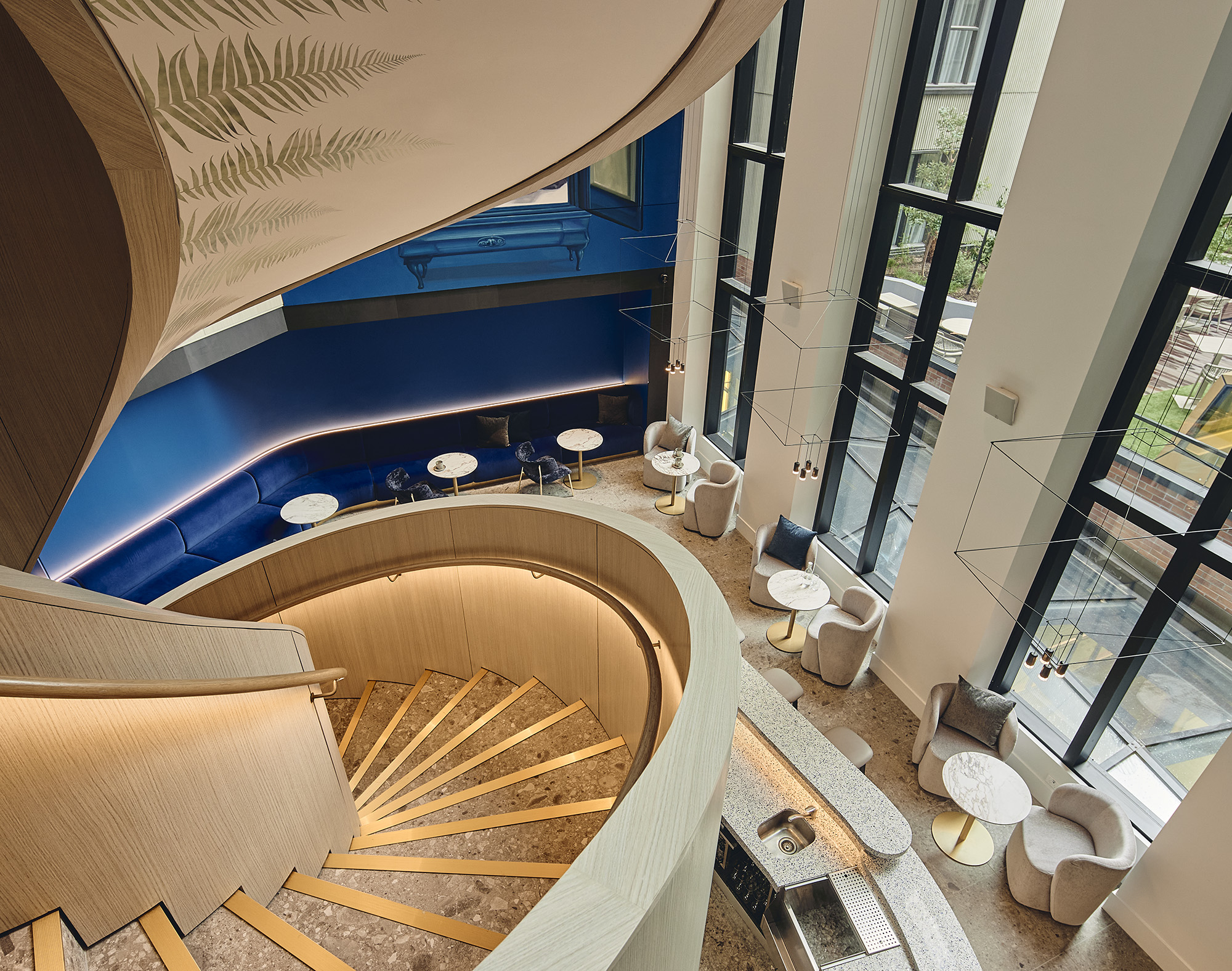
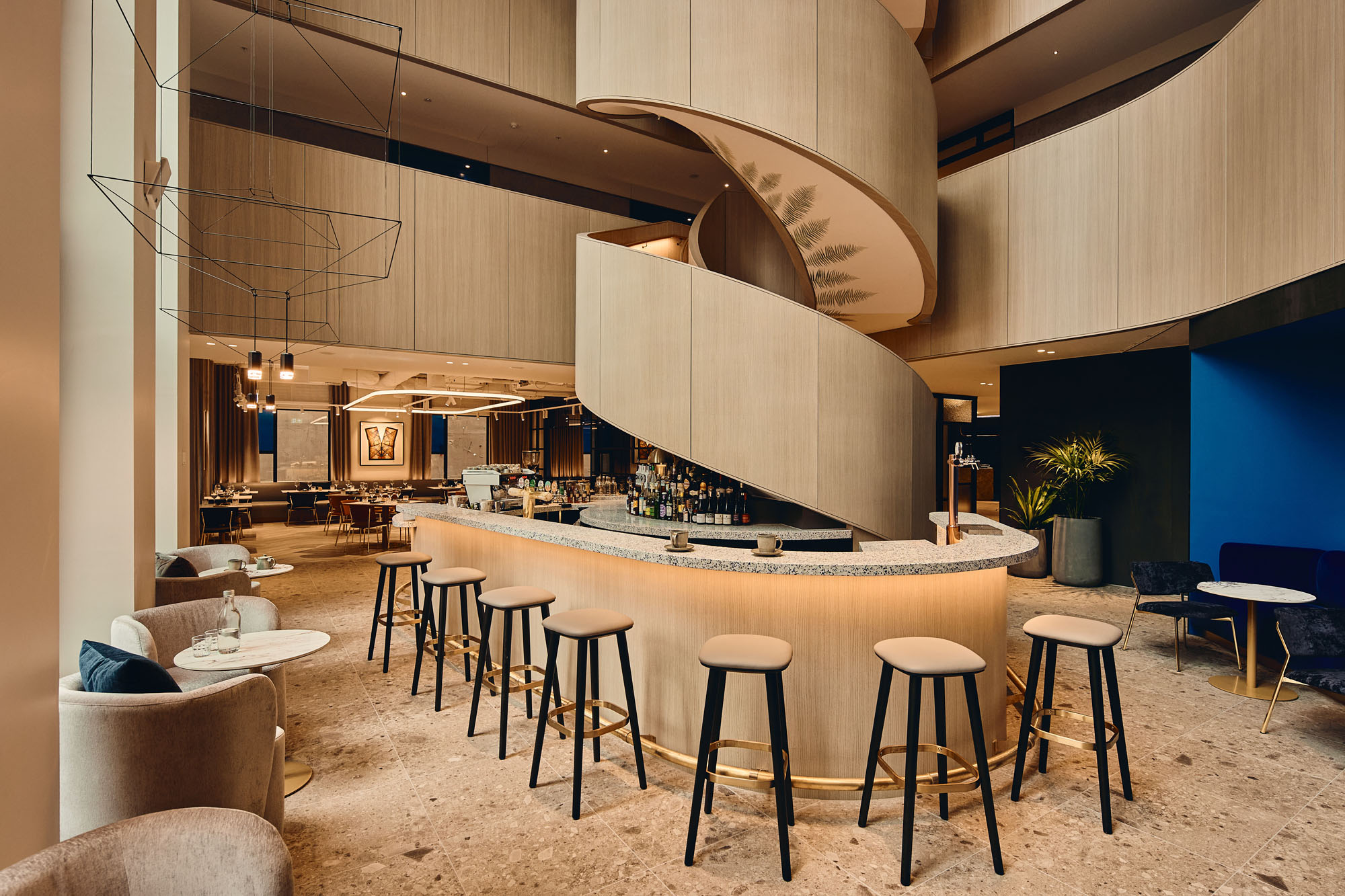
The lobby and bar act as a key narrative anchor. “Conceived as a voluminous four-level space centred on a striking spiral staircase, the lobby introduces a sense of drama and movement that reflects the idea of exploration,” Djakic says.
From here, through skylights, guests overlook a landscaped courtyard that opens the site to the sky, while also maintaining views to the arcade below, creating a moment of calm within the dense urban environment.
As guests move through the hotel, in-between spaces continue the story. Circulation routes, visual connections and layered details are intentionally designed to feel exploratory, echoing laneways and arcades.
Guest room details
The rooms are where the narrative becomes more intimate. They invite guests to engage with Melbourne’s history at a finer grain.
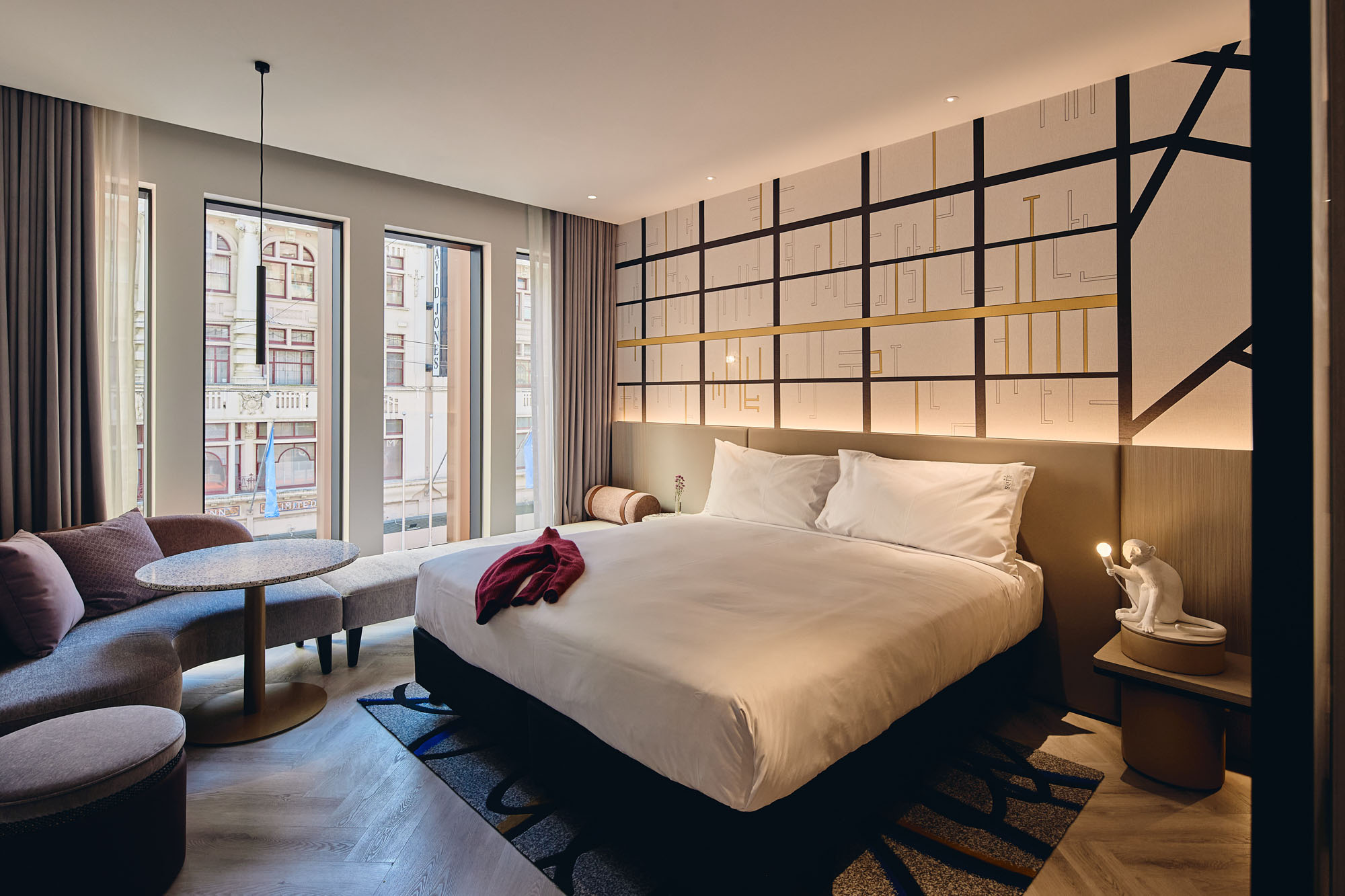
Wallpapered bedheads depict the Melbourne street grid, embedded with a crystal light marking the Diamond House location – a direct reference to the site’s former identity as a gem merchant precinct.
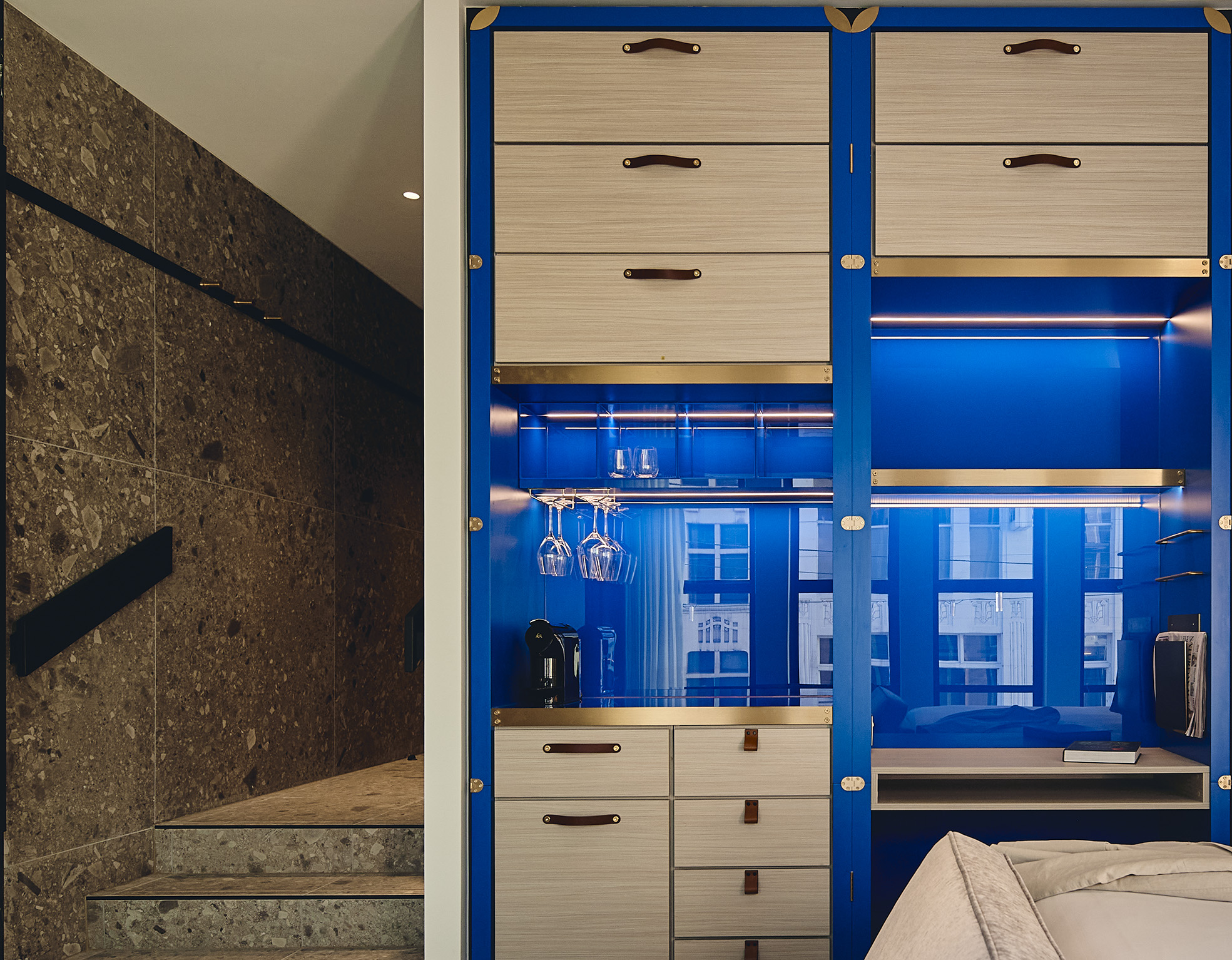
Joinery inspired by Louis Vuitton trunks speaks to travel and movement, while herringbone flooring harks back to the mahogany floorboards of the original upper-floor warehouses.
Even the bathrooms have storytelling intentions.
“Dual-opening bathrooms reference the city’s offset laneways, and hidden artwork [is] revealed through movement.” Djakic says. “This layered discovery mirrors how Melbourne reveals itself through side streets.”
Fixtures and fittings contribute to a cohesive expression of the design narrative. In the bathrooms, Buchan specified Laufen Living round under-counter basins, while the penthouse is elevated by the inclusion of a Laufen Val round freestanding bath.
Roca products feature prominently throughout both Hotel Indigo and Holiday Inn, including Meridian wall basins with shelves, The Gap close-coupled back-to-wall toilet suites, The Gap back-to-wall pans and seats.
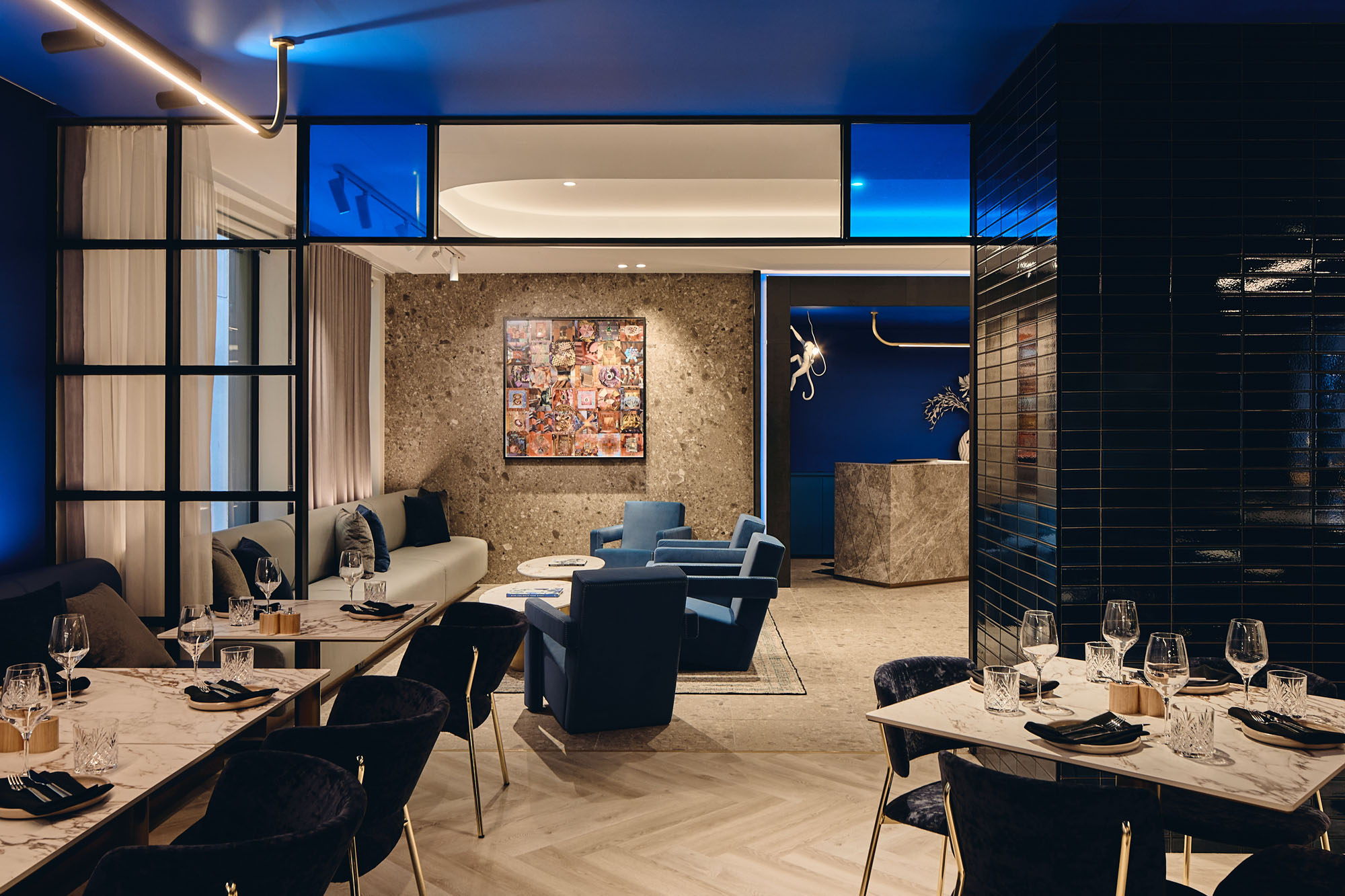

“The design of a boutique hotel like Hotel Indigo relies heavily on the careful specification with every touch point across a project,” Djakic says. “While the overarching story anchors the concept, it is the refinement of detail and the quality of individual elements that ultimately define the guest experience.”
Materiality and detail bind these spaces together. The Hotel Indigo palette, which combines Mondrian blue with Ceppo tiles and brass highlights, appears consistently across public and private areas.
A sum of interior parts
According to Djakic, finely crafted fittings, cohesive material and colour palettes, and a sense of effortless comfort all contribute to how a space is perceived. At Hotel Indigo, “every fixture, finish and texture was considered for both visual consistency and quality”.
“It is through these details that the narrative is deepened, the brand promise is delivered, and the guest experience is elevated from functional accommodation to a memorable, design-led stay,” Djakic says.
Learn more about the LAUFEN Living collection and The Gap by Roca.

© Niche Media 2026