

30UNDER30’s Morgan Wolpers on depth, interdisciplinary thinking and finding her place
30UNDER30’s Morgan Wolpers on depth, interdisciplinary thinking and finding her place

Share
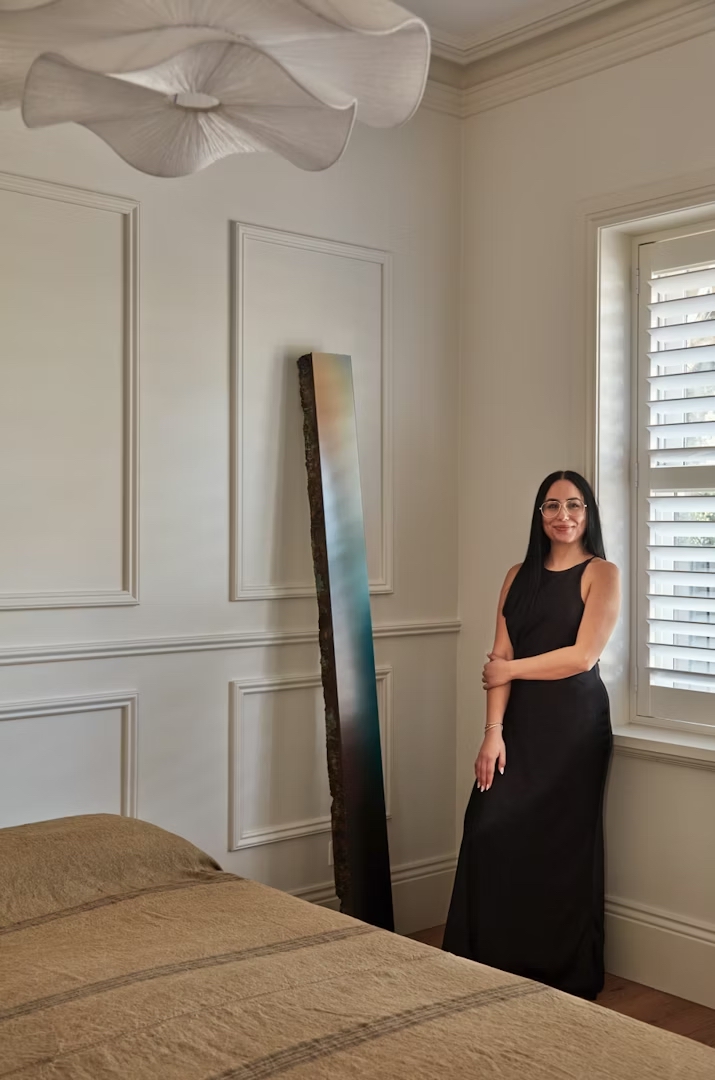
Morgan Wolpers is a Sydney-based interior designer at Lawless & Meyerson whose practice is shaped by a non-traditional pathway and an interest in interdisciplinary thinking. Below, the member of Australian Design Review’s 30UNDER30 for 2025/2026 reflects on finding her place in the industry and why depth matters in an increasingly fast-paced design landscape.
Australian Design Review: Why did you enter the 30UNDER30 program?
Morgan Wolpers: I entered because I felt ready – and because I’ve become really aware of how much I still want to learn. 30UNDER30 felt like a rare chance to be in a room with people who are genuinely invested in this industry: mentors who’ve navigated paths. I’m still finding my way along, and other young designers who are just as deep in it as I am.
My path into design wasn’t traditional, and that means I’ve had to be deliberate about finding my people and building the right support around me. There’s also something about being recognised within a profession I chose with real intention that means a lot. This felt like exactly the right moment, and exactly the right place to do that.
What most excites you about the Bali retreat?
The place and the people. Bali has a quality where the architecture and landscape feel completely intertwined – and that resonates with how I think about design. Bali has been a constant in my life growing up in Perth, and there’s something about that familiarity that I think creates the right conditions for genuine connection and conversation. I’m looking forward to meeting people from different disciplines and backgrounds who are driven by the same curiosity. Some of my best thinking has come from conversations outside my immediate world, and I’m hoping Bali brings more of that.
What are the most pressing challenges for designers coming up to 2030?
The one I feel most strongly about is the recognition of interior architecture as a legitimate profession. I came from nursing – a field built on registration, standards and accountability – so I feel the absence of that quite acutely in our industry. The work we do is genuinely complex: technical documentation, compliance, multimillion-dollar budgets, intricate stakeholder management. Some form of accreditation or registration would go such a long way toward validating that, not just externally but for designers ourselves. The other big one is technology – which I think is both exciting and worth being honest about. The visualisation tools available now have genuinely transformed how we communicate ideas to clients, and I love that. But there’s a real risk of speed replacing depth. The designers who do well toward 2030 will be the ones who use those tools to serve their thinking, not substitute for it.
Do you remember your first encounter with design?
Mine came through internships in New York, working across set and prop design, as well as interior design, for some remarkable design and fashion brands. Before I’d ever formally studied, I was being thrown into environments where every material choice, every spatial decision, every object placement carried real weight – and I found I had a natural instinct for it. What struck me most was how consistent that instinct was across disciplines; whether it was a film set or an interior, the underlying question was always the same – how does this make someone feel? I came back to Perth with that clarity, enrolled in interior architecture, and everything that had felt scattered suddenly had some form of direction.
If you could work with any designer, artist, or other creative – living or dead – who would it be and why?
Axel Vervoordt, Vincent Van Duysen, Norm Architects – I keep coming back to all of them. What I love is that their work looks effortless, but is actually the result of incredibly considered detail. There’s a stillness and softness to it that I find really hard to achieve and even harder to articulate. That Belgian and Danish sensibility – across interiors, furniture and product design through studios like &Tradition – represents everything I aspire my work to one day be like: timeless rather than fashionable, calm without being cold, restrained in a way that actually takes enormous skill. Working alongside any of them would push me to be more precise, more patient and more willing to let a space simply exist.
Australian Design Review’s 30UNDER30 is brought to you by major sponsor Neolith, alongside partners Designer Rugs, Laufen, Krost, Miele, Signature Appliances powered by Miele and Tongue & Groove.
Australian Design Review is also grateful to our 30UNDER30 practice partners AJC Architects, BVN, Cera Stribley, COX Architecture, Genton, GroupGSA, HDR, Richards Stanisich, RIZEN Atelier, Rob Mills Architects, Rothelowman, SJB and Design by WBLfor helping us foster the future of Australian design.
Learn more about ADR’s 30UNDER30 here.
You Might also Like



Related Stories

© Niche Media 2026