

Eames Shell Chair celebrates 75th anniversary
Eames Shell Chair celebrates 75th anniversary

Share

Herman Miller and Eames Office are celebrating 75 years – and more than 2 million permutations – of the Eames Shell Chair.
It’s hard to imagine a world without the Eames Shell Chair, but the market had not seen anything like this unique seating configuration when Herman Miller introduced it in 1950.
Making its mark as the world’s first mass-produced plastic chair, the Eames Shell Chair has since evolved through materials like fibreglass, polypropylene and recycled plastics to meet modern needs, becoming an enduring symbol of innovation, versatility and authentic design in the process.

Educational seating at Pitzer College, c.1970. Image: Courtesy of Herman Miller Archives.
The original Eames Shell Chair
The birth of a design icon started with a simple idea from designers Charles and Ray Eames: a shell. Built on the principle of universality, their single-shell chair design features biomorphic shapes that welcome bodies of all shapes and sizes.
As with many of the designs that came out of the Eames Office, the Eames Shell Chair was inspired by previous iterations and emboldened by failure. After years of experimenting with moulded plywood to create the single shell form, the pair shifted to stamped metal as part of their entry into the Museum of Modern Art’s 1948 International Competition for Low-Cost Furniture Design.
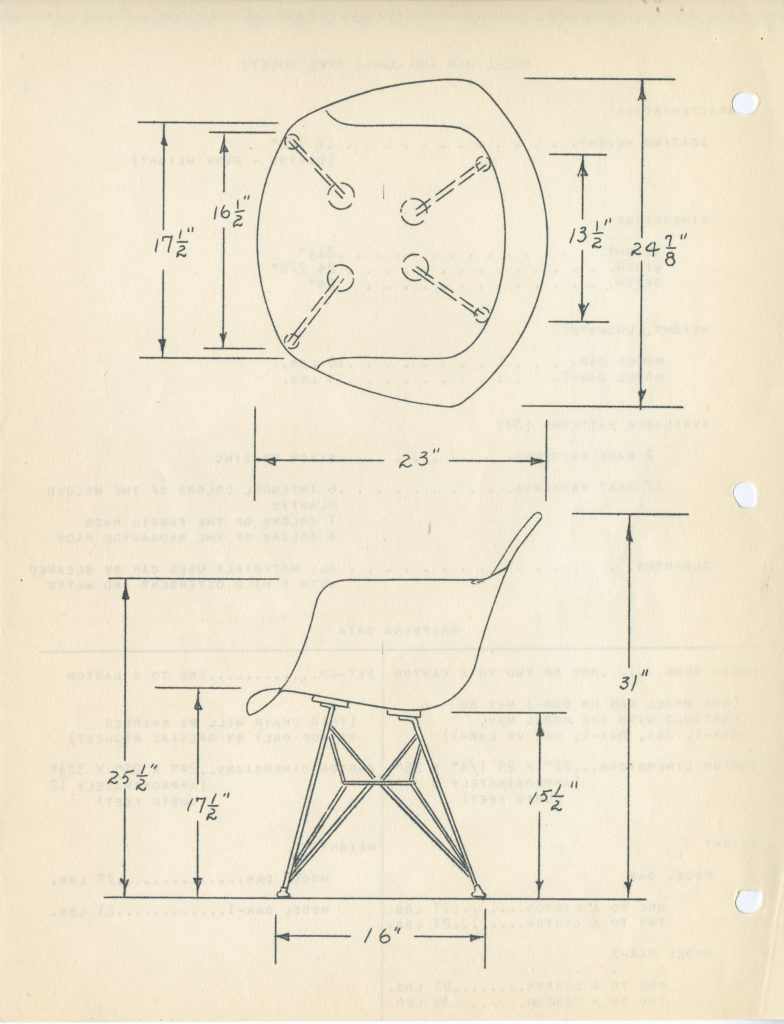
Specifications for Eames DAR fiberglass shell chair, 1955. Image: Courtesy of Herman Miller Archives.
The designers soon realised how difficult and costly their original design would be to produce and pivoted to fibreglass, ultimately making the world’s first mass-produced plastic chair.
This marked the beginning of many material explorations the Eames Office would undertake with Herman Miller.
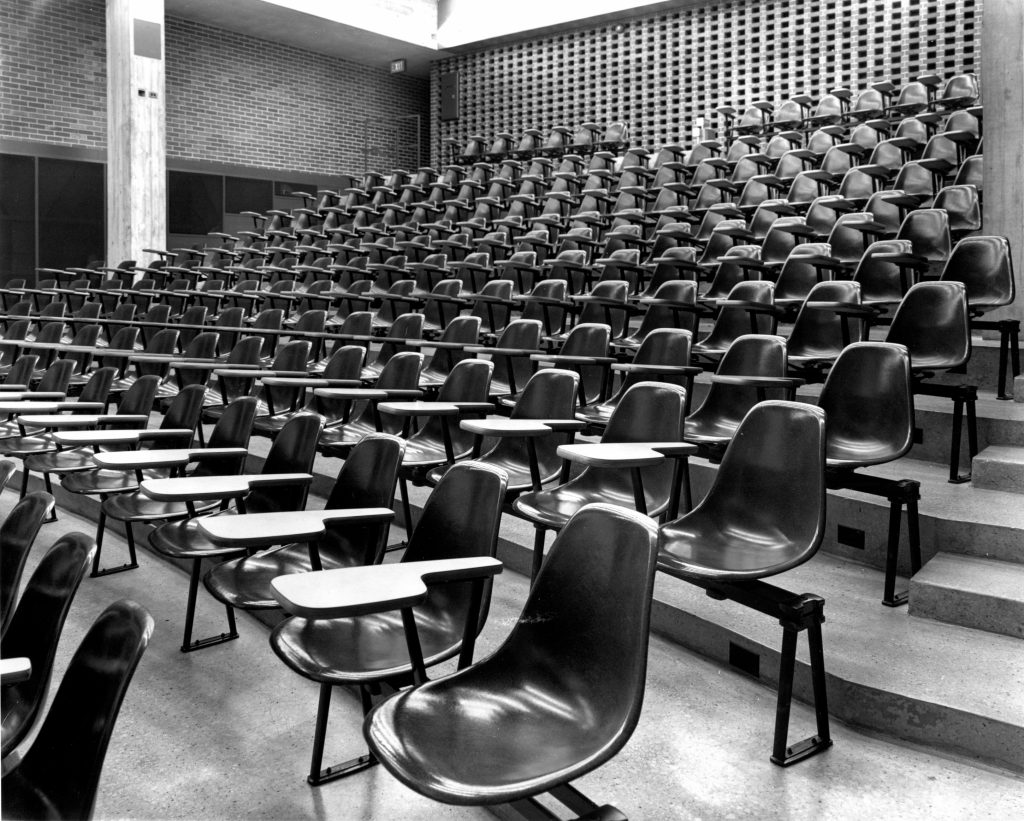
Olympic Sports Centre Rochester, NY, 1965. Image: Courtesy of Herman Miller Archives.
A canvas for material possibilities
The Eameses’ one-piece shell concept has never been tied to any one material. The original 1950 designs were fibreglass, with bent wire following the next year.
The environmental hazards of working with fibreglass prompted a switch to polypropylene, before evolving material technology made it possible to return to a safer fibreglass option for customers. Wood and recycled plastic options soon followed this.
Its most recent innovation is the addition of moulded plastic shells containing 100 percent post-industrial recycled plastic in 2022. They’re all part of the brand’s line today, along with options for upholstery and seat pads.
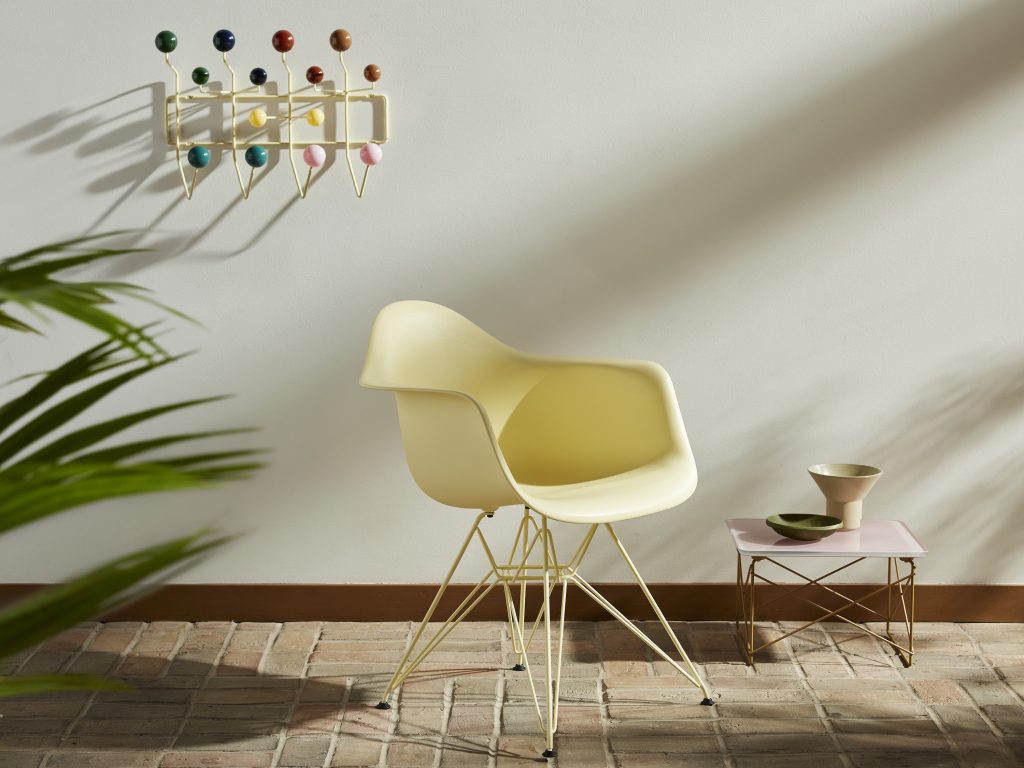
Danish design house HAY thoughtfully reimagined eight Eames Chairs for the HM x HAY Collection. Image: Herman Miller.
A choice of bases addresses most seating needs, including dining, lounging and working. A joyful palette, multiple base types and finishes, arms or armless, upholstered or not, lead to almost-infinite combinations to choose from.
A chair for every context
What makes the Eames Shell Chair so beloved is its universality and adaptability. At once striking yet unintrusive and familiar, it is equally at home in museum collections, dining rooms, workplaces, airports and cafés around the world.
By the 1960s, as the design grew in popularity, Eames Shell Chairs also became a staple in school auditoriums, gymnasiums and classrooms, thanks to the addition of a stacking and interlocking base.
Over its 75 years of existence, this humble chair has witnessed generations grow up, embedding itself into schoolyard memories and cradling moments as precious as a baby rocked slowly to sleep.
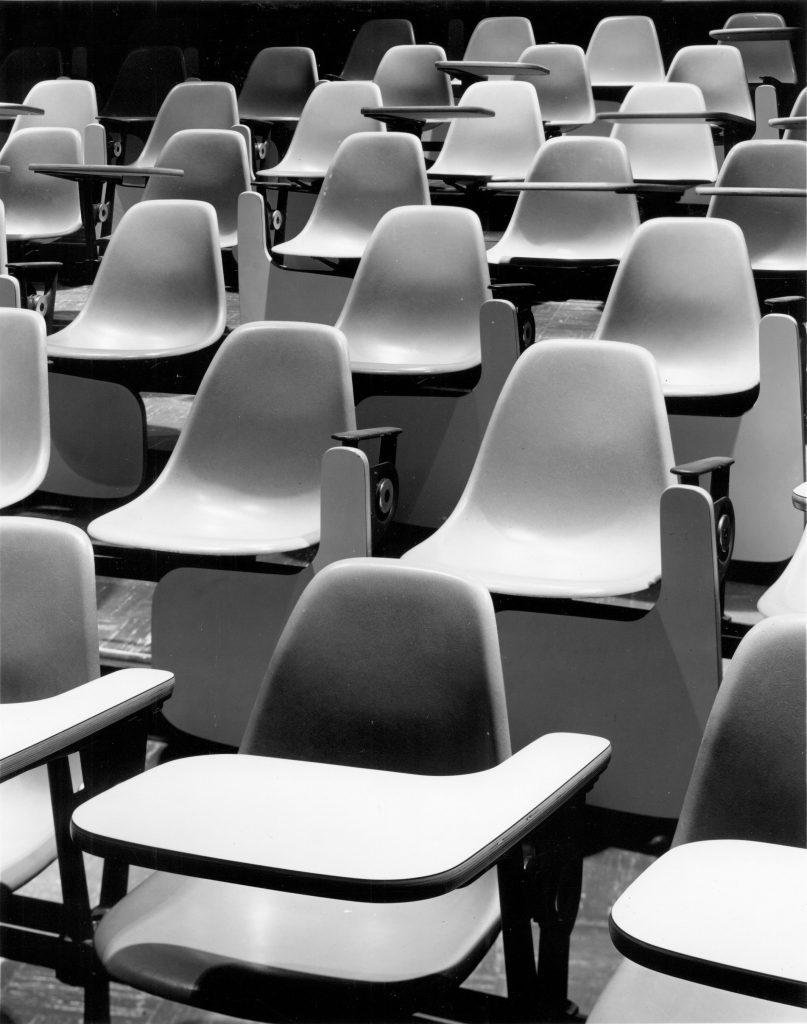
Eames Educational System (EES) seating installation at University of New York, Stonybrook, 1967. Image: Courtesy of Herman Miller Archives.
Celebrating unparalleled design
Despite its iterations, at its core, there is only one Eames Shell Chair. Often imitated, the design has never been equalled. It captures a history of design and material evolutions, steadfast in its commitment to adapt to the needs of people over time.
In celebration of the chair’s 75th anniversary, Herman Miller has commissioned three artists, including Tete Garcia (Sydney), Benjamin Critton (Los Angeles) and Luis Mendo (Tokyo), to create unique interpretations of the Eames Shell Chair, to further articulate its mutability and relatability.
The brand will share the artwork across its social channels over the coming months, and commemorative displays will also be exhibited in select dealer showrooms around Australia.
For architects and designers, the anniversary of the Eames Shell Chair is a reminder of the potential for simple, problem-solving design to last lifetimes.

Two Eames moulded plastic armchairs with low wire bases. Image: Herman Miller.
Discover more about the Eames Shell Chair and how you can bring authentic, timeless design to your next project. Visit your local MillerKnoll dealer or explore the collection online.

© Niche Media 2026