

A hidden carbon cost of plastics
A hidden carbon cost of plastics

Share
We all know plastics aren’t the best option for winning sustainability points. But recent changes to plastic manufacturing, particularly in China, mean that plastics are increasingly being made from coal rather than oil, with significantly higher carbon emissions.
In this article for Australian Design Review‘s thought leadership series, The Podium, University of Technology Sydney research fellow Geoff Isaac interrogates how the origins of plastics in products and packaging could offer Australian designers a significant opportunity to help reduce global emissions.
Plastic is so prevalent in our lives that we likely give little thought to where or how it is made. Australians consume around four million tonnes of plastic packaging, products and resin every year. Yet consumers, and often even product designers, are likely unaware of recent changes in how plastics are being made. These shifting manufacturing processes are hiding devastating global emissions. Designers, manufacturers and importers need to start asking not from where, but from what their plastics are made.
Plastics are lightweight, strong, durable, malleable, warm to the touch, impermeable, resistant to heat and chemicals and, above all, cheap. These characteristics have made plastics a popular choice among designers, manufacturers and consumers alike.

We are often reminded of the environmental impact of plastic products and packaging after we have thrown them away. We are encouraged to place plastic waste in our yellow bins, in the often-vain hope that it will be recycled for a second life. In practice, mixed plastic waste is challenging to recycle, and most of it ends up in Australian landfill (86 percent), with two percent incinerated. In addition, plastics that escape formal waste processing end up polluting our land and waterways.
While we fixate on these downstream end-of-life impacts, the upstream emissions from fossil fuels used to manufacture plastics are often ignored. The environmental footprint of a plastic depends not only on its polymer type, but also on how it is produced. Plastics can be made from oil, coal or gas, but the choice of feedstock makes a significant difference to greenhouse gas (GHG) emissions, even within the same type of plastic. Generic life cycle assessment (LCA) databases often fail to distinguish between plastics made from different fossil feedstocks, potentially obscuring significant differences in emissions and limiting designers’ ability to make informed material choices for both products and packaging.
The rise of coal-based plastics
The majority of plastic has, since World War II, been made from oil. Much publicity has been given to efforts to replace fossil feedstock with renewable organic sources, but these still account for less than one percent of the plastics being manufactured today.
Meanwhile, China, responsible for approximately one-third of the world’s plastics output, has increasingly exploited plentiful coal resources to make the chemical building blocks of plastics. The multiple processes required to produce plastics can emit several times more GHG emissions than oil-based alternatives, further compounded by the fact that over half (around 58 percent) of Chinese grid energy is powered by coal, the dirtiest fossil source.
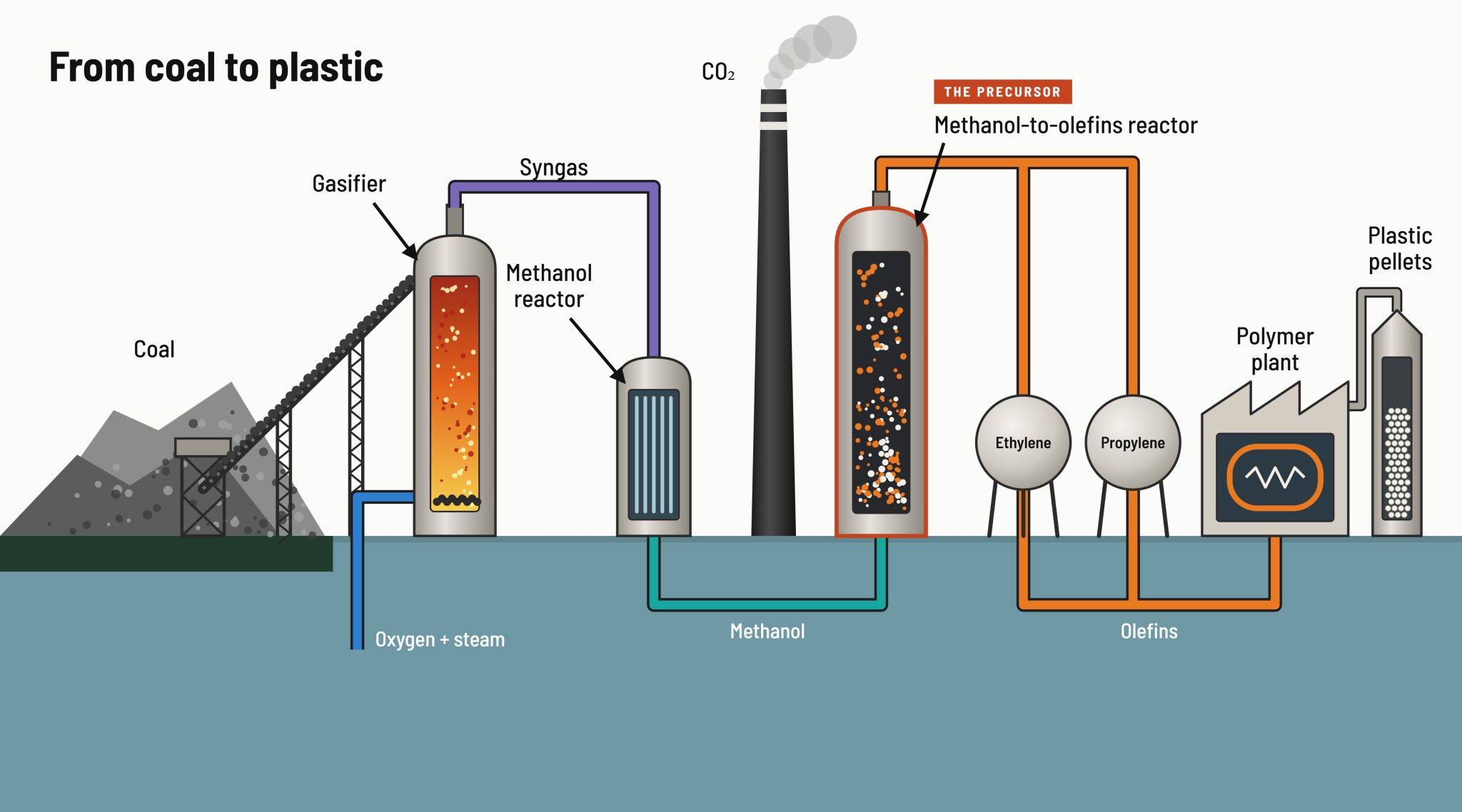

For example, one LCA found that coal-based PVC (polyvinyl chloride) production produced 7.66 tonnes of carbon dioxide (CO₂) per tonne of PVC, compared with 2.25 tonnes for the oil-based route, more than three times as much. Another study found the coal-derived propylene used to make polypropylene (PP) can have five to eight times the life-cycle emissions of petroleum-derived propylene. A third study found coal-to-olefins production of propylene generated 12.16 tonnes of CO₂e (carbon dioxide equivalent) per tonne, compared with 1.60 tonnes for petroleum-based catalytic cracking, about 7.6 times as much.
Coal-derived feedstocks accounted for an estimated 25 percent of China’s polyethylene and 37 percent of its PP production, while approximately 76 percent of PVC was produced through the coal-based calcium-carbide route. China continues to develop capacity, converting more domestic coal into chemical feedstocks for plastics, maintaining demand for coal (and jobs for miners), even as renewable electricity rapidly expands. Importantly for China, these developments reduce its reliance on imported oil and allow plastics to be produced at a significantly lower cost.
Australia’s plastics
Nearly two-thirds (62 percent) of the four million tonnes of plastic entering Australia every year arrives as finished goods (some of which were designed here), while the remainder comes as resin, to be used by local manufacturers. Although a breakdown by country of origin is not available, we do know that China is Australia’s dominant merchandise import source. In this globalised environment, it is almost impossible to know where the plastic originates; for example, a Chinese factory may import polyethylene from Saudi Arabia, manufacture a product and export it to Australia. Conservatively, assuming that 45 percent of plastic imports originate in China, then at least 380 kilotonnes (kt) of this plastic was likely made from coal.
Just the coal-derived PP and PVC entering Australia could carry around 1.8 megatonnes (Mt) more GHG emissions than comparable oil-based production. Note that this is just for these two plastics, as robust comparable coal-versus-oil data is not available for other types (PET [polyethylene terephthalate] and HDPE [high-density polyethylene] being especially common). Using Australian Plastics Flows and Fates 2023–24 consumption data and Australian life cycle inventory emission factors, the cradle-to-gate production of all the plastics consumed in Australia is estimated at approximately 12 Mt CO₂-e per year.
While a reduction of 1.8 Mt may not sound like a lot, it is equivalent to nearly a fifth (18.6 percent) of the annual emissions reduction Australia achieved between 2024 and 2025. Of course, such a saving would not contribute to Australia’s emissions targets and, in practice, China would likely find another market for any coal-based plastic we reject. However, by avoiding these plastics, we can send a clear message that the climate impact of coal-based production methods is unacceptable, and perhaps encourage other countries to do the same and give pause to the continued expansion of this industry.
Global emissions have already increased by about 200 Mt per year, due to substituting coal for oil as feedstock for just PP and PVC in China. Again, this is a substantial underestimate, as it ignores the impacts of other, more commonly used, types of plastic.
Take action
Australia is not trapped into buying coal-based plastic, but this is not a call to boycott all Chinese plastic. Competitive non-coal alternatives already exist in our region, notably from China itself, and also from Taiwan, South Korea and even domestically for PP.
For environmentally-conscious Australians, this hidden carbon footprint matters. The carbon provenance of plastic has been overlooked for too long. It is time product designers and interior designers started asking questions about the source of this ubiquitous material. Consumers deserve to be educated and given access to information that allows them to understand the environmental impacts of their purchase decisions. Design has a responsibility to take the lead here, starting by demanding that suppliers disclose not only from where, but also from what their plastics are made.
Geoff Isaac is a research fellow at the University of Technology Sydney and a casual academic at the Australian National University. His books include Rethinking Plastics in Product Design (Bloomsbury, 2025) and a monograph on Grant Featherston (Thames & Hudson, 2017). His research explores design history, material culture and plastics’ environmental impacts.
Top photo: ObjectType RAW, Unsplash.
The Podium is ADR’s op-ed and thought leadership series providing a platform for some of Australia’s leading designers and built environment professionals to share their views on the topics that matter to the A+D sector. If you’d like to submit an article, reach out to us at ausdesignreview@niche.com.au with the subject line ‘The Podium’.

© Niche Media 2026