

Glazed façades alter the heat we feel
Glazed façades alter the heat we feel

Share
Glazed buildings cast more than reflections across the city. New Adelaide research shows how their thermal behaviour reaches deep into the public realm.
Glass carries its own language, an ambient force that can tilt the balance of comfort in the open air. New research from the University of Adelaide reveals how glazed façades do far more than influence the thermal behaviour of interiors, they cast a radiant field across the spaces people walk through, work in and inhabit.
PhD candidate Elham Sanagar Darbani from the School of Architecture and Civil Engineering describes the inquiry with clear urgency. “We studied how the glass emissivity affected the mean radiant temperature and long-wave radiation,” she says. “Mean radiant temperature shows how the human body responds to radiant energy from its surroundings. When this temperature rises above the temperature of exposed skin or clothing, the body receives a net heat gain. That shift is central to thermal comfort, and it matters for anyone who spends time outdoors.”
Darbani worked with Dr Ehsan Sharifi and Professor Veronica Soebarto to measure the effect across three buildings – Mawson, Benham and Braggson – at the University’s City East campus. The buildings form a compact urban canyon that echoes the proportions and material mix of the Adelaide skyline.
Braggs, the primary focus of the research, rises with a skin of glass, metal and concrete in proportions that reflect contemporary architectural tendencies across the city. Darbani says the team collected surface temperature data and then amplified the findings through a large series of digital models. “We ran 64 simulations on the city’s hottest and coldest days in 2024. Each simulation tested a different pairing of emissivity and orientation so we could understand how these variables would influence mean radiant temperature and long-wave radiation.”
The range stretched from regular, clear glass with high emissivity to advanced coatings with greatly reduced emissivity. This spectrum revealed a distinct pattern. “Higher emissivity façades increase mean radiant temperature and long-wave radiation, especially in summer,” Elham says. “Mean radiant temperature emerged as the most sensitive parameter. In winter, the higher emissivity offered a slight improvement in cold conditions. In summer, the opposite occurred. Lower emissivity improved comfort at a much stronger rate.”
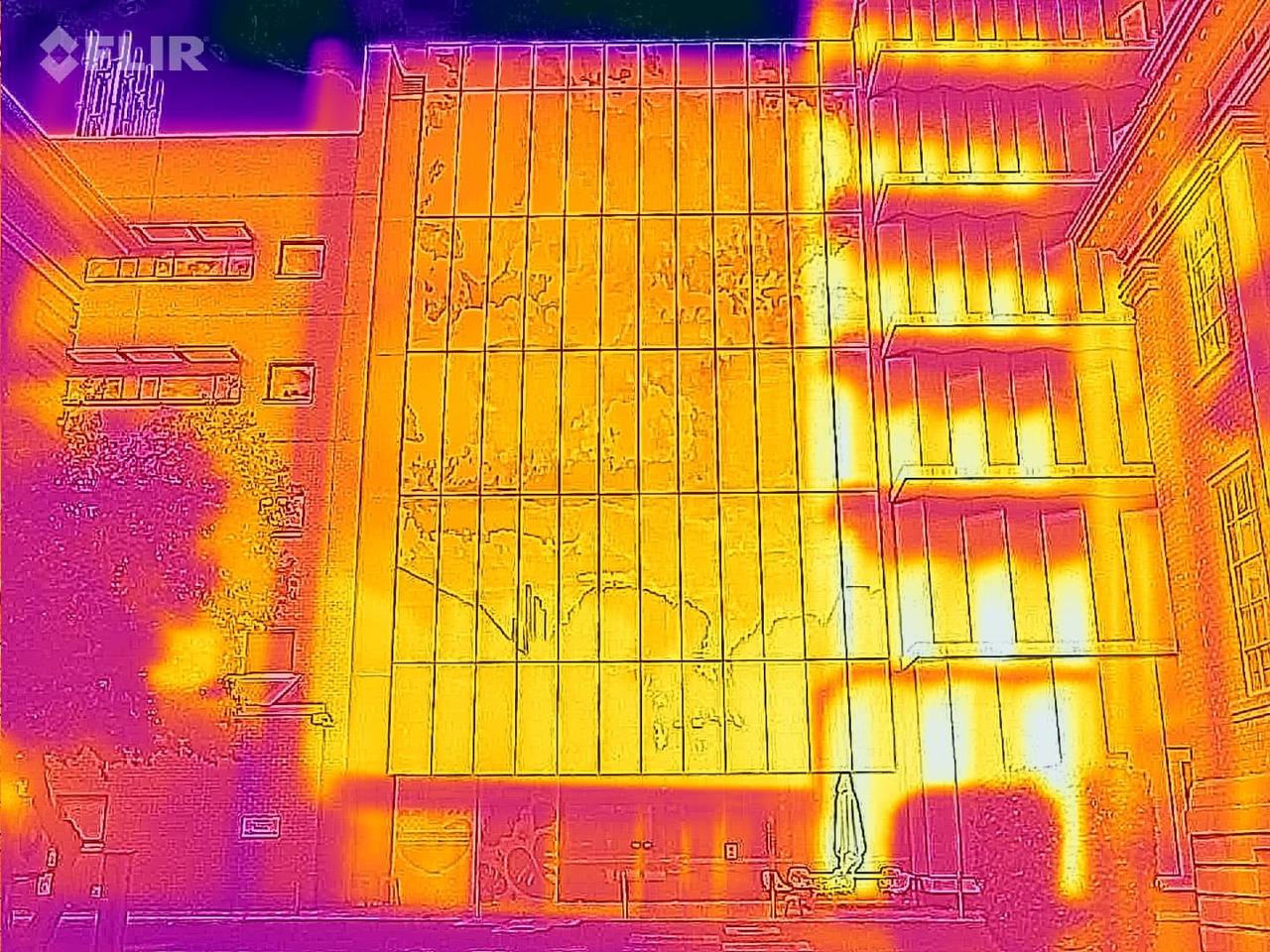

The shifting field of heat
Darbani points to the timing of peak impact. “The highest mean radiant temperature occurred around three in the afternoon during summer and midday during winter,” she says. “When the façade faced west at three in the afternoon, the mean radiant temperature dropped by more than three degrees in summer and four degrees in winter, when we shifted from high emissivity glass to low emissivity glass. That change is significant because it relates directly to how hot a person feels while standing or moving near the building.”
Orientation also played its part. A façade set at 135 degrees from the north created the coolest conditions in summer. The temperature reduction at the peak period was more restrained but still notable, falling slightly over one degree in both summer and winter. These nuances, Darbani explains, show how even modest shifts in material performance can amplify the experience of the city at street level.
Professor Soebarto captures the broader implication with clarity. “Using low emissivity glass reduces mean radiant temperature by up to five degrees in summer with only a small penalty in winter,” she says. “If we can reduce the emissivity of glass used in buildings, the outdoor temperature and comfort in those spaces will improve. This becomes more important as urban populations grow and as more of our public life unfolds in the open air.”
Emissivity reshapes the pedestrian realm
The research reveals a simple truth behind the measurements. Glass interacts with the environment beyond the building’s edge and sends energy into the public realm. It shifts the radiant load on the human body and shapes the small pockets of climate that build along footpaths, plazas and major entries.
“Many people work outside and move through these spaces every day,” Darbani says. “Understanding how these surfaces behave helps us design cities that support comfort across longer periods of the year.”
The study’s publication in the journal, Developments in the Built Environment, delivers the findings to a global audience, but the work remains anchored in Adelaide, where the new Adelaide University will emerge in 2026 through the union of the University of Adelaide and the University of South Australia.
Soebarto sees the research as an example of what this expanded institution can contribute. “This is research that shapes the way cities perform,” she says. “It advances knowledge and it informs design choices that influence daily life. That is central to the mission of Adelaide University.”
Images by Elham Sanagar Darbani
You Might also Like

Related Stories

© Niche Media 2026