

Fire, Water, Building exhibition reframes architecture’s relationship to environmental risk
Fire, Water, Building exhibition reframes architecture’s relationship to environmental risk

Share
Running until 28 February, Fire, Water, Building at Melbourne’s 3553 Gallery reimagines architecture’s relationship with elemental forces, shifting from risk aversion toward deliberate engagement.
Set against the backdrop of environmental crises – bushfires, building fires and floods – the exhibition examines safety-driven design paradigms and the regulatory frameworks that shape contemporary practice. In their place, it calls for a more nuanced, historically informed and ecologically attuned understanding of how humans inhabit shifting environments.
Curators Hannah Zhu and Allan Burrows, both architects and academics, have brought together 13 Victoria-based practices to exhibit built projects, research and speculative works that propose alternative ways of building, caring and living with risk.
Fire
A collection of works from different practices explore rarely questioned fire safety standards and norms.
Simulaa, working with the Palynology, Palaeoecology and Biogeography Research Lab, reframes fire not as catastrophe but as long-standing care. At Banyule Flats on Wurundjeri Country, sediment cores extracted from remnant billabongs preserve microscopic charcoal fragments that record millennia of vegetation change and cultural land management, affirming Traditional Owner-led burning as ecological stewardship.
Collective Territories navigates tensions between the bushfire management overlay and sgnificant landscape overlay in the Yarra Ranges. By locating Healesville House at the block’s corner, the project minimises defendable space clearing, exposing how regulation often frames fire as threat rather than relational force.
Sibling Architecture, at Aireys Inlet Primary School on Wadawurrung Country, treats fire and water as formative conditions. Located in a Bushfire Attack Level – Flame Zone (BAL-FZ), the highest risk rating in Australian building standards, the school integrates steel cladding, fire-rated assemblies and protective canopies as both safety infrastructure and pedagogical device.
Architecture Associates and Waters Architects transform compliance into spatial opportunity, embedding fire-rated construction and coordinated water management into residential form on Wotjobaluk Country.
Jean-Marie Spencer and Todd de Hoog of SSdH embrace impermanence in the Jamieson cabins on Wurundjeri Country. Three compact timber structures accept exposure and ephemerality, acknowledging risk as intrinsic to living with Country.
Water
Water-focused works extend this inquiry across deep time and domestic scales.
Heliotope and SBLA studio trace the Nipaluna/Hobart waterfront through 40,000 years of coastal transformation, positioning water as an agent reshaping land, memory and futurity.
Michael McMahon advances ethics of material decay in wetlands, selecting materials that return to organic matter rather than persist as pollutants. Simulaa’s House for Lichen designs for slow ecological succession, anticipating gradual reclamation over centuries.
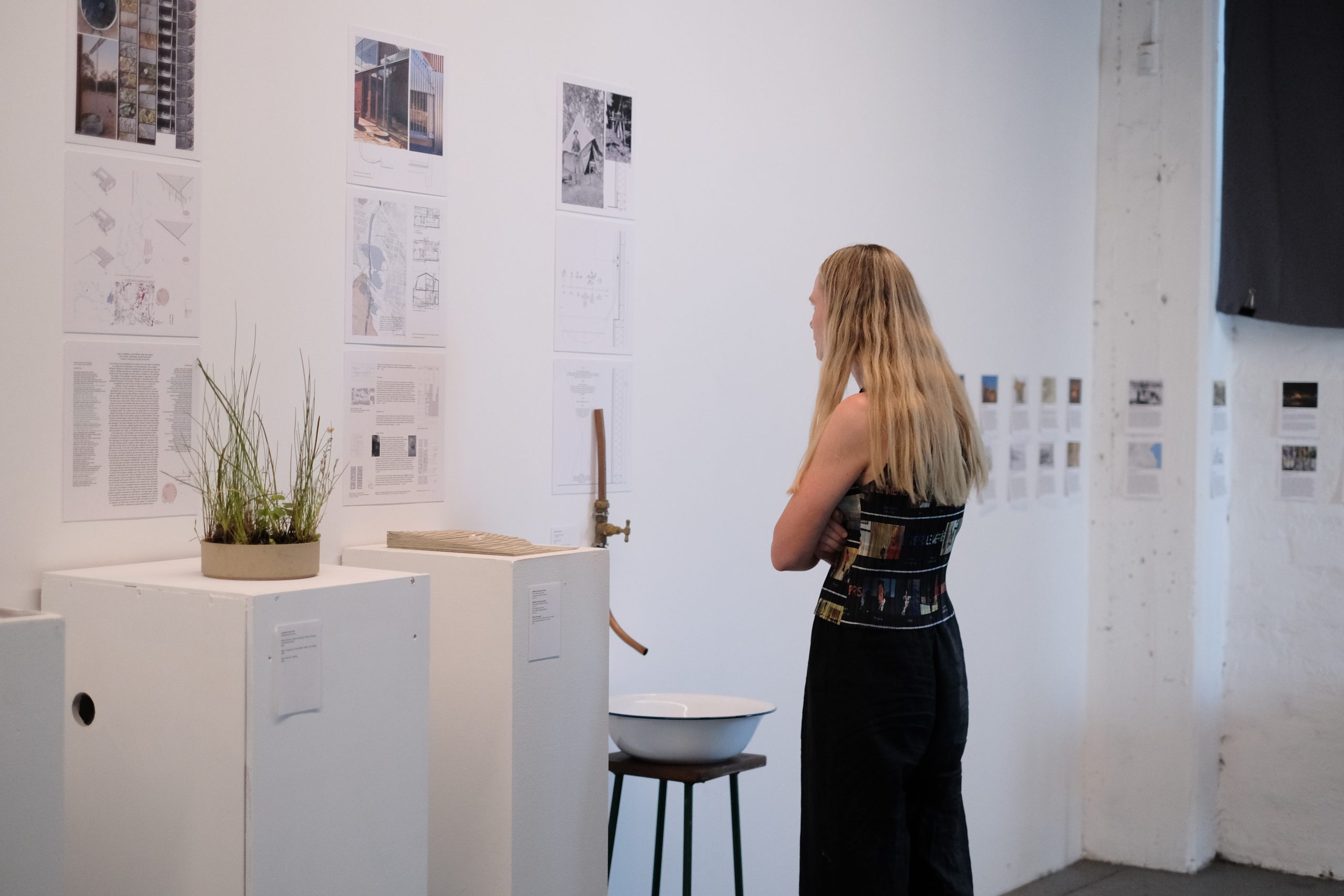
Architect Brew Koch redirects gutter overflow into a modest trough sustaining indigenous plants and fauna, resisting water’s commodification.
Ava Clifforth interrogates moisture trapped within airtight envelopes, revealing unintended consequences of ‘green’ construction. NMBW Architecture Studio choreographs visible rainwater flows at North Melbourne House, recalling the site’s swampy past.
Marika Neustupny questions whether future generations will recognise where daily water originates, tracing how infrastructure has progressively concealed these systems.
Towards coexistence
Collectively, these practices insist that architecture must engage fire and water not only through mitigation, but through care, visibility and coexistence.
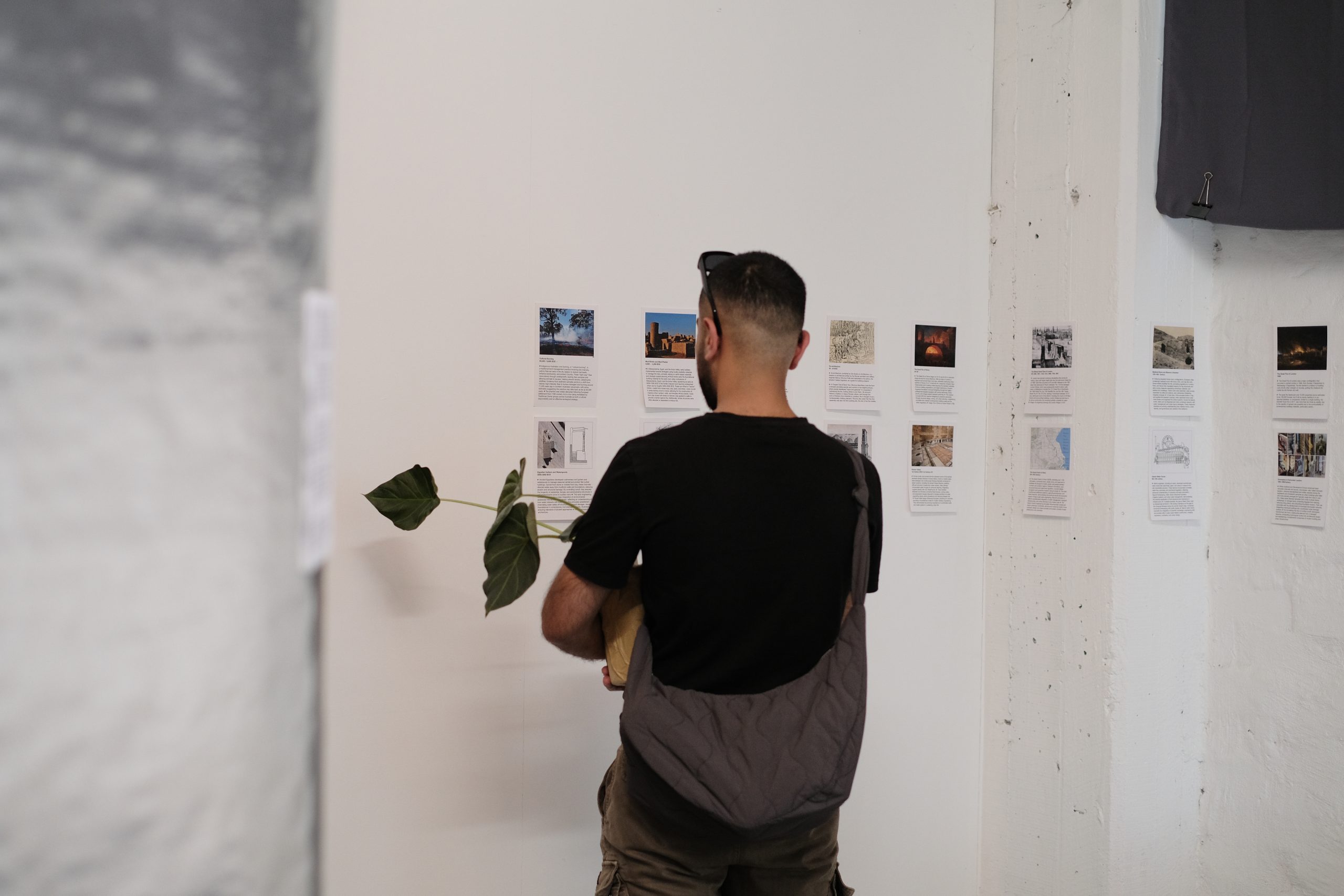
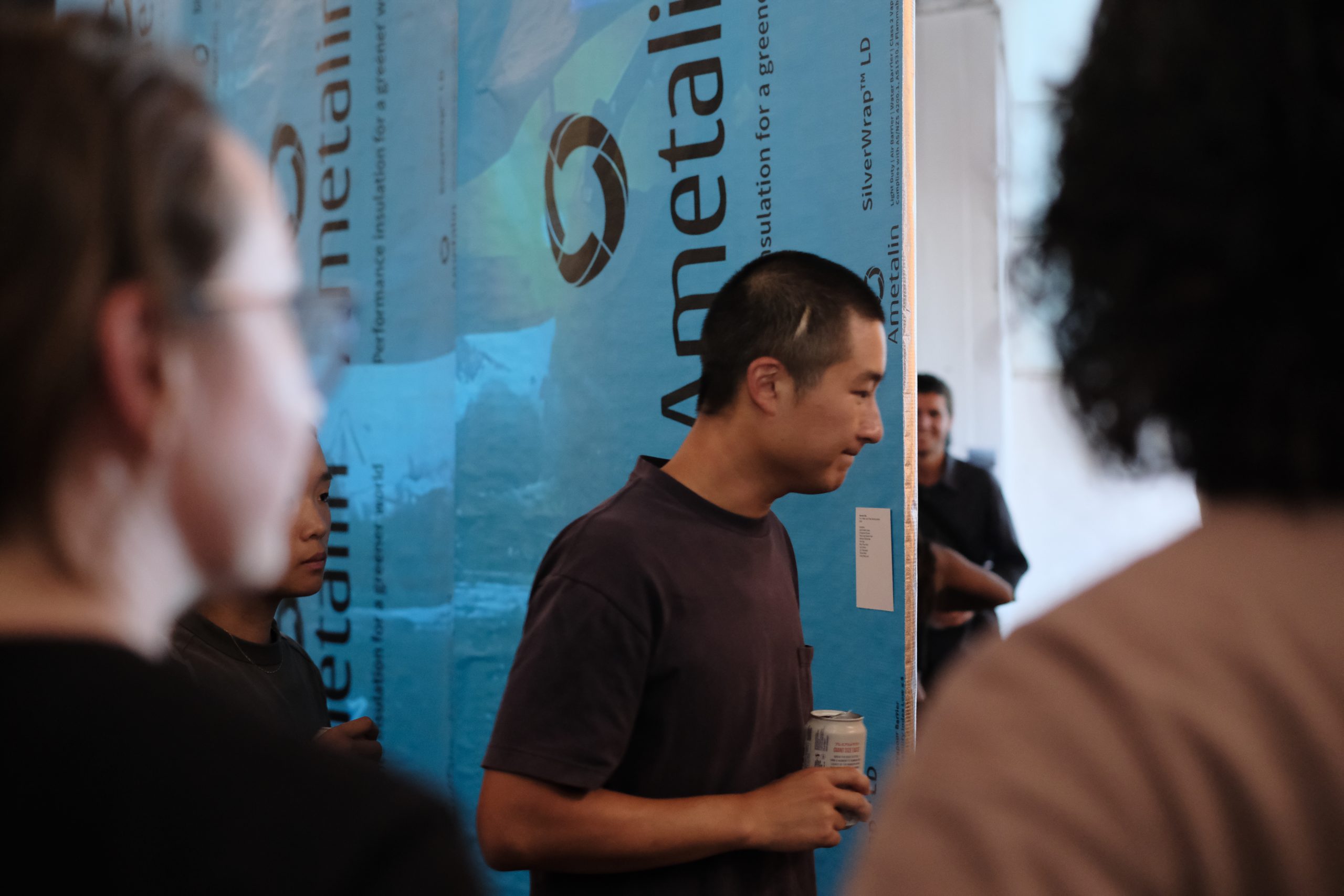
The exhibition also features student video work projected onto vapour-permeable wall wrap from RMIT University studios led by Alan ‘Ho Kyeong’ Kim and Hannah Zhu, a historical timeline of fire and water’s impact on the built environment, and an extended literary library curated by Melbourne Art Library and OFFICE.

Visit
Fire, Water, Building is on exhibition at 3553 Gallery, 35-53 Johnston Street Collingwood until Saturday 28 February 2026.
Learn more on the 3553 website.
Photography by Tope Adesina.
Related: Catch the Loose Leaf exhibition at the Robin Boyd Foundation’s Walsh Street residence in March.

© Niche Media 2026