

Meet Tom Black… from football to fostering the 30UNDER30 as a practice partner

Share

The founder and director of T. Black and T. Black Atelier has only been in Australia for five years, but he’s already made an undeniable impact on the interior architecture and product design industries. And now he’s looking to give something back to the design community by joining ADR‘s 30UNDER30 program as a practice partner.
Tom Black is the founder and director of T. Black, his own Brisbane-based practice, having moved to Queensland from the UK after meeting his partner. But his path to design excellence has been anything but linear. While the worlds of sport and design may seem far apart, Black has straddled them both. Sixteen years ago, you would have found him playing football as a midfielder for the Kansas City Roos, while studying for his first degree (in the Liberal Arts and Sciences) at the University of Missouri-Kansas City.
Football had certainly been a priority to that point. Manchester born, he played club and academy football for both of Manchester’s top English Premier League teams, as well as Liverpool. Towards the end of his playing career, he played and lived in Melbourne for a couple of years. And, yes, before you ask, he supported the Socceroos at the FIFA World Cup. He has a soft spot for an underdog, he says.
But when a professional career didn’t transpire, he pivoted and went back to study, picking up his second bachelor’s degree, this time in interior design, from one of his hometown universities.
On graduating, Black moved to London to work with Brinkworth on global projects, for such clients as Adidas, Jordan, Supreme and other high-end fashion labels. And then having ticked the interior design box, he decided he didn’t have enough on his plate and pivoted again, adding furniture design to his list of creative pursuits and establishing the companion brand, T. Black Atelier.
The support he has received throughout his career to date has given him an appreciation for the importance of nurturing and growing young talent. Here he talks to Australian Design Review about his respect for the 30UNDER30 program and his career to date. And a little bit about football, of course.
Australian Design Review: How long have you been aware of 30UNDER30?
Tom Black: I’ve been in Australia for coming up to five years now. And it was pretty prominent as soon as I got over here, to be honest.
Why did you decide to sign up?
There are probably about three or four people in the mix for the awards that I have crossed paths with or worked with in some capacity. Having some personal connection with people on the shortlist made me feel it was going to be worthwhile.
And I think it’s really good to support some of these younger generation of designers coming through. Brinkworth, the company I worked for in London, was great with supporting new designers and they gave a lot scope to the work. It also felt as if I received that lift up and it’s nice to give everyone else that lift up as well, especially with the talent that’s [in the program]. All the people I’ve crossed paths with have been great to work with.
On the topic of mentorship, you said you received a lift up? Was that through a program or did you have other mentors?
After my degree show, which we had in Manchester, we had a secondary degree show in London, which gave me some exposure and put me in a great position to get a job. Considering the support that I received, I would equally like to give some back.
You studied at Manchester (Metropolitan University); what did you do after after that? Did you go straight into a large practice or did you set up on your own in the UK?
I was fortunate enough to win a couple of degree-show awards and I went straight into a big architectural practice – Sheppard Robson – as it had a connection with the degree course that I was on. It was a great learning curve, but it was a huge architecture and interior design company. They worked on offices predominantly, with the BBC, Deloittes – big names, high-profile jobs. You’re in a team of people and you get one floor of an office fitout. But, because I was a bit older, they gave me a lot of responsibility for a first year in the job. It was a sink or swim sort of situation, but quite quickly I realised that I needed a bit more creativity.
So, through that degree show in London, there was another company called Brinkworth that reached out to me. They do quite a lot of high-end retail and had a more global reach with their projects. I joined them and it was the perfect fit. I probably would have stayed there for the next 10 or 20 years if I’d not met my wife and moved over here. I was there for three or four years and worked on some amazing jobs. I then moved to Australia post-COVID.
Arriving in Brisbane did you set up your own studio from the start?
I worked remotely with Brinkworth for around six months and then moved to Collectivus, which is based in Brisbane, for about 18 months. It was a big change because the Australian market is very different and, with the time zones and distance to the rest of the world, I have gone from working on these big international jobs to just being Australia-focused.
We made a lifestyle choice to move to Noosa with CLO Studios to do a bit of residential work. From this, an opportunity arose to branch out and start my own thing. I had two companies reach out and ask if I wanted to to do some work for them and then it just steamrolled from there really. That would be about three years ago now.
How’s it going?
In the first instance it was fine because you’ve created a new job for yourself basically. As it’s grown, it’s becoming more about managing the finances and the structure of things. That’s a bit more interesting! Then I began the furniture side of the business, which has brought a bit more attention. I can’t complain; I’m very busy, which is good.
Are you a sole practitioner or do you have others working in the practice now?
I was working on my own for quite a long time, which is as close to burnout as you can get. So I hired someone a few months ago. It’s difficult to juggle, because I’ve got a young daughter, so I’ve been juggling that and then trying to build the business up as well. But it’s now at a point where it’s a good place to start growing.
Talking to designers, they often say how they have studied and learned how to be fabulous designers, but nobody ever teaches them how to run a business – how to do finances, how to look after HR and compliance etc. You said that’s a bit of a struggle, so how did you learn to do all that?
On the fly really! I’ve actually just moved accountants to get someone who’s more of a part-time CFO (chief financial adviser) role. They come and review your accounts and your processes. The biggest one was, with Collecitvus I was at an associate level and I was doing a lot of the fee proposals and meeting new clients. So that side of things wasn’t too much of a stretch, but the difficulty rose when I started with the furniture, because now I’ve got a logistical business to run. I’m getting some more support on that now, because I can’t do everything, or I thought I could do everything, but I can’t!
How much time is split between the furniture design and the traditional design work?
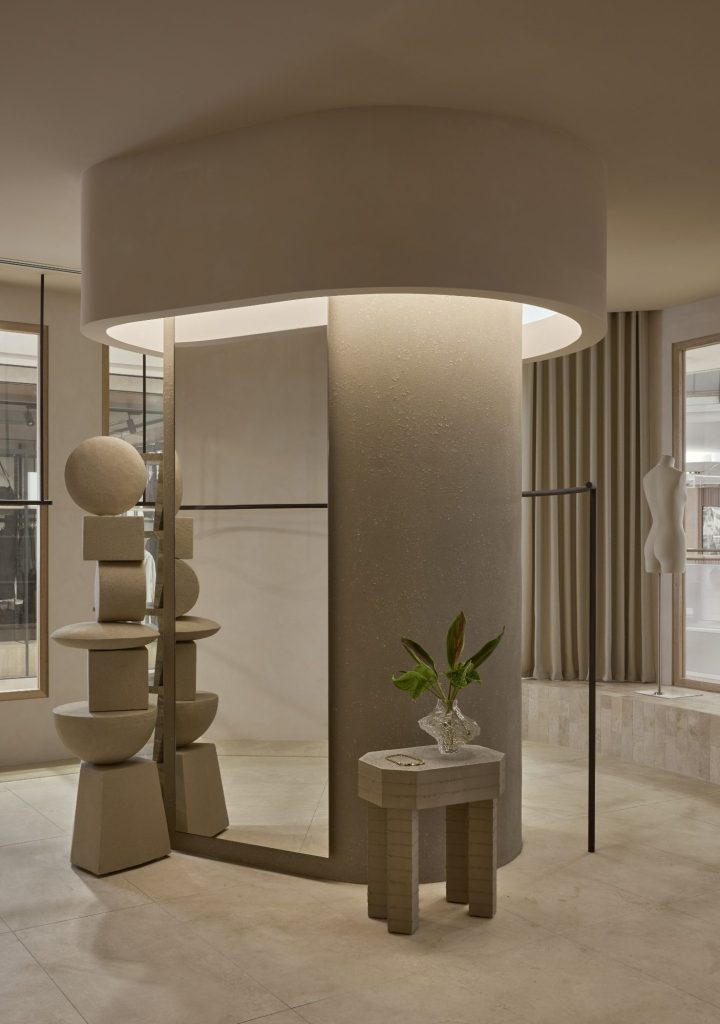
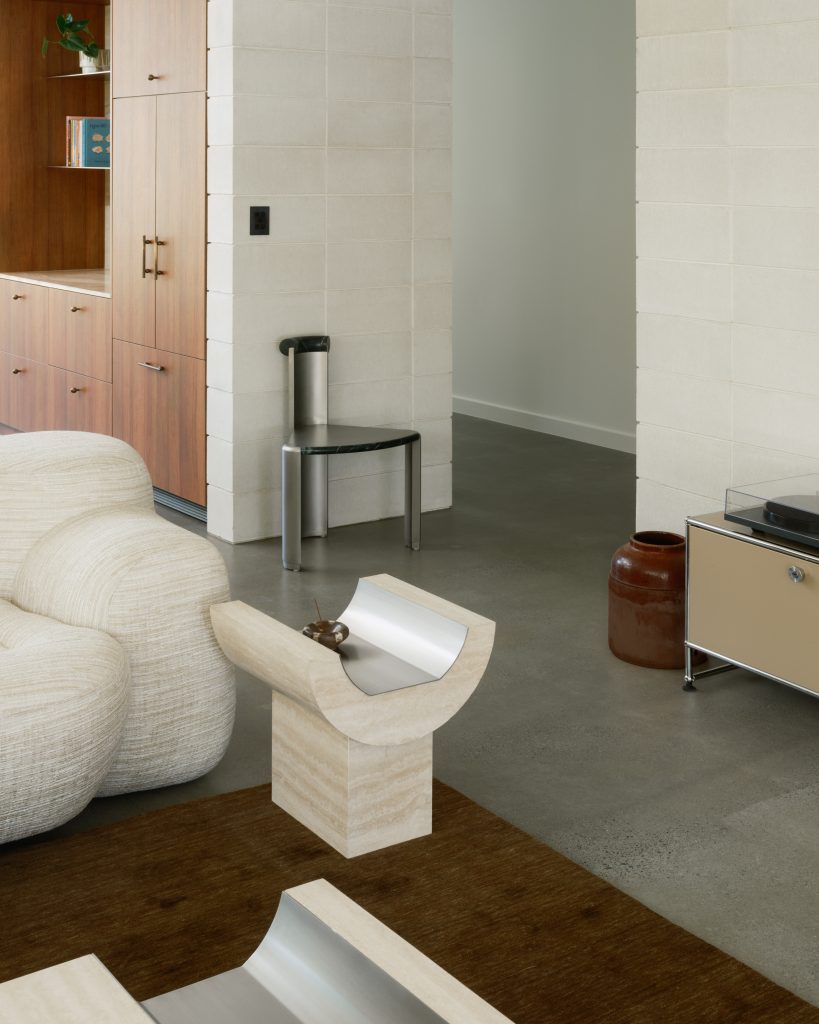
The traditional stuff is the predominant breadwinner. The furniture is growing. I didn’t realise how much I probably needed to invest in marketing to begin with. The furniture has been great as a publicity and a promotional [tool] and to show what you can do creatively outside of the client brief.
Looking at the industry overall, what would you say are the big topics for young designers in the 30UNDER30 demographic in the short term and and the near term?
Well, it’s a good question. I think the biggest takeaway has been regarding Australian retail, which is a very trend-driven market and it seems there’s a lot of crossover. Working in retail design in London, it was very much ‘what more can you add to the business that you’re working with?’ In a roundabout way, it’s more that initial concept look – moving away from aesthetics and looking at what you’re delivering to the client first and foremost. Then the aesthetics just follow anyway. But I think really building that structure at the start with a client and understanding that communication, how important that is, was my biggest takeaway I’d say.
After a few years of running your practice, what do you know now that you wish you’d know starting out?
Quite a few things. Such as getting my head out of the design element and into the structure of a project. Some understanding of working with different types of clients before you go out on your own has helped. Because a lot of the time as a designer you’re trying to think of what someone else’s needs are. You’re trying to meet their client requirements and we’re quite malleable in that sense. It’s important to set clear boundaries and it requires a different relationship for the client management side, where you need to add some structure, and getting a balance between those two things is hard.
Right brain and left brain?
Exactly.
Are there any projects that you’re currently either working on or have recently worked on that you’re particularly proud of?
Yes! There are a few in the mix. There’s [clothing brand] Kivari off James Street in Brisbane; that’ll be another flagship site for them. There’s TH7, which is the wellness company I do a lot of work with. We’re looking to do a space down in Byron for them – saunas, plunge pools etc. We have been working with Sheike on the concept development of their stores also, with two more stores before the end of the year to be built. And then there’s another company I’m working with – a new brand called Homeground. It’s a different type of wellness space, but it will have a gym/recovery area. They look at the science behind your bloods and it’s catering to more of a health side than the wellness. So that’s been interesting to work on as well.
You settled in Brisbane, but you had been to Australia before?
Well, I used to play football. I played for both clubs [Manchester United and Manchester City] when I was a kid. I got to a decent level, but probably never reached the heights that I should have done, to be honest. I travelled a bit doing that though and then I actually lived in Melbourne for two years playing towards the end of my career. It was great. I loved it here and I always felt as if I was going to come back somehow. I met my wife and we ended up moving, but it was quite an easy decision after COVID in London…
ADR’s 30UNDER30 program is brought to you by co-major sponsors Neolith and King Living, alongside partners Designer Rugs, LAUFEN, Krost, Miele, Signature Appliances powered by Miele and Tongue & Groove.
ADR is also grateful to our 30UNDER30 practice partners AJC Architects, BLP, BVN, Cera Stribley, COX Architecture, Design by WBL, DKO, Genton, Gray Puksand, GroupGSA, Hare + Klein, Hassell, HDR, Lawless & Meyerson, Luchetti Krelle, Made For, Mim Design, Richards Stanisich, RIZEN Atelier, Rothelowman, SJB, T. Black and Tom Mark Henry for helping us foster the future of Australian design.
Follow @ausdesignreview and @adr30under30 and subscribe to ADR’s newsletter to stay up-to-date with the program.

© Niche Media 2026